


Skip to content
Off the Leash
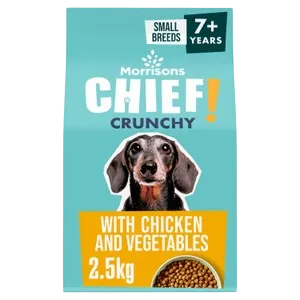
Morrisons Chief Dry Senior – —

Morrisons

Morrisons Chief Dry Senior review

25.7/100Poor
DryAdultSenior

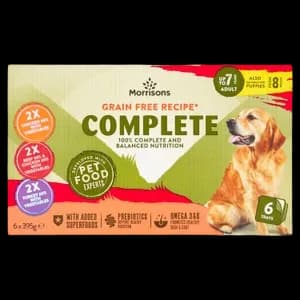
Morrisons Chief Dry Senior is the older-dog recipe in the Chief line, built on the same shorthand as its stablemates but with the fat pulled back and a joint pair added. Meat and animal derivatives supply 25% with chicken named for 4% of the food, chondroitin is declared at 0.025% and glucosamine matches it, arriving by way of molluscs and crustaceans. It reads Poor on our scoring against the Good of the typical adult dry food, a gap that comes from general ingredient headings rather than from anything an older dog would notice.

Where to buy: coming soon
Live retailer pricing is coming soon. Once we have prices from UK retailers, the best price, cost per day and where to buy will appear here.

Our view

Likely to suit

For a small dog slowing down at the edges but still keen at dinner time, this is a gentle, low-fuss bowl.

  • Older small dogs whose appetite has held up better than their energy, with fat declared at just 8.2% of dry matter
  • Owners who want joint ingredients written on the label instead of implied, with glucosamine and chondroitin each at 0.025%
  • Households feeding a senior alongside a younger adult, since one bag covers both life stages
  • Small dogs up to about 10kg, the size the feeding table is drawn for

Worth watching

Before you settle on it for an older dog, take in these label details.

  • Those 0.025% joint declarations are modest ones, a welcome extra but not the reason to pick the bag
  • Molluscs and crustaceans are how the glucosamine arrives, so a dog with a shellfish reaction behind it needs that noted
  • Chicken accounts for 4% and no species is given for the rest of the meat, so an elimination plan is out of reach on this bag
  • Carbohydrate is estimated at 57.0% of dry matter where the typical adult dry food sits at 46.2%

Written by our editorial team. Independent guidance, not veterinary advice.

How this scores

How we score
25.7/100Poor
Protein and processingPoor
Nutritional balancePoor
TransparencyPoor
ValuePoor

The Details

Dog fit

For a small dog slowing down at the edges but still keen at dinner time, this is a gentle, low-fuss bowl. Before you settle on it for an older dog, take in these label details.

Food type

Dry

Life stage

Adult, Senior

Breed size

Small

Main protein

Chicken

The score, in context

Our scoring settles this in the Poor band, two bands below the Good the typical adult dry food manages. The reason runs through the whole Chief line. Cereals, oils and fats and derivatives of vegetable origin name nothing, and the meat is only 4% accounted for. Very little on the panel can be verified by the person doing the feeding. Protein at 22.8% of dry matter and a high carbohydrate share hold nutritional balance down as well, so three of the four pillars finish Poor. Read that as a problem with the label and not with the bowl. It is a complete food with a full mineral panel, a sensibly low fat level for a quieter dog and two joint ingredients printed with figures beside them.

What's in it

Ingredients, as declared: Cereals, Meat and Animal Derivatives (25%, Including 4% Chicken, 0.025% Chondroitin), Oils and Fats, Vegetables (0.5% Dried Peas, Equivalent to 4% Peas), Derivatives of Vegetable Origin, Minerals, Molluscs and Crustaceans (0.025% Glucosamine)

Named ingredients

Cereals, Meat and Animal Derivatives (25%, Including 4% Chicken, 0.025% Chondroitin), Oils and Fats, Vegetables (0.5% Dried Peas, Equivalent to 4% Peas), Derivatives of Vegetable Origin, Minerals, Molluscs and Crustaceans (0.025% Glucosamine)

Nutritional additives

_Vitamins_ — Vitamin A 17,000 IU; Vitamin D₃ 1,500 IU; Vitamin E 70mg _Trace Elements_ — Iodine (calcium iodate anhydrous) 2.5mg; Selenium (sodium selenite) 0.1mg; Copper (copper (II) sulphate pentahydrate) 8mg; Iron (iron (II) sulphate monohydrate) 60mg; Manganese (manganese (II) oxide) 50mg; Zinc (zinc oxide) 100mg

Ingredient notes

Cereals leads, which puts grain at the centre of the recipe without naming which grain. That covers a very wide field, from decent whole cereals through to milling by-products, and it also means the mix can be reworked between batches. Most older dogs will eat it without a murmur; the catch is simply that there is nothing to check if one does not.

Meat and animal derivatives at 25% is the meat, with 4% of the food declared as chicken. Chicken is easy to digest and reliably popular with dogs, and it is also the meat most often behind a food intolerance, which makes naming it useful information. The remaining meat sits under a heading that legally spans the fleshy parts and processing products of any warm-blooded land animal, so the panel gives no way of telling what else is in there.

The senior thinking shows in two places. Chondroitin at 0.025% sits inside the meat declaration and glucosamine at the same figure comes in through molluscs and crustaceans, shellfish shells being where most supplemented glucosamine starts life. These are small helpings, not therapeutic doses, and each is printed with a number. Many labels do not go that far. Fat is the other senior move, held down to 8.2% of dry matter for a dog whose walks are shorter now.

Moisture is not declared, so the dry matter conversions here assume the 8% a dry food usually holds. On that basis protein reads 22.8% and estimated carbohydrate 57.0%, against 46.2% for the typical adult dry food. Most of the bowl is plant material. Calcium comes out at 2.39% of dry matter with ash at 8.2%, the fuller reading you would expect from a cereal base carrying a heavy mineral supplement. The 321 kcal per 100g is our estimate, since the label prints no energy figure of its own.

The additive panel is complete and dosed throughout. Vitamins A and D3 have a figure beside each and vitamin E is at 70mg per kilo. Zinc is at 100mg, iron at 60mg, manganese at 50mg, copper at 8mg, iodine at 2.5mg and selenium at 0.1mg. The trace elements are oxides and sulphates, not chelated forms, taken up a little less efficiently but entirely standard for the shelf.

Price and value

£1.20 a kilo, sold in a 2.5kg bag.

For a 15kg adult dog in moderate condition, needing about 840 kcal a day on the standard maintenance estimate (110 × bodyweight^0.75), that comes to around 262 grams and £0.31 a day. This is a small breed recipe, and its own table asks 95 to 155 grams for a dog between 5kg and 10kg, which is where most dogs eating it will actually sit.

Nutritional analysis

Declared analysis

Energy
321 kcal/100g

Estimated using Modified Atwater factors*

Protein

21%

Fat

7.5%

Fibre

3.5%

Ash

7.5%

Dry weight

Protein

22.8%

Fat

8.2%

Fibre

3.8%

Ash

8.2%

Carbs

57%

As-fed composition

Estimated breakdown of the finished product by ingredient category, from the declared ingredient list and ingoing weights. These are estimates, not measurements.

Meat

25%

Carbs

47.8%

Veg

9.5%

Oils

12.2%

Other

5.5%

Pricing & size
Pack size
approx. 2.5 kg (not stated in the product name; this total weight is derived from Morrisons' own price-per-kg) · 2.5Kg
Retailer pricing
Coming soon

Live retailer pricing is not yet available for this food. Prices, cost per day and where to buy will appear here once retailer data is live.

Ingredients and nutrition are taken from manufacturer data. Retailer pricing is not yet live for this food.

Related dog food guides

Ranked shortlists that include foods like this one.
All reviews

Featured feeding accessories

All feeding accessories

Brackenwood

Slow Feeder Maze Bowl

Slows fast eaters and eases gulping at mealtimes.

From £12.99· 4 retailers
View

Tarn & Co

Raised Double Diner

Height-set stand for easier, tidier eating.

From £28.99· 3 retailers
View

Reviewed by Off the Leash Editorial

Last updated 28 August 2026