


Skip to content
Off the Leash
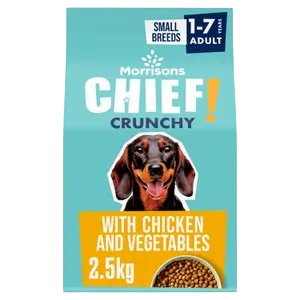
Morrisons Chief Adult Small Breed – —

Morrisons

Morrisons Chief Adult Small Breed review

29.6/100Poor
DryAdult

Morrisons Chief Adult Small Breed is an everyday kibble for grown small dogs, written in the shorthand that own-label recipes tend to use. Cereals lead, and meat and animal derivatives account for 27% with chicken pinned at 4% of the food. The label closes with a full panel of vitamins and trace elements, each with a dose beside it. Our scoring lands it in our Poor band while the typical adult dry food reaches Good. The gap comes from the names the label withholds, and not from a small dog going short.

Where to buy: coming soon
Live retailer pricing is coming soon. Once we have prices from UK retailers, the best price, cost per day and where to buy will appear here.

Our view

Likely to suit

For a settled small dog with an easy stomach, this is about as uncomplicated as feeding gets.

  • Owners of grown small dogs who want one straightforward complete food and no weekly decisions to make
  • Fat declared at 10.4% of dry matter suits a small dog who does better on a lighter kibble
  • Households that pick dog food up with the rest of the shopping rather than ordering it in
  • Owners who like the supplement panel spelled out, with vitamins A, D3 and E and six trace elements all dosed per kilo

Worth watching

Before you choose it, know that this label leaves a fair bit unsaid.

  • Only 4% of the food is named as chicken, and the rest of the 27% meat and animal derivatives could be any warm-blooded land animal, so a diet trial cannot be run on this bag
  • The grain side is given as cereals with no type attached, which leaves an owner avoiding wheat with nothing to check against
  • Oils and fats are declared without a source, so there is no telling whether the fat is animal or vegetable
  • The plant side carries most of the bulk, with estimated carbohydrate at 53.3% of dry matter against 46.2% for the typical adult dry food

Written by our editorial team. Independent guidance, not veterinary advice.

How this scores

How we score
29.6/100Poor
Protein and processingPoor
Nutritional balancePoor
TransparencyGood
ValuePoor

The Details

Dog fit

For a settled small dog with an easy stomach, this is about as uncomplicated as feeding gets. Before you choose it, know that this label leaves a fair bit unsaid.

Food type

Dry

Life stage

Adult

Breed size

Small

Main protein

Chicken

The score, in context

This finishes in our Poor band, two bands under the Good band of the typical adult dry food, and naming accounts for nearly all of the difference. Cereals, meat and animal derivatives, oils and fats and derivatives of vegetable origin are umbrella terms, and between them they account for nearly the whole recipe. A food that will not say what is inside it cannot be scored as though it had. Protein and processing and nutritional balance both read Poor on that evidence, while the dosed vitamin and mineral panel lifts transparency into our Good band. None of that means a small dog eats badly here. Protein sits at 24.2% of dry matter, the mineral panel is complete and properly dosed, and it is a complete food that plenty of small dogs get on with. It simply cannot show its working.

What's in it

Ingredients, as declared: Cereals, Meat and Animal Derivatives (27%, including 4% Chicken), Oils and Fats, Minerals, Vegetables (0.5% Dried Peas, equivalent to 4% Peas), Derivatives of Vegetable Origin

Named ingredients

Cereals, Meat and Animal Derivatives (27%, including 4% Chicken), Oils and Fats, Minerals, Vegetables (0.5% Dried Peas, equivalent to 4% Peas), Derivatives of Vegetable Origin

Nutritional additives

_Vitamins_ — Vitamin A 17,000 IU; Vitamin D3 1,500 IU; Vitamin E 70mg _Trace Elements_ — Iodine (calcium iodate anhydrous) 2.5mg; Selenium (sodium selenite) 0.1mg; Copper (copper (II) sulphate pentahydrate) 8mg; Iron (iron (II) sulphate monohydrate) 60mg; Manganese (manganese (II) oxide) 50mg; Zinc (zinc oxide) 100mg

Ingredient notes

Cereals is the first entry and the vaguest one on the label. The term stretches across every grain there is, from good whole cereals to the leftovers of milling. None of them is named, so the mix can change between batches. Most dogs will not notice one way or the other. For an owner trying to pin down a suspected wheat reaction, there is nothing on the panel to work with.

Meat and animal derivatives at 27% is the protein engine, with 4% of the food tied to chicken. In law the phrase covers the fleshy parts of slaughtered warm-blooded land animals along with the products of processing the carcass. That takes in genuinely good material and very ordinary material alike, and which end this bag draws from is not stated. Protein lands at 24.2% of dry matter, gentle for a dry food, and the estimated carbohydrate figure of 53.3% against 46.2% typical tells you where the rest of the bulk comes from.

The peas are worth reading twice. The label declares 0.5% dried peas and then explains that this is equivalent to 4% peas before drying. That is an honest piece of arithmetic, and a fair indication of how little pea is actually in the bag. Derivatives of vegetable origin, further down, is another catch-all covering anything left over from processing vegetables, legumes and oil seed.

Where the label does get specific is the additive block, and it is a complete one. Vitamins A, D3 and E are each dosed per kilo, with vitamin E at 70mg. Zinc follows at 100mg, iron at 60mg, manganese at 50mg, copper at 8mg, iodine at 2.5mg and selenium at 0.1mg. These come as oxides and sulphates, not chelates, and a dog's gut generally takes those up a shade less readily. The doses themselves are sound. Sodium selenite is the selenium form here, the commoner of the two allowed in pet food.

Calcium works out at 2.2% of dry matter with ash at 8.8%, both fuller than a meat-led kibble would show, which is the shape a mineral-supplemented, cereal-based recipe tends to take. For a healthy adult small dog that is ordinary feeding. The energy figure is our own estimate at 328 kcal per 100g, since the label declares none of its own.

Price and value

£1.20 a kilo, sold in a 2.5kg bag.

As a guide, a 15kg adult in moderate condition would eat about 256 grams a day at £0.31, on an assumed requirement of 840 kcal a day (110 × bodyweight^0.75, the standard maintenance estimate). This is a small breed recipe, though, and its own table stops at 175 grams for a 10kg dog, so most dogs actually eating it will get through rather less than that.

Nutritional analysis

Declared analysis

Energy
327.5 kcal/100g

Estimated using Modified Atwater factors*

Protein

22%

Fat

9.5%

Fibre

3%

Ash

8%

Moisture

9%

Dry weight

Protein

24.2%

Fat

10.4%

Fibre

3.3%

Ash

8.8%

Carbs

53.3%

As-fed composition

Estimated breakdown of the finished product by ingredient category, from the declared ingredient list and ingoing weights. These are estimates, not measurements.

Meat

27%

Carbs

45.8%

Veg

6.4%

Oils

12.6%

Other

8.2%

Pricing & size
Pack size
2.5Kg
Retailer pricing
Coming soon

Live retailer pricing is not yet available for this food. Prices, cost per day and where to buy will appear here once retailer data is live.

Ingredients and nutrition are taken from manufacturer data. Retailer pricing is not yet live for this food.

Related dog food guides

Ranked shortlists that include foods like this one.
All reviews

Featured feeding accessories

All feeding accessories

Brackenwood

Slow Feeder Maze Bowl

Slows fast eaters and eases gulping at mealtimes.

From £12.99· 4 retailers
View

Tarn & Co

Raised Double Diner

Height-set stand for easier, tidier eating.

From £28.99· 3 retailers
View

Reviewed by Off the Leash Editorial

Last updated 28 August 2026