



McIntyres
McIntyres Wet Cans: Chicken review
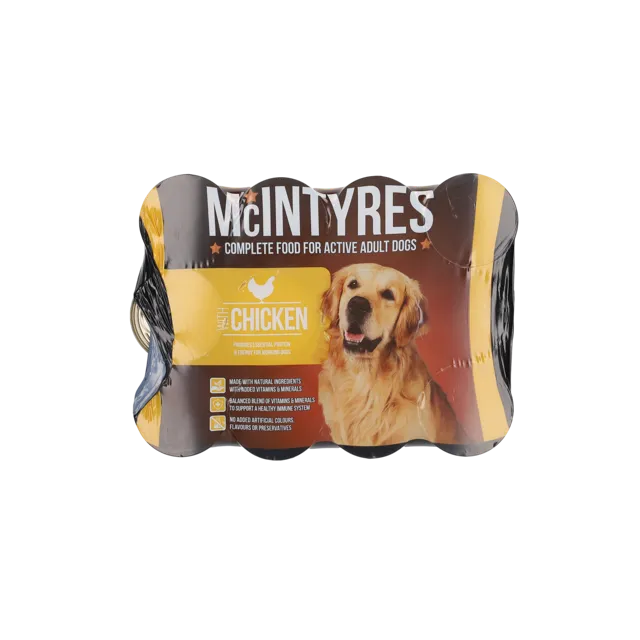
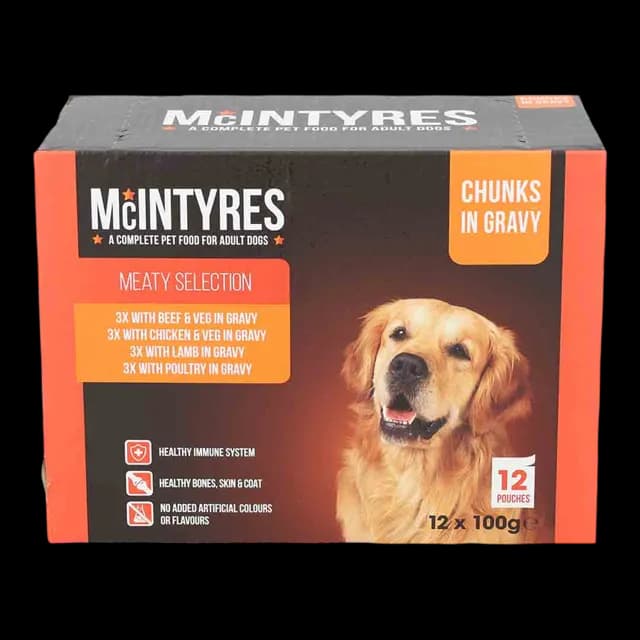
McIntyres Wet Cans comes in beef and chicken, 400g tins built to the same short recipe. Meat and animal derivatives account for 40% of each can with 4% given over to the species on the label, then unnamed cereals, derivatives of vegetable origin, minerals and various sugars. Both tins land in our Average band, and it is the vagueness of that list, rather than the analysis under it, that puts them there.
Our view
Likely to suit
If your dog has eaten happily from a plain tin for years, there is nothing here to unsettle that.
- Dogs that already do well on this food and have every reason to stay on it
- Owners who want a straightforward tin with no long list of ingredients to work through
- Dogs that drink little, since 78% of each can is moisture
- Households with a dog who alternates between red meat and poultry, as the beef and chicken tins are otherwise the same food
- Dogs of any build, with a 400g can fed by bodyweight from the smallest breeds upward
Worth watching
Almost every entry on this label is a category, which shapes what you can and cannot know about the tin.
- Just 4% of the 40% under meat and animal derivatives carries a species name, so neither tin will pin down a suspected food trigger
- No cereal is named, and that leaves wheat or maize impossible to rule out of these tins
- The grain does more work here than a tinned food usually asks of it, with estimated carbohydrate at 20.0% of dry matter against 15.8% for the typical adult wet food
- Various sugars are listed on both tins
- The printed additive panels differ between the beef and the chicken labels, and the maker's website publishes a third version again
Written by our editorial team. Independent guidance, not veterinary advice.
How this scores
How we scoreThe Details
Dog fit
If your dog has eaten happily from a plain tin for years, there is nothing here to unsettle that. Almost every entry on this label is a category, which shapes what you can and cannot know about the tin.
Wet
Adult
Toy, Small, Medium, Large, Giant
Chicken
The score, in context
Both tins are placed in our Average band, and protein and processing is the pillar carrying it, reading Poor on each. Almost nothing is identified: the meat is a category, the cereals are a category, the vegetable content is a category, and sugars are added on top of all three. The fairer half of the story is nutritional balance, which reads Excellent, with protein converting to 36.8% of dry matter and fat to 29.1%. The figure that stands out is the estimated carbohydrate at 20.0% of dry matter against 15.8% for adult wet food generally, which points at the unnamed cereals rather than at the meat. Adult wet food typically settles in our Excellent band, and the distance to it here is made of names this label does not give.
What's in it
Ingredients, as declared: transcribed from the pack panel: Meat and Animal Derivatives 40% (including 4% Chicken), Cereals, Derivatives of Vegetable Origin, Minerals,Various Sugars. The website prints this differently:Meat And Animal Derivatives (40%), Chicken (4%), Cereals, Derivatives Of Vegetable Origin, Minerals, Various Sugars
Named ingredients
Nutritional additives
ADDITIVES NUTRITIONAL ADDITIVES/KG: Vitamin A 3750IU, Vitamin D3 375IU, Zinc (Zinc Sulphate, Monohydrate) 25mg, Vitamin E 20mg, Manganese (Manganous Sulphate, Monohydrate) 3.75mg, Iodine (Calcium Iodate, Anhydrous) 0.3mg. > ⚠ The website publishes a different panel here: Iodine (Calcium Iodate, Anhydrous) (0.3mg/Kg), Manganese (Manganous Sulphate, Monohydrate) (3.75mg/Kg), Vitamin A (3750IU/Kg), Vitamin D3 (375IU/Kg), Vitamin E (20mg/Kg), Zinc (Zinc Sulphate, Monohydrate) (25mg/Kg) — and prints it under the WRONG heading **"Analytical Constituents"**.
Ingredient notes
Five entries make up the whole composition and four of them are legal umbrella terms. Meat and animal derivatives at 40% can be any warm blooded land animal in any proportion, cereals can be any grain, and derivatives of vegetable origin can be almost anything grown and processed. The named species holds 4%, and that is the single fixed point on the list. A recipe written this way can be perfectly sound; the difficulty is that there is no way to check.
The analysis reads better than the composition above it. Protein converts to 36.8% of dry matter with fat at 29.1%, and moisture is declared at 78%, all of it normal territory for a tinned food. Where it slips is the carbohydrate estimate, converting to 20.0% of dry matter against a 15.8% typical, so the cereal share is larger than a wet recipe usually carries.
Various sugars appear on both labels. Sugar in a tin is there for taste and colour and dogs take to it much as we do, which makes it worth noticing on a food that will be eaten every day for years.
The additive panels are dosed but they do not match each other. The beef label prints vitamin A at 2,250 IU, vitamin D3 at 328 IU and vitamin E at 26 mg, with a full trace set that includes iron and selenium. The chicken label prints vitamin A at 3750 IU, vitamin D3 at 375 IU and vitamin E at 20 mg, with a shorter trace list. Same recipe, two panels, and the maker's own website prints a third.
How this variety differs
Chicken takes the named 4%, with the same 40% of meat and animal derivatives behind it. At 102 kcal per 100g it is the lighter tin of the pair, and its additive panel is the shorter one, listing vitamins A, D3 and E alongside zinc, manganese and iodine.
Price and value
£1.35 a kilo across both flavours, in 400g cans boxed in twelves.
For a 15kg adult dog in moderate condition the beef works out at about £1.07 a day and the chicken at about £1.11, roughly 792 and 824 grams. Behind that sits a maintenance need of about 840 kcal a day (110 × bodyweight^0.75, the standard estimate). The small difference between them is energy, since the beef tin carries a few more calories in every 100g.
Nutritional analysis
Declared analysis
8.1%
6.4%
0.4%
2.7%
78%
Dry weight
36.8%
29.1%
1.8%
12.3%
20%
As-fed composition
Estimated breakdown of the finished product by ingredient category, from the declared ingredient list and ingoing weights. These are estimates, not measurements.
84%
9.6%
5.8%
0.6%
Pricing & size
- Pack size
- 12X400G
- Retailer pricing
- Coming soon
Live retailer pricing is not yet available for this food. Prices, cost per day and where to buy will appear here once retailer data is live.
Ingredients and nutrition are taken from manufacturer data. Retailer pricing is not yet live for this food.
Related dog food guides
Ranked shortlists that include foods like this one.