



McIntyres
McIntyres Puppy Pouches: Chicken & Rice review
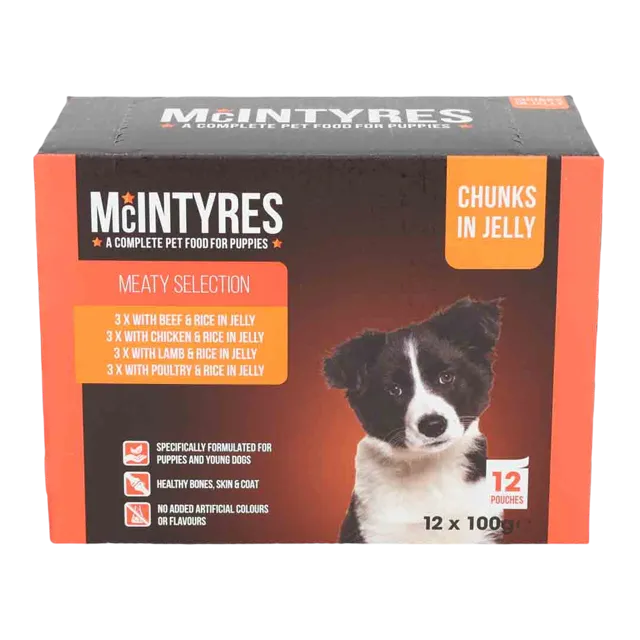
A mixed box of four flavours, all set in jelly, is what McIntyres Puppy Pouches gives you. The composition names categories where other labels name foods: meat and animal derivatives at 39%, of which 4% is the meat printed on the pouch. Behind it come cereals, oils and fats, then minerals and various sugars. Where the label does commit to a number it does well, with calcium declared at 1.58% of dry matter, inside the range growth needs, and protein converting to 42.1%. On the balance of what is declared, the range sits in our Average band.
Our view
Likely to suit
Some households need small, simple meals that a young dog will clear happily, and this box is built for exactly that.
- Owners rearing a big puppy, with calcium declared at 1.58% of dry matter and inside the growth range
- Puppies who eat better for a change of flavour, since the box rotates beef, chicken, lamb and poultry
- Small dogs and small appetites, with 100g pouches that open fresh at every meal
- Pups who prefer jelly to a loaf or a pate, which is the texture all four recipes are set in
- Owners who want the added nutrients printed, with an amount given for vitamin E, vitamin D3, zinc and iodine
Worth watching
Read what this label does not say, and what that means for your puppy.
- Meat and animal derivatives at 39% names no species beyond the 4% on the front, so the remainder could come from any warm-blooded land animal
- Cereals, oils and fats and derivatives of vegetable origin are category terms too, which allows the recipe to move between batches
- Various sugars appears on every pouch, where the sugar is there for taste and does no nutritional work
- Fish oil is on all four labels, and that matters if fish is off the menu for your pup
- With beef, chicken, lamb and poultry in one box, an elimination diet cannot be run from it
Written by our editorial team. Independent guidance, not veterinary advice.
How this scores
How we scoreThe Details
Dog fit
Some households need small, simple meals that a young dog will clear happily, and this box is built for exactly that. Read what this label does not say, and what that means for your puppy.
Wet
Puppy
Toy, Small, Medium, Large, Giant
Beef
The score, in context
Our Average band is where these pouches land, and the distance to the wet puppy field is wide, since the typical example there reaches our Excellent band. The reason sits almost entirely in what the label declares rather than in a failure of the analysis. Nutritional balance reads Outstanding and transparency Good, while protein and processing reads Poor because the composition is written in legal categories instead of foods. Where the label does put a number down it earns credit, with calcium printed and in the growth range and protein converting to 42.1% of dry matter, a respectable figure for a wet food.
What's in it
Ingredients, as declared: the pack prints a SEPARATE composition for each variety in the box (transcribed from the back-of-pack panel): With Beef & Rice in Jelly: Meat and Animal Derivatives (39% including 4% Beef), Cereals (1.5% Uncooked Rice, equivalent to 4% Cooked Rice), Oils and Fats (1.0% Fish Oil), Minerals, Derivatives of Vegetable Origin (0.08% Chicory), Various Sugars. With Chicken & Rice in Jelly: Meat and Animal Derivatives (39% including 4% Chicken), Cereals (1.5% Uncooked Rice, equivalent to 4% Cooked Rice), Oils and Fats (1.0% Fish Oil), Minerals, Derivatives of Vegetable Origin (0.08% Chicory), Various Sugars. With Lamb & Rice in Jelly: Meat and Animal Derivatives (39% including 4% Lamb), Cereals (1.5% Uncooked Rice, equivalent to 4% Cooked Rice), Oils and Fats (1.0% Fish Oil), Minerals, Derivatives of Vegetable Origin (0.08% Chicory), Various Sugars. With Poultry & Rice in Jelly: Meat and Animal Derivatives (39% including 4% Poultry), Cereals (1.5% Uncooked Rice, equivalent to 4% Cooked Rice), Oils and Fats (1.0% Fish Oil), Minerals, Derivatives of Vegetable Origin (0.08% Chicory), Various Sugars. What the website publishes instead (one merged list for the whole box), Meat And Animal Derivatives (39%), Beef (4%), Cereals, Uncooked Rice (2%), Cooked Rice (4%), Oils And Fats, Fish Oil (1%), Minerals, Derivatives Of Vegetable Origin, Chicory, Various Sugars, Chicken (4%), Lamb (4%), Poultry (4%)
Named ingredients
Nutritional additives
Nutritional Additives per kg: Vitamin D3 140 IU, Vitamin E 12 mg, Iodine (Calcium Iodate Anhydrous) 0.3 mg, Zinc (Zinc Sulphate Monohydrate) 12 mg. Technological Additives per kg: Cassia Gum 1700 mg. > ⚠ The website publishes a different panel here: Cassia Gum (1700 mg/kg), Lodine (Calcium Iodate Arhydrous) (0.3 mg/kg), Vitamin D (140 IU/kg), Vitamin E (12 mg/kg), Zinc (Zinc Sulphate Monohydrate) (12 mg/kg) — and prints it under the WRONG heading **"Analytical Constituents"**.
Ingredient notes
The composition leans on umbrella terms that labelling law permits. Meat and animal derivatives at 39% tells you the material came from slaughtered warm-blooded land animals and no more than that. Beyond the 4% of named meat, which animal it was, and which part of it, stays unknown. That vagueness is not proof of poor material, but it does take away your ability to check.
Cereals is the heading over the rice, declared as 1.5% uncooked and equivalent to 4% cooked, and oils and fats is the heading over 1.0% fish oil. The fish oil is a genuinely good inclusion. It brings the omega 3s a growing puppy puts to work in the brain, in the coat and in the joints. It is also the one ingredient here named clearly enough to be sure of.
Derivatives of vegetable origin covers chicory at 0.08%. Inulin comes from chicory root, and it is the prebiotic fibre the helpful gut bacteria feed on. Even under a broad heading, a small amount of it is a thoughtful addition.
Various sugars is the entry that gives most owners pause. Sugar goes into wet food because dogs eat more readily with it. Its place on the list implies a small quantity, and it earns that place on taste alone.
The analysis is better than the ingredient list leads you to expect. Protein at 8.0% as fed converts to 42.1% of dry matter and fat at 7.0% to 36.8%, with carbohydrate estimated at only 8.0% of dry matter, comfortably under the 13.6% typical of wet puppy food. Moisture is declared at 81.0% and energy at 96 kcal per 100g, a shade under the 106 typical.
Calcium is declared at 1.58% of dry matter, and that deserves credit on a label which otherwise says so little. It falls inside the range growth needs, large breeds included, and owners of big pups tend to make that check before any other.
The added panel is short and printed in full: 140 IU of vitamin D3, 12 mg of vitamin E, 12 mg of zinc and 0.3 mg of iodine in every kilogram. Cassia gum at 1700 mg does the gelling that gives the jelly its set.
How this variety differs
The chicken pouch declares 4% chicken within the same 39% derivatives block. No meat goes into British dog food more often than chicken, so this is familiar territory for a young dog. That same popularity is also why more dogs react to chicken than to any other meat. Keep it in mind if your pup has an unsettled tummy.
Price and value
£2.50 a kilo, sold in a box of 12 x 100g pouches.
How many pouches a day a puppy needs keeps changing. The maker's guide sets it by age and by the adult size the pup is growing towards. Expect the number to move as they do.
Nutritional analysis
Declared analysis
8%
7%
0.5%
2%
81%
Dry weight
42.1%
36.8%
2.6%
10.5%
8%
As-fed composition
Estimated breakdown of the finished product by ingredient category, from the declared ingredient list and ingoing weights. These are estimates, not measurements.
62.5%
22.8%
11.5%
2.4%
0.8%
Pricing & size
- Pack size
- 12X100G
- Retailer pricing
- Coming soon
Live retailer pricing is not yet available for this food. Prices, cost per day and where to buy will appear here once retailer data is live.
Ingredients and nutrition are taken from manufacturer data. Retailer pricing is not yet live for this food.
Related dog food guides
Ranked shortlists that include foods like this one.