


Skip to content
Off the Leash
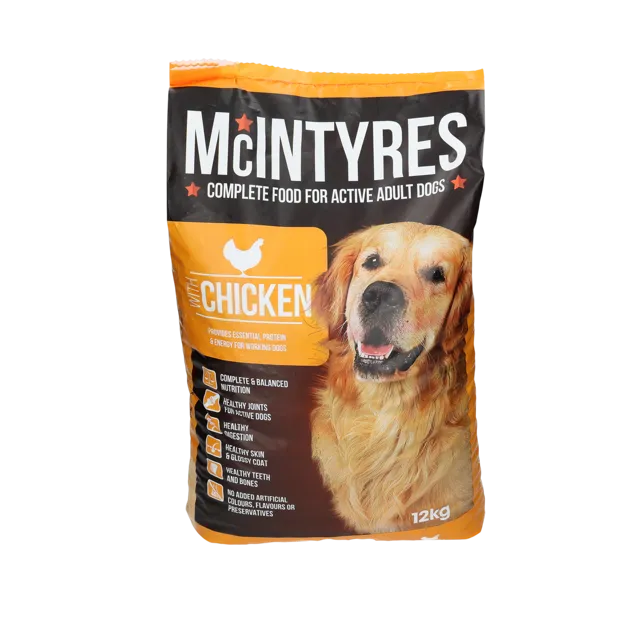
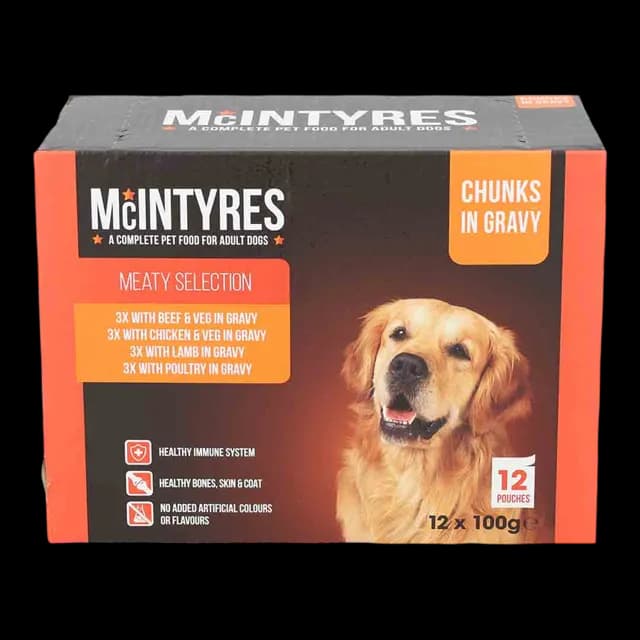
McIntyres Adult Dry – Chicken

McIntyres

McIntyres Adult Dry: Chicken review

28/100Poor
DryAdult

McIntyres Adult Dry is a plain, everyday kibble built on umbrella ingredient terms rather than named parts. Cereals lead, meat and animal derivatives follow, and the named meat, beef or chicken depending on which bag you pick, is declared at 4%. Protein converts to 23.1% of dry matter and fat to 8.8%, a gentler bowl than most, with a printed dose against each added mineral. Both bags land in our Poor band, and the reasons have far more to do with what the label declines to name than with anything it admits to.

Where to buy: coming soon
Live retailer pricing is coming soon. Once we have prices from UK retailers, the best price, cost per day and where to buy will appear here.

Our view

Likely to suit

You feed a straightforward kibble, your dog has never asked for more, and this bowl stays that simple.

  • Any adult dog at all, since the label runs from toy through to giant
  • Owners of a settled dog with no history of reacting to a particular ingredient
  • Dogs that gain weight without trying, since fat is declared at 8.0% and energy estimated at 316 kcal per 100g against the 357 typical for adult dry food
  • Households running two dogs with different tastes, because the beef and chicken bags are the same recipe with the named meat swapped

Worth watching

Before you move the household onto this one, there is a little about the wording to get straight.

  • Cereals, meat and animal derivatives, oils and fats and derivatives of vegetable origin all appear without a named source, which puts an elimination plan out of reach here
  • Only 4% is the named meat, and the rest of the animal content sits inside the umbrella term above it
  • The plant side carries most of it, with carbohydrate estimated at 54.9% of dry matter against the 46.2% typical for adult dry food

Written by our editorial team. Independent guidance, not veterinary advice.

How this scores

How we score
28/100Poor
Protein and processingPoor
Nutritional balancePoor
TransparencyAverage
ValuePoor

The Details

Dog fit

You feed a straightforward kibble, your dog has never asked for more, and this bowl stays that simple. Before you move the household onto this one, there is a little about the wording to get straight.

Food type

Dry

Life stage

Adult

Breed size

Toy, Small, Medium, Large, Giant

Main protein

Chicken

The score, in context

Both bags land in our Poor band, where the typical adult dry food holds our Good band, and the arithmetic only confirms what the ingredients list has already said out loud. Umbrella terms take first, second, fourth and fifth place on that list, the named meat is a 4% entry, and carbohydrate does more of the carrying than protein does. There is nothing here to be nervous about. It is a complete kibble with a full vitamin and mineral panel printed behind it. Written for an adult dog with a settled stomach and no particular requirements, it delivers what the bag describes.

What's in it

Ingredients, as declared: Cereals, Meat And Animal Derivatives, Chicken (4%), Oils And Fats, Derivatives Of Vegetable Origin, Vegetables, Peas (4%), Minerals, Yeasts

Named ingredients

Cereals, Meat And Animal Derivatives, Chicken (4%), Oils And Fats, Derivatives Of Vegetable Origin, Vegetables, Peas (4%), Minerals, Yeasts

Nutritional additives

Calcium Iodate Anhydrous (3 mg/Kg), Cupric Sulphate Pentahydrate (40 mg/Kg), Manganous Oxide (80 mg/Kg), Sodium Selenite (0.2 mg/Kg), Vitamin A (12,000 iu/Kg), Vitamin D3 (1,200 iu/Kg), Vitamin E (Alpha Tocopherol Acetate) (90 iu/Kg), Zinc Chelate (390 mg/Kg), Zinc Oxide (55 mg/Kg)

Ingredient notes

Cereals heads the list, and that one word can mean anything from good rice or oats to the lowest grade grain fraction going that month. The same applies to meat and animal derivatives in second place, a term that covers every fleshy part of any warm blooded land animal. Neither entry is proof of a poor ingredient, but neither lets you check, and both leave the maker free to change what sits behind them between batches.

The named meat, beef on one bag and chicken on the other, is declared at 4%. That reads as a flavour marker rather than the bulk of the animal content, which comes from the derivatives term above it. Peas are also declared at 4%, and whole peas are a genuinely useful addition, bringing fibre and a decent spread of minerals alongside their starch.

Oils and fats and derivatives of vegetable origin repeat the pattern further down the list, so the fat is not pinned to a plant or an animal either. Vegetables and yeasts round things off, again without saying which.

The analysis reads gently across the board. Protein converts to 23.1% of dry matter and fat to 8.8%, both at the modest end for a kibble, with estimated carbohydrate at 54.9% of dry matter against the 46.2% typical for adult dry food. Energy is estimated at 316 kcal per 100g, under the 357 typical, which is why the feeding table asks for such generous portions.

Nothing on this label is stronger than the mineral panel. Every entry carries a figure, and zinc is supplied twice over, as a chelate at 390 mg/kg and as the oxide at 55 mg/kg. The larger share therefore comes in the form a dog absorbs more easily. Selenium comes as sodium selenite at 0.2 mg/kg, one of only two selenium forms European law permits in pet food and by far the more widely used. Copper is at 40 mg/kg, manganese at 80 mg/kg and iodine at 3 mg/kg alongside it.

How this variety differs

Chicken fills the named 4% slot in this bag, and it is the only line on the ingredients list that changes. No meat is fed to dogs more often than chicken, which is exactly why more of them react to it than to anything else. If yours has form there, the beef version covers identical ground. The vitamin E entry is also written out in full as alpha tocopherol acetate on this label, which is the same ingredient the beef bag lists more briefly.

Price and value

£0.79 a kilo, sold in a 12kg bag.

As a guide, a 15kg adult dog in moderate condition needs about 265 grams a day, assuming around 840 kcal a day (110 × bodyweight^0.75, the standard maintenance estimate). That works out at £0.21 a day. The bag's own table asks 200 to 360 grams for a 10kg dog and 360 to 540 grams for a 20kg dog. If the two disagree, the waistline decides.

Nutritional analysis

Declared analysis

Energy
316.5 kcal/100g

Estimated using Modified Atwater factors*

Protein

21%

Fat

8%

Fibre

3%

Ash

9%

Moisture

9%

Dry weight

Protein

23.1%

Fat

8.8%

Fibre

3.3%

Ash

9.9%

Carbs

54.9%

As-fed composition

Estimated breakdown of the finished product by ingredient category, from the declared ingredient list and ingoing weights. These are estimates, not measurements.

Meat

29.6%

Carbs

54.1%

Veg

4.2%

Oils

8.3%

Other

3.8%

Pricing & size
Pack size
12KG
Retailer pricing
Coming soon

Live retailer pricing is not yet available for this food. Prices, cost per day and where to buy will appear here once retailer data is live.

Ingredients and nutrition are taken from manufacturer data. Retailer pricing is not yet live for this food.

Related dog food guides

Ranked shortlists that include foods like this one.
All reviews

Featured feeding accessories

All feeding accessories

Brackenwood

Slow Feeder Maze Bowl

Slows fast eaters and eases gulping at mealtimes.

From £12.99· 4 retailers
View

Tarn & Co

Raised Double Diner

Height-set stand for easier, tidier eating.

From £28.99· 3 retailers
View

Reviewed by Off the Leash Editorial

Last updated 28 August 2026