


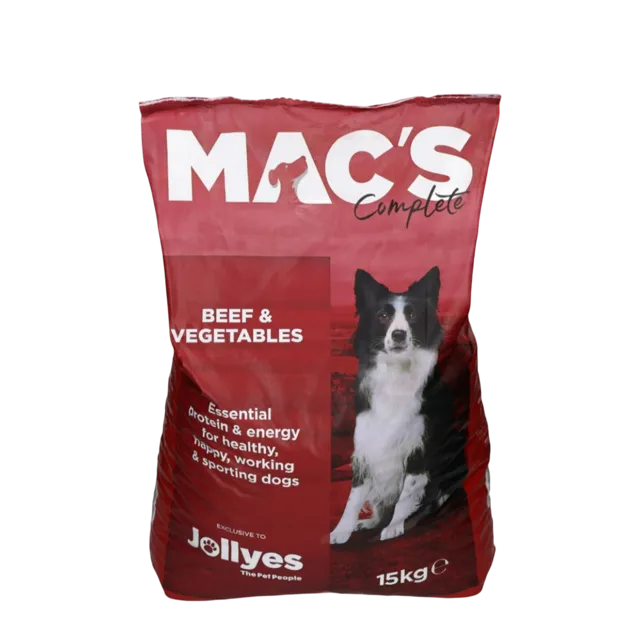

Mac's
Mac's Complete Dry: With Beef & Veg review
Mac's Complete Dry is a plain everyday kibble sold in one big sack, with a beef bag and a chicken bag sharing the same recipe underneath. Cereals open the list, the named meat is declared at a minimum of 4% inside a wider meat and animal derivatives entry, and peas come in at a minimum of 4% on the vegetable side. Fat is held low and the mineral panel is dosed in print. The Poor band is where our scoring puts it, and that verdict is about a label that names very little, not about a dog who has been thriving on it.
Our view
Likely to suit
You want one uncomplicated bag that every dog in the house gets on with, and this is that sort of food.
- Multi-dog households buying one sack at a time, since both recipes come in a 15kg bag
- A dog who gains weight easily, since fat is declared at 8.0% and energy sits under what most dry foods carry
- Owners who want the front of the bag to name a meat, with a beef version and a chicken version to choose between
- Dogs already settled on a cereal based kibble, because this keeps them on ground they know
Worth watching
The label asks to be read carefully, and here is what a careful read turns up.
- Only the named 4% is pinned to a species, since meat and animal derivatives covers the rest, so this cannot anchor an elimination plan
- Cereals are listed without the grain being named, so an owner tracking one particular grain has nothing to check against
- Carbohydrate is estimated at 56.0% of dry matter against the 46.2% typical of adult dry food, which makes it a starchier bowl than most
- Colorants are declared, and while the label states they come from a mineral source, colour in a kibble is always for the person holding the bag
Written by our editorial team. Independent guidance, not veterinary advice.
How this scores
How we scoreThe Details
Dog fit
You want one uncomplicated bag that every dog in the house gets on with, and this is that sort of food. The label asks to be read carefully, and here is what a careful read turns up.
Dry
Adult
Toy, Small, Medium, Large, Giant
Beef
The score, in context
Our scoring lands this in the Poor band, two bands under the Good reading the middle of the adult dry shelf earns. Nearly all of that gap is about naming. Cereals, oils and fats and derivatives of vegetable origin are all umbrella terms, and the animal side is tied to a species only for the named 4%. The starch share also runs well clear of what a dry food usually carries. What the band is not saying is that a dog doing well on this needs moving off it. This is a complete food with a properly dosed mineral panel behind it. The reading is really about a label that holds its cards close.
What's in it
Ingredients, as declared: Cereals, Meat and Animal Derivatives (min 4% beef), Oils and Fats, Derivatives of Vegetable Origin, Vegetables (min 4% peas), Minerals, Yeasts (0.08%).
Named ingredients
Nutritional additives
Vitamin A 12,000 iu, Vitamin D3 1,200 iu, Vitamin E (alpha tocopherol acetate) 90 iu, Calcium Iodate Anhydrous 3 mg, Cupric Sulphate Pentahydrate 40 mg, Manganous Oxide 80 mg, Zinc Oxide 55 mg, Zinc Chelate 390 mg, Sodium Selenite 0.2 mg. *Colorants, Antioxidant, Preservative. *Colorants - from a mineral source found in nature.
Ingredient notes
The list opens with cereals, a single word that covers every grain there is, from the finest to the least useful. Meat and animal derivatives works the same way: it is the legal catch-all for parts of warm blooded land animals that nobody has chosen to name. Neither term proves a food is poorly made, and some good recipes use broad wording to protect a formula, but neither lets you verify what is actually going in the bowl.
The named entries are the ones you can hold on to. A minimum of 4% beef in one bag and a minimum of 4% chicken in the other. On the plant side, a minimum of 4% peas does the same work. Beef and chicken are both highly digestible meats and whole peas bring fibre and useful micronutrients, so the parts that are named are decent parts. Everything around them, oils and fats and derivatives of vegetable origin included, is described by category. The maker is therefore free to change a source from one batch to the next.
The analysis reads exactly as that build suggests. Protein converts to 22.8% of dry matter and fat to 8.7%, both gentle by kibble standards. Carbohydrate is estimated at 56.0% of dry matter, and the typical adult dry food sits at 46.2%. Energy is an estimate, not a declared figure, and works out at roughly 322 kcal per 100 grams. That is on the low side, and part of why this suits a dog who gains weight on richer food.
The mineral side is more generous than the ingredient list would lead you to expect. Zinc turns up twice, as zinc oxide at 55 mg and as zinc chelate at 390 mg per kilo. A dog's gut generally absorbs the chelated form with less trouble. Manganese, copper, iodine and selenium are each dosed in print. Selenium comes as sodium selenite. Two forms are permitted in pet food and sodium selenite is the commoner of them, though the organic one is generally reported as easier for the body to take up.
Yeasts appear at 0.08%, a token amount rather than a working one. The label also declares an antioxidant and a preservative without naming either, which is common enough on a food built this way. Moisture is left off the analysis altogether. The dry matter figures here therefore use the 8% a kibble usually holds, and calcium is not declared.
How this variety differs
The beef bag names beef at a minimum of 4% inside the meat entry. Beef is a strongly flavoured red meat with a reputation for being easy to digest and hard to refuse. Reach for this bag when your dog has gone off poultry.
Price and value
£0.83 a kilo, sold in a 15kg bag.
As a guide, a 15kg adult dog in moderate condition needs about 261 grams a day, which works out at £0.22. The figure rests on around 840 kcal a day (110 × bodyweight^0.75, the standard maintenance estimate). The label's own table asks 200 to 400 grams for a dog between 10kg and 20kg. The waistline is the tiebreaker.
Nutritional analysis
Declared analysis
Estimated using Modified Atwater factors*
21%
8%
3%
8.5%
Dry weight
22.8%
8.7%
3.3%
9.2%
56%
As-fed composition
Estimated breakdown of the finished product by ingredient category, from the declared ingredient list and ingoing weights. These are estimates, not measurements.
28.2%
55.4%
4.7%
9.2%
2.6%
Pricing & size
- Pack size
- 15kg
- Retailer pricing
- Coming soon
Live retailer pricing is not yet available for this food. Prices, cost per day and where to buy will appear here once retailer data is live.
Ingredients and nutrition are taken from manufacturer data. Retailer pricing is not yet live for this food.
Related dog food guides
Ranked shortlists that include foods like this one.