

Lily's Kitchen
Lily's Kitchen Tins Puppy review
Flavour
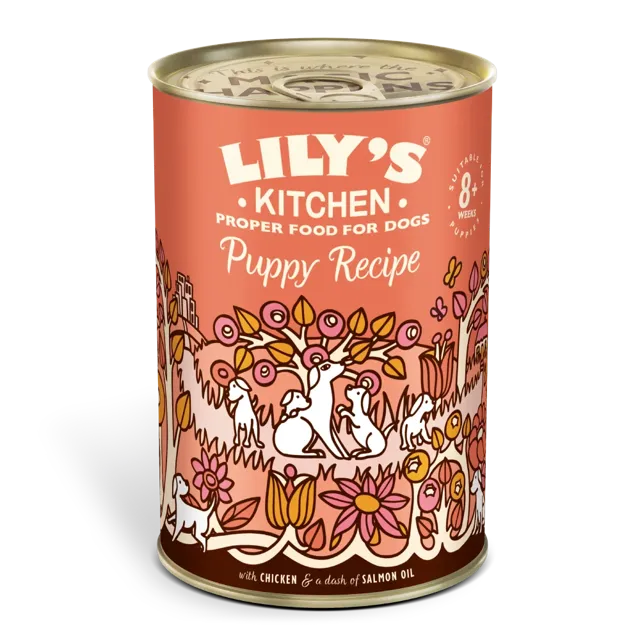
Lily's Kitchen Tins Puppy is a two recipe wet range that leads with fresh meat and keeps everything behind it short. The chicken tin is 67% fresh chicken with potatoes at 2% and carrots at 1%; the turkey and duck tin pairs 41% turkey with 20% duck and brings sweet potato, pumpkin and kale along. Both convert more than half their dry matter into protein, both keep starch near the floor, and both tins sit in our Excellent band.
Our view
Likely to suit
If you want a wet growth food whose ingredients you can read out loud in one go, this range is built for you.
- Puppies who take to a wet dinner, since fresh meat opens both labels
- Owners who like a short list, since neither tin runs past a handful of named foods before the botanicals
- Pups kept on very little starch, since carbohydrate is estimated at 1.8% as fed in both recipes
- Households feeding kibble as well, since a tin alongside it brings water and appetite to the same meal
Worth watching
Some of the thinking behind these tins is worth knowing before you commit.
- Neither label prints a calcium figure, and a large breed growth plan really wants that number in front of it
- Neither tin can anchor a fish free diet, because salmon oil runs through both recipes
- The vitamins and chelated minerals are named but not dosed, so there is no panel to check them against
Written by our editorial team. Independent guidance, not veterinary advice.
How this scores
How we scoreThe Details
Dog fit
If you want a wet growth food whose ingredients you can read out loud in one go, this range is built for you. Some of the thinking behind these tins is worth knowing before you commit.
Wet
Puppy
Toy, Small, Medium, Large, Giant
Chicken
The score, in context
Both tins finish in our Excellent band. The middle of the wet puppy field lands there too, so this is a strong category and these recipes belong in the thick of it. The turkey and duck tin edges just ahead of the chicken, and both read Excellent for protein and processing, thanks to the fresh meat that opens each list. Nutritional balance and transparency read Outstanding on both tins, with value Excellent alongside protein and processing, the two of them matching each other pillar for pillar.
What's in it
Ingredients, as declared: Fresh Chicken (67%), Potatoes (2%), Carrots (1%), Vitamins & Chelated Minerals, Salmon Oil. Herbs & botanicals: Golden Rod, Nettle, Aniseed, Celery Seed, Rosehips, Marigold Petals, Cleavers, Seaweed, Alfalfa, Milk Thistle, Dandelion Root, Burdock Root.
Named ingredients
Ingredient notes
Fresh meat leads both recipes, and that is the format's honest headline as well as its quirk. Fresh meat carries its water when it is weighed, so what reaches the finished tin is a smaller share than the printed percentage suggests. Even discounted, meat is plainly the bulk of what is in here.
The starch is nominal in both. The chicken tin takes potatoes at 2% and carrots at 1% and stops there, while the turkey and duck tin adds sweet potatoes at 4% with pumpkin, kale at 2%, cranberries, potatoes and carrots. Carbohydrate is estimated at 1.8% as fed either way. That works out at 9.0% of dry matter in the chicken tin and 8.6% in the turkey and duck, both under the 13.6% typical for wet puppy food.
The analysis is the shape you want from a meat-led wet food. Protein converts to 53.0% of dry matter in the chicken tin and 52.4% in the turkey and duck, with fat at 25.5% and 25.2%. The two are close cousins nutritionally even where their ingredient lists diverge.
Salmon oil appears in both, declared at 0.5% where the turkey and duck tin bothers to say so. It does the omega 3 job that a growing brain and eye draw on, and the coat with them. Fish therefore belongs on the allergen picture for a range whose meats are otherwise poultry.
Herbs and botanicals close both labels and, refreshingly, they are named one by one instead of hiding behind a blanket term. Golden rod, nettle, rosehips, cleavers, milk thistle and dandelion root are among the trace inclusions, so treat them as character in the bowl.
What neither label offers is a mineral panel. The label lists vitamins and chelated minerals as an ingredient, with no doses printed and no calcium figure anywhere. On that one point the tins ask for trust in the recipe. Energy reads 91 kcal per 100g in the chicken tin and 95 in the turkey and duck, both a little under the 106 typical for the format.
How this variety differs
The original tin keeps to a single meat, fresh chicken at 67%. Behind it there are only potatoes at 2% and carrots at 1%, plus the vitamin and chelated mineral mix, the salmon oil and the named herb blend. Protein comes in at 10.6% as fed, or 53.0% of dry matter once the 80.0% moisture is taken out, and energy reads 91 kcal per 100g. With chicken as the only meat, this is the tin for a pup kept to one animal, though the salmon oil stops it being a fish free recipe.
Price and value
£11.33 a kilo, sold in 150g tins.
Puppy appetites climb and then level off as growth slows. Read the tin count off the maker's guide for the age your pup is now and the weight they are heading towards, then revisit it every few weeks.
Nutritional analysis
Declared analysis
10.6%
5.1%
0.5%
2%
80%
Dry weight
53%
25.5%
2.5%
10%
9%
As-fed composition
Estimated breakdown of the finished product by ingredient category, from the declared ingredient list and ingoing weights. These are estimates, not measurements.
67%
18%
2%
4.3%
2.8%
6%
Pricing & size
- Pack size
- - 150g - £1.70
- Retailer pricing
- Coming soon
Live retailer pricing is not yet available for this food. Prices, cost per day and where to buy will appear here once retailer data is live.
Ingredients and nutrition are taken from manufacturer data. Retailer pricing is not yet live for this food.
Related dog food guides
Ranked shortlists that include foods like this one.