
Skip to content
Off the Leash
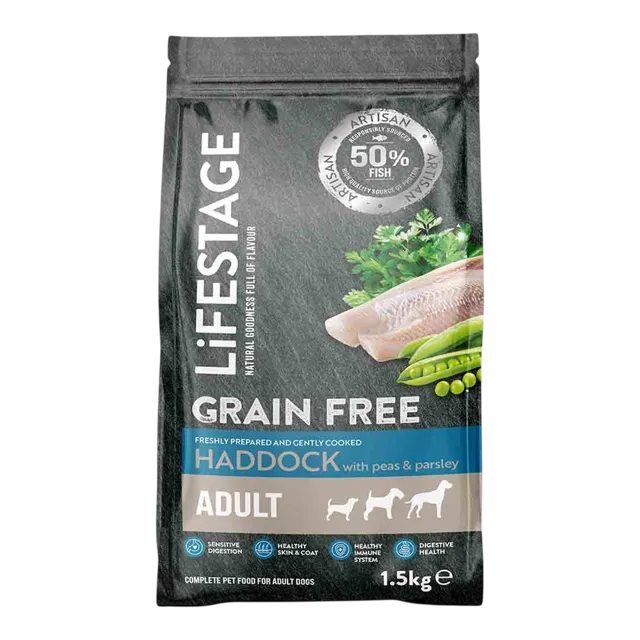
Lifestage Artisan Grain Free Dry Adult – Haddock with Peas & Parsley

Lifestage

Lifestage Artisan Grain Free Dry Adult: Haddock with Peas & Parsley review

65.7/100Good
DryAdult

Lifestage Artisan Grain Free Dry Adult is a two recipe fish range that never leaves the water. One bag leads on haddock, the other on Scottish salmon, and neither of them names a land animal anywhere on its ingredients list. Sweet potato and vegetables stand in for cereal, both labels itemise their fish declaration part by part, and prebiotics arrive with a milligram figure beside them. The salmon bag sits in our Excellent band, with the haddock just behind it in our Good band.

Where to buy: coming soon
Live retailer pricing is coming soon. Once we have prices from UK retailers, the best price, cost per day and where to buy will appear here.

Our view

Likely to suit

Fish is what your dog does better on, and these two bags keep to it all the way down the list.

  • Dogs kept off land meats, because no bird and no red meat appears in either recipe
  • Grain free households, where the starch comes from sweet potato, peas and beans
  • Owners who rotate flavours, since the fish is the only thing that changes between the two recipes
  • Dogs with a temperamental gut, since both labels print doses for their FOS and MOS prebiotics
  • Label readers, as the fresh, dried, oil and stock portions of the fish are all broken out on both bags

Worth watching

Before you pick between the two, here are the honest limits.

  • Fish is the whole story here, so a dog that reacts to it wants one of the brand's meat recipes instead
  • The haddock recipe also carries dried salmon and trout oil, so it is not built around a single species
  • The haddock label leaves ash and moisture undeclared, so its analysis cannot be converted to dry matter for comparison
  • Calcium converts to 2.17% of dry matter on the salmon recipe, comfortably above what a grown dog needs, so there is no case for a mineral topper alongside it

Written by our editorial team. Independent guidance, not veterinary advice.

How this scores

How we score
65.7/100Good
Protein and processingGood
Nutritional balanceGood
TransparencyGood
ValueGood

The Details

Dog fit

Fish is what your dog does better on, and these two bags keep to it all the way down the list. Before you pick between the two, here are the honest limits.

Food type

Dry

Life stage

Adult

Breed size

Toy, Small, Medium, Large, Giant

Main protein

Fish

The score, in context

The salmon reaches our Excellent band and the haddock our Good band, level there with the middle of the adult dry shelf, and they get there by slightly different routes. The salmon bag declares the larger fish share and prints a complete analysis, which is why its transparency pillar reads Excellent. The haddock bag pairs a slightly smaller fish share with a broader set of oils and leaves two figures off its panel. Either way, what puts them where they are is the amount of named animal in the bag.

What's in it

Ingredients, as declared: Fish (50%), Freshly Prepared Haddock (26%), Dried Salmon (18%), Trout Oil (5%), Salmon Stock (2%), Sweet Potato (24%), Peas, Potato, Beet Pulp, Olive Oil, Linseed, Sunflower Oil, Minerals, Vitamins, Parsley, Vegetable Stock

Named ingredients

Fish (50%), Freshly Prepared Haddock (26%), Dried Salmon (18%), Trout Oil (5%), Salmon Stock (2%), Sweet Potato (24%), Peas, Potato, Beet Pulp, Olive Oil, Linseed, Sunflower Oil, Minerals, Vitamins, Parsley, Vegetable Stock

Nutritional additives

Fos (92 mg/kg), Mos (23 mg/kg)

Ingredient notes

Both labels do the thing we always want to see and break the fish headline into its parts. The haddock recipe declares fish at 50%. Inside that sit trout oil at 5%, salmon stock at 2%, dried salmon at 18% and freshly prepared haddock at 26%. The salmon recipe goes further at 65%: freshly prepared Scottish salmon at 35% and dried salmon at 23% carry it, finished with 4% salmon oil and 3% salmon stock.

The dried entries matter more than their position implies. Most of a fresh fish's weight is water, and the oven claims it. That leaves the dried salmon in each recipe carrying a large part of the protein that ends up in the bowl. On the salmon bag, where the full analysis is printed, protein converts to 34.8% of dry matter and estimated carbohydrate to 35.8%, against the 46.2% carbohydrate typical of adult dry food.

Neither recipe uses grain. Sweet potato at 24% opens the plant side of the haddock bag, then peas and potato. The salmon bag pairs sweet potato with beans. Beet pulp appears on both lists as the fermentable fibre that steadies digestion, and neither bag reaches for a cereal to hold the kibble together.

The oils are chosen with some care. On top of its trout oil the haddock recipe adds olive oil, sunflower oil and linseed, which between them cover both omega families and bring along a natural helping of vitamin E. The salmon recipe leans on salmon oil, the form a dog's body can put to work directly, with an added omega 3 supplement behind it.

Prebiotics come with a figure beside them: 92 mg/kg of FOS and 23 mg/kg of MOS on the haddock recipe, 175 mg/kg and 50 mg/kg on the salmon. Yeast cell walls give the MOS and plants like chicory the FOS, and both go to feed the large intestine's bacteria.

The green tail of each label is there for flourish. Parsley finishes the haddock bag. On the salmon it is a dried mix of dill and spinach with fennel, asparagus and tomato, and olive extract behind them. Calcium is the one figure worth a note, working out at 1.09% of dry matter on the haddock and 2.17% on the salmon, the second being generous for a grown dog.

How this variety differs

Haddock at 26% freshly prepared, with dried salmon at 18% and trout oil at 5% completing a 50% fish declaration. The fresh haddock is what the front of the bag names, and the rest of the fish sits behind it. Olive oil and sunflower oil appear here and not on the salmon. Its label also leaves ash and moisture out, and the panel stops at protein, fat and fibre. Calcium works out at 1.09% of dry matter and parsley is its finishing note.

Price and value

The salmon recipe is £4.40 a kilo and the haddock £6.00 a kilo. The salmon comes in 1.5kg and 10kg bags, the haddock in a 1.5kg bag.

As a guide, a 15kg adult dog in moderate condition eats about 222 grams a day of the salmon recipe and about 239 grams of the haddock. Both amounts come off a target of 840 kcal a day (110 × bodyweight^0.75, the standard maintenance estimate). That comes to £0.98 a day on the salmon and £1.43 a day on the haddock. Let the waistline set the portion.

Nutritional analysis

Declared analysis

Energy
351.8 kcal/100g

Estimated using Modified Atwater factors*

Protein

26%

Fat

14%

Fibre

4%

Dry weight

Protein

28.3%

Fat

15.2%

Fibre

4.3%

As-fed composition

Estimated breakdown of the finished product by ingredient category, from the declared ingredient list and ingoing weights. These are estimates, not measurements.

Meat

76.8%

Carbs

19.2%

Oils

4%

Pricing & size
Pack size
1.5kg
Retailer pricing
Coming soon

Live retailer pricing is not yet available for this food. Prices, cost per day and where to buy will appear here once retailer data is live.

Ingredients and nutrition are taken from manufacturer data. Retailer pricing is not yet live for this food.

Related dog food guides

Ranked shortlists that include foods like this one.
All reviews

Featured feeding accessories

All feeding accessories

Brackenwood

Slow Feeder Maze Bowl

Slows fast eaters and eases gulping at mealtimes.

From £12.99· 4 retailers
View

Tarn & Co

Raised Double Diner

Height-set stand for easier, tidier eating.

From £28.99· 3 retailers
View

Reviewed by Off the Leash Editorial

Last updated 28 August 2026