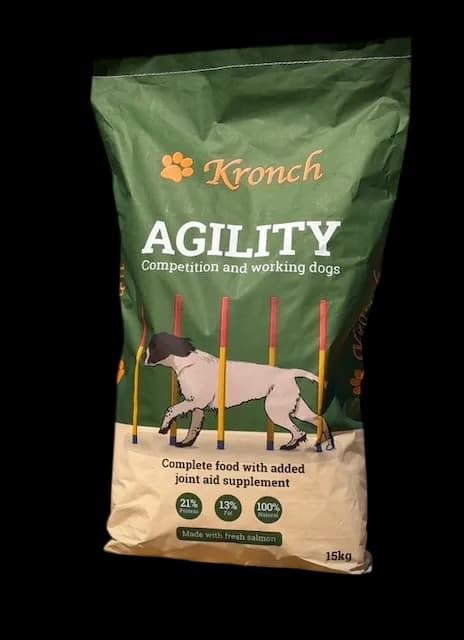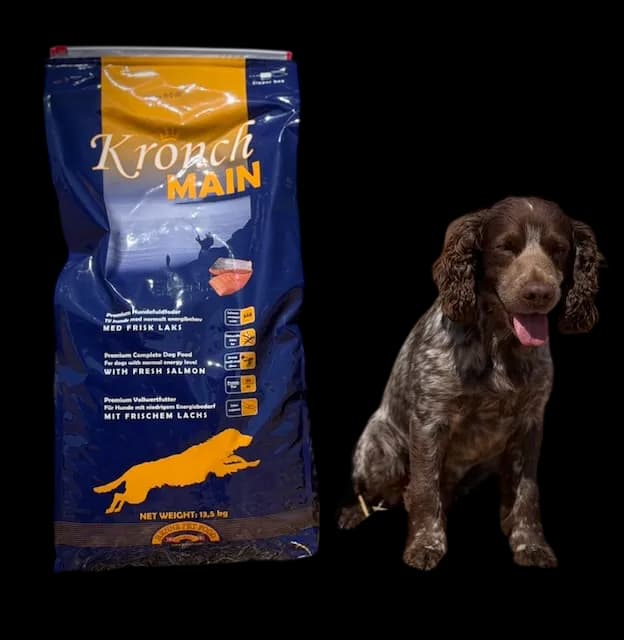

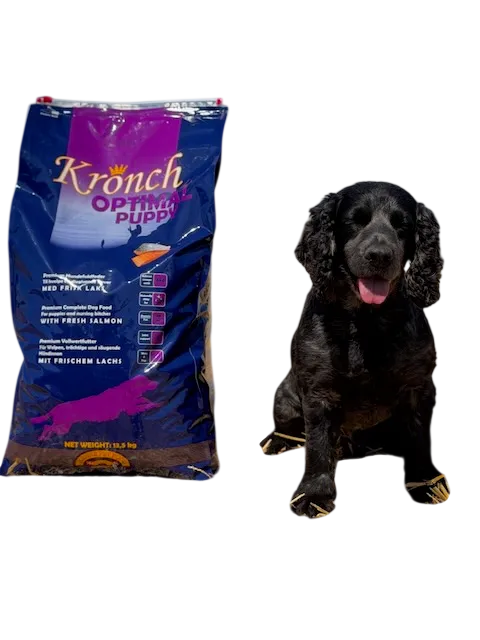

Kronch
Kronch Optimal Puppy review
Kronch Optimal Puppy is a salmon led growth kibble built the traditional way, with fresh salmon and salmon meal at the front and rice, maize and barley behind them. Protein is declared at 26.0% and energy at 365 kcal per 100g, so this is a steady recipe. The mineral and vitamin listing is written out row by row in a way most labels never bother with. It lands in our Good band.
Our view
Likely to suit
If salmon agrees with your pup and you like seeing a maker set out its minerals in full, this bag will suit you.
- Pups who do well on fish, with fresh salmon and salmon meal opening the recipe
- Households with no reason to avoid cereal, since the starch here is carried by rice, maize and barley
- Owners who read mineral panels, because this one prints calcium, phosphorus, magnesium, potassium and the trace minerals with figures attached
- A pup of small or medium breed, since a mineral load this restrained matches that growth most easily
- Puppies who need gentle fibre in the mix, with beet pulp on the list and brewer's yeast behind it
Worth watching
Look over the points below before you settle on this bag.
- Pork fat and blood meal both appear further down, so a feeding plan resting on salmon alone cannot rest on this recipe
- Rice, maize and barley are all on the list, which rules the food out for grain free households and for pups who react to maize
- Calcium is printed at just under a gram in every 100g, a restrained level for growth, so check the sums with your vet if the pup is a large or giant breed
- The salmon entries carry no inclusion percentages, so exactly how much of the bag is fish stays with the maker
Written by our editorial team. Independent guidance, not veterinary advice.
How this scores
How we scoreThe Details
Dog fit
If salmon agrees with your pup and you like seeing a maker set out its minerals in full, this bag will suit you. Look over the points below before you settle on this bag.
Dry
Puppy
Toy, Small, Medium, Large, Giant
Salmon
The score, in context
Kronch Optimal Puppy lands in our Good band, level with the typical puppy dry food rather than out ahead of it. Transparency reads Excellent. Nutritional balance reads Average, which is what stops it climbing clear of the middle, while protein and processing and value both read Good.
The distance is easy enough to trace on the ingredients list. A strong salmon opening gives way to three cereals in a row, and the protein declaration is workmanlike for a growing dog. The analysis stops before moisture, so the dry matter column rests on an assumption.
What's in it
Ingredients, as declared: Fresh Salmon, Salmon Meal, rice, maize, barley, Pork Fat, blood meal, brewer's yeast, Beet Pulp, lecithin, garlic, vitamins and minerals.
Named ingredients
Nutritional additives
- **Minerals** _(per 100 g)_: Calcium (Ca) 0,85 g · Sodium (Na) 0,3 g · Phosphorus (P) 0,85 g · Magnesium (Mg) 0,2 g · Potassium (K) 0,6 g · Iron (Fe) 17,9 mg · Zink (Zn) 10,6 mg · Copper (Cu) 0,4 mg · Manganese (Mn) 1,0 mg · Iodine (I) 0,1 mg · Cobalt (Co) 0,002 mg · Selenium (Se) 0,07 mg - **Additives per 100g:** Vitamin A 1200 i.e. · Vitamin D3 60 i.e. · Vitamin E (Alpha-tocopherol) 15,0 mg · Vitamin B1 0,30 mg · Vitamin B2 0,64 mg · Vitamin B6 0,30 mg · Niacin 3,3 mg · D-Pantothenic acid 3,3 mg · **Vitamin B12 2,0 mg** - _Reproduced verbatim: **Vitamin B12 2,0 mg** — see the scope note. This additives list ends at Vitamin B12; **the choline, folic acid, biotin and vitamin C rows that all other Kronch products carry are absent from this page** and are recorded as not published rather than assumed. Calcium (0,85 g) and phosphorus (0,85 g) are the lowest in the range, matching the "bala
Ingredient notes
Fresh salmon opens the recipe and salmon meal follows it. That order is worth decoding. The fresh fish figure includes its water. The meal has already lost that water. The meal usually contributes more protein to the finished kibble than its position implies. Neither entry carries a percentage, so the fish share has to be read from the analysis and not from the front of the bag.
Rice, maize and barley then take three consecutive places. Of the three, barley is the sound one. Once cooked it digests easily, and its starch comes with fibre and a few trace minerals. Maize is the entry allergy minded owners tend to query. The cereals between them put the estimated carbohydrate at 40.1% of dry matter. A typical puppy dry food sits at 39.0%, so the grain load here is an ordinary one.
Pork fat provides the added fat and blood meal adds concentrated protein. Both are perfectly normal inclusions, and few dogs will have met pork before, which can be useful in itself. Together, though, the two of them mean the recipe is not the single fish diet the salmon headline might suggest. Lecithin sits alongside them as an emulsifier, and beet pulp brings the kind of moderate, well tolerated fibre that keeps a puppy's digestion predictable.
Near the end sits brewer's yeast, a quietly good entry. Few natural sources beat it for the B vitamins a fast growing dog gets through, and its protein is a complete one. Garlic follows it at what will be a token amount, the level used for palatability and circulation, nowhere near a dose that would worry anyone.
The mineral listing is the most generous part of this label. Calcium and phosphorus are both printed at just under a gram in every 100g of food, the lowest calcium figure anywhere in the Kronch line. Sodium, magnesium, potassium, iron, zinc, copper, manganese, iodine, cobalt and selenium are all given figures too. A restrained calcium level is not automatically a drawback. It is excess calcium that large and giant breed pups need protecting from. Still, a figure this low belongs in a conversation with your vet when the pup is a big one and the totals need to add up.
The vitamin panel runs from A and D3 through E and the B group, then stops at vitamin B12. Other Kronch foods go on from there to list choline, folic acid, biotin and vitamin C. Read the ending as a limit on what has been published, not as evidence of what is in the bag.
One thing the analysis leaves out is moisture. Protein at 26.0%, fat at 17.0%, fibre at 3.0% and ash at 9.0% are all declared. With no moisture figure, the dry matter column falls back on the 8% carried by a kibble of this kind. Energy is declared properly at 365 kcal per 100g, a little under the 376 typical of a puppy dry food. That fits a recipe pitched at steady growth.
Price and value
Bags of 5kg and 13.5kg, at £4.66 a kilo.
No single daily amount fits a puppy: the portion moves with age and with the size the dog is heading for. Our energy estimate, rather than a printed chart, puts a 10kg pup between 4 and 12 months old at roughly 194.1 to 237.3 grams a day. Begin around there, then judge by how the pup is filling out.
Nutritional analysis
Declared analysis
26%
17%
3%
9%
Dry weight
28.3%
18.5%
3.3%
9.8%
40.1%
As-fed composition
Estimated breakdown of the finished product by ingredient category, from the declared ingredient list and ingoing weights. These are estimates, not measurements.
61.1%
33.6%
2.1%
3.1%
Pricing & size
- Pack size
- 5kg, 13.5kg
- Retailer pricing
- Coming soon
Live retailer pricing is not yet available for this food. Prices, cost per day and where to buy will appear here once retailer data is live.
Ingredients and nutrition are taken from manufacturer data. Retailer pricing is not yet live for this food.
Related dog food guides
Ranked shortlists that include foods like this one.