



Kronch
Kronch Main review
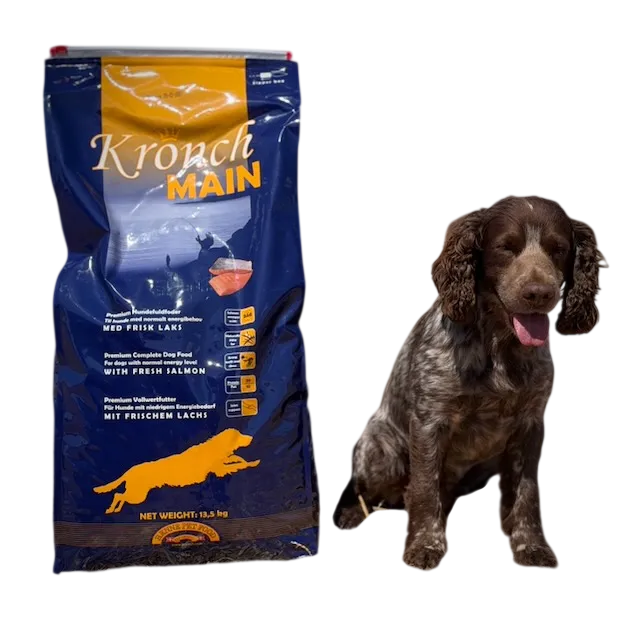
Kronch Main is a fresh salmon kibble built for maintenance, declaring salmon at 16%, keeping fat down to 10% and covering seniors as well as adults on the same bag. Barley and wheat carry the starch, fish meal backs up the fresh salmon, and the mineral and vitamin panels are printed line by line underneath. Everything about the analysis says maintenance rather than performance, which is the point of it. Our scoring brings it out in the Average band, a step under the Good band where most adult dry foods finish.
Our view
Likely to suit
If your dog is past their sprinting years and does better on a lighter bowl, this is the quiet one.
- Older dogs and steady adults, since the label covers both and keeps the fat down to 10%
- A dog that gains weight on very little, since the energy is declared at 340 kcal per 100g and the fat level behind it is modest
- Fish-fed dogs, with fresh salmon at 16% and fish meal supporting it
- Owners who want the minerals printed, from calcium and phosphorus through to cobalt and selenium
- Households feeding a very large dog, since the label's own table carries on up to 70kg
Worth watching
There are a few things here you will want to know before the first bag arrives.
- Wheat is on the list, and it is the first entry to check for a dog with a known cereal intolerance
- Blood meal carries no species name, which is the gap to know about on an otherwise fish-led recipe
- Lard supplies the fat, and lard is pork, so it is worth a look if pork is off the menu at home
- Much of the carrying falls to the grains, with carbohydrate estimated at 57.6% of dry matter
- With no moisture declared, the dry matter figures are worked from the customary 8% for a dry food
- There is garlic in the mix, in the modest amount typical of this style of recipe, worth flagging if you would rather avoid it
Written by our editorial team. Independent guidance, not veterinary advice.
How this scores
How we scoreThe Details
Dog fit
If your dog is past their sprinting years and does better on a lighter bowl, this is the quiet one. There are a few things here you will want to know before the first bag arrives.
Dry
Adult, Senior
Toy, Small, Medium, Large, Giant
Salmon
The score, in context
Our scoring brings this one out in the Average band, a step under the Good band the typical bag of adult dry food reaches. On paper it is an ordinary maintenance kibble. The label gives the reasons, with nothing hidden in the method. Protein converts to 21.7% of dry matter and fat to 10.9%, and both figures are gentle by kibble standards. Carbohydrate is estimated at 57.6% against the 46.2% that is typical, and wheat sits second on the list. Transparency reads Excellent, while protein and processing reads Average and nutritional balance Poor. None of that stops it doing what it was designed for. For an older or steadier dog that does not want a rich bowl, a light analysis is the feature. The full mineral declaration underneath is more than plenty of gentler foods offer.
What's in it
Ingredients, as declared: Fresh salmon (16%) Barley, wheat, fish meal, lard (food grade), maize, blood meal, beet pulp, brewer's yeast, garlic, vitamins and minerals.
Named ingredients
Nutritional additives
- **Minerals** _(the page heads this "Kronch Main – Minerals"; per 100 g)_: Calcium (Ca) 1,4 g · Sodium (Na) 0,3 g · Phosphorus (P) 1,0 g · Magnesium (Mg) 0,2 g · Potassium (K) 0,7 g · Iron (Fe) 18,1 mg · Zink (Zn) 10,0 mg · Copper (Cu) 0,4 mg · Manganese (Mn) 1,1 mg · Iodine (I) 0,1 mg · Cobalt (Co) 0,002 mg · Selenium (Se) 0,05 mg - **Additives per 100g** _(the page's own heading)_: Vitamin A 1000 i.e. · Vitamin D3 60 i.e. · Vitamin E (Alpha-tocopherol) 15,0 mg · Vitamin B1 0,30 mg · Vitamin B2 0,64 mg · Vitamin B6 0,30 mg · Niacin 3,0 mg · D-Pantothenic acid 1,0 mg · **Vitamin B12 3,0 mg** · Choline 50,0 mg · Folic acid 0,1 mg · Biotin 0,03 mg · Vitamin C 5,5 mg - _Reproduced verbatim: **Vitamin B12 3,0 mg** — see the scope note; the unit is almost certainly wrong on the source data sheet but is printed as published. "i.e." is the site's rendering of the German/Danish "I.E." (internat
Ingredient notes
Fresh salmon leads at 16% and fish meal comes a little further down, and the pairing is the recipe's best idea. Water accounts for most of a fresh fish entry and the oven takes it back out. Fish meal arrives dried already, so the meal is what actually delivers protein into the kibble. The finished analysis is modest by design: protein at 21.7% of dry matter, fat at 10.9% and energy at 340 kcal per 100g, a deliberately light combination for a dry food.
Barley heads the plant side with wheat immediately behind it and maize further along. Barley is a decent grain for dogs once cooked, bringing fibre with selenium and copper. Opinion divides over wheat. It bakes well, though of all the cereals it is the one dogs react to most, so keep it in mind if a grain has caused trouble before. Between them the three put carbohydrate at an estimated 57.6% of dry matter against the 46.2% typical of adult dry food.
Lard provides the added fat. Lard is pork fat, worth registering on a bag led by salmon. Blood meal follows as a concentrated protein source with no animal named against it, and beet pulp brings the fermentable fibre that helps keep stools firm, a detail that matters more as a dog ages.
Brewer's yeast and garlic finish the list. Brewer's yeast is a genuinely good natural source of B vitamins and makes a plain kibble more appealing. Garlic sits far enough down the list to count as seasoning, a Nordic convention and not a claim. With garlic the quantity is everything. At this level it is a very different thing from a large dose, though some owners will still want to be told it is there.
The published panels are the most generous part of the label. Calcium, sodium, phosphorus, magnesium, potassium, iron, zinc, copper, manganese, iodine, cobalt and selenium are all declared, and the vitamins get a line each. The B12 line is printed in milligrams, though micrograms are the usual measure for it. Read it as a unit slip in the published sheet and not as anything different in the food.
Price and value
£3.70 a kilo, sold in 5kg and 13.5kg bags.
A 15kg adult dog in moderate condition would get through about 247 grams a day, based on around 840 kcal a day (110 × bodyweight^0.75, the standard maintenance estimate), which is £0.91 a day. The label asks 200 to 305 grams for a dog between 10kg and 20kg, so an older dog taking things easy will sit below the middle of that range.
Nutritional analysis
Declared analysis
20%
10%
2.5%
6.5%
Dry weight
21.7%
10.9%
2.7%
7.1%
57.6%
As-fed composition
Estimated breakdown of the finished product by ingredient category, from the declared ingredient list and ingoing weights. These are estimates, not measurements.
38.6%
48.3%
7.3%
5.8%
Pricing & size
- Pack size
- 5kg, 13.5kg
- Retailer pricing
- Coming soon
Live retailer pricing is not yet available for this food. Prices, cost per day and where to buy will appear here once retailer data is live.
Ingredients and nutrition are taken from manufacturer data. Retailer pricing is not yet live for this food.
Related dog food guides
Ranked shortlists that include foods like this one.