


Skip to content
Off the Leash
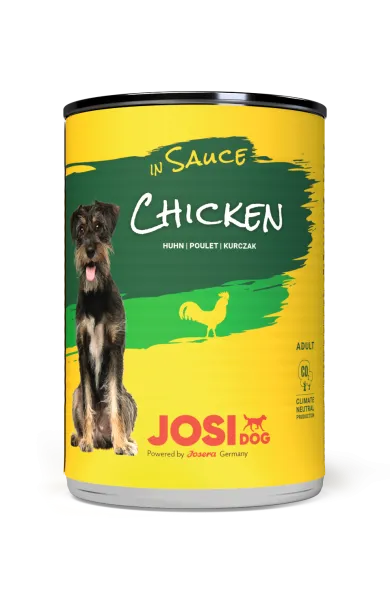
JosiDog in Sauce – Chicken

JosiDog

JosiDog in Sauce: Chicken review

45.4/100Average
WetAdult

JosiDog in Sauce is a German kitchen's take on the everyday tin: chunks in sauce, and a 4.0% declaration for the animal on the front inside a broader meat and animal derivatives line. Five recipes cover beef, chicken and game, two of them with carrot alongside. The analysis behind the label is better than the label itself reads, and three of the five sit in our Average band with the two carrot tins a step up in Good.

Where to buy: coming soon
Live retailer pricing is coming soon. Once we have prices from UK retailers, the best price, cost per day and where to buy will appear here.

Our view

Likely to suit

Plenty of dogs eat this style of tin happily for years, and there is a solid analysis sitting behind this one.

  • Dogs already settled on a plain, familiar tin who see no reason to change
  • Owners who want the energy figure to come from the label rather than from an estimate, since these tins declare their calories
  • Dogs that need protein in a wet bowl, with 38.9% of dry matter on the plain recipes and 37.5% on the two with carrot
  • Households with several dogs to feed, since a single recipe covers toy breeds and giants
  • Dogs that prefer their dinner in sauce rather than as a solid loaf

Worth watching

This label says little about itself, so here is what to hold in mind.

  • The animal on the front accounts for 4.0% of the tin, and everything else meaty is described as meat and animal derivatives
  • Fish and fish derivatives sits on the beef, chicken and game recipes, which matters for a dog who has to steer clear of fish
  • Cereals goes unnamed, so the grain inside it may vary between batches with the label unchanged
  • Caramel syrup is on every recipe, and its job is the colour of the food, not the dog eating it

Written by our editorial team. Independent guidance, not veterinary advice.

How this scores

How we score
45.4/100Average
Protein and processingGood
Nutritional balanceExcellent
TransparencyGood
ValueAverage

The Details

Dog fit

Plenty of dogs eat this style of tin happily for years, and there is a solid analysis sitting behind this one. This label says little about itself, so here is what to hold in mind.

Food type

Wet

Life stage

Adult

Breed size

Toy, Small, Medium, Large, Giant

Main protein

Chicken

The score, in context

Our Average band is where the three plain tins finish, with the two carrot recipes a step up in Good, and the typical adult wet food sits above both in our Excellent band. Category terms leave a scoring system with nothing to reward. Meat and animal derivatives can be any warm-blooded animal in any proportion, and cereals can be any grain. The wording stays put while what sits behind it changes from batch to batch. Read the analysis instead and the picture warms up considerably, with dry-matter protein in the high thirties and an estimated carbohydrate only a little above the 15.8% typical for wet food. None of this is a safety verdict. The verdict is about how the meat is described, and the analysis is a separate matter: nutritional balance reads Excellent right across the five.

What's in it

Ingredients, as declared: meat and animal derivatives (chicken 4.0%); cereals; fish and fish derivatives; minerals; caramel syrup

Named ingredients

Meat and animal derivatives (chicken 4.0%); cereals; fish and fish derivatives; minerals; caramel syrup

Nutritional additives

| Zusatzstoff (verbatim) | Additive (EN) | Amount per kg | |---|---|---| | Vitamin A | Vitamin A | 1.100 I.E. | | Vitamin D3 | Vitamin D3 | 100 I.E. | | Vitamin E | Vitamin E | 15 mg | | Taurin | Taurine | 520 mg | | Zink (Zinksulfat, Monohydrat) | Zinc (zinc sulphate monohydrate) | 10,0 mg | | Mangan (Mangan(II)-oxid) | Manganese (manganese(II) oxide) | 2,50 mg | | Kupfer (Kupfer(II)-sulfat-Pentahydrat) | Copper (copper(II) sulphate pentahydrate) | 1,20 mg | | Jod (Kalziumjodat, wasserfrei) | Iodine (calcium iodate, anhydrous) | 0,20 mg |

Ingredient notes

Meat and animal derivatives is the entry that shapes everything else. In European law it covers the fleshy parts of any slaughtered warm-blooded land animal, plus what comes off the carcass afterwards. Good material or very ordinary material can sit behind it with the wording unchanged. Continental makers reach for it more freely than British ones do, so it is not the alarm signal it first looks like. It does mean the recipe is taken on trust.

The named animal is the fixed point on each tin, printed at 4.0%, and it is what separates beef from chicken from game. Everything above that share is unnamed. That is why these tins cannot be used to keep a particular animal in or out with any confidence.

Fish and fish derivatives appears on the beef, chicken and game tins as a second, equally broad heading. It has a real job to do, since fish brings protein and oils a cereal cannot, but the species behind it is not given.

The two carrot recipes read a little differently. Beef and Carrot adds bakery products with cooked pasta declared at 4.0%. Both carrot tins carry vegetable protein extracts, a plant protein of unstated origin, and dried carrots at 0.45% with the fresh equivalent of 4.0% printed beside them. Carrot at that level is a garnish and no more.

Caramel syrup closes each list. It is there to colour the food, and it is the reason sugars show on the allergen reading. At the levels a tin like this uses, it is a cosmetic touch aimed squarely at the person opening it.

The added panel is more generous than the ingredients list suggests, with vitamins A, D3 and E dosed per kilo alongside zinc, manganese, copper and iodine. The beef, chicken and game tins carry taurine at 520 mg per kilo. The analysis holds up too. Protein converts to 38.9% of dry matter on the plain tins and fat to 22.2%. The declared energy of 76 kcal per 100g is the maker's own figure, not our arithmetic.

How this variety differs

Chicken at 4.0% on exactly the construction used for the beef, fish heading included. Most dogs meet chicken before any other meat. That makes this an easy pick for a settled eater, and one to skip if poultry has caused trouble before.

Price and value

Four of the five recipes are £2.76 a kilo and the game tin is £7.16, sold in 415g and 830g sizes.

As a guide, feeding a 15kg adult dog in moderate condition works out at between £2.66 and £3.03 a day on the beef and chicken tins, and about £7.87 a day on the game. Those figures assume around 840 kcal a day (110 × bodyweight^0.75, the standard maintenance estimate). That is roughly 962 to 1099 grams a day, the sort of amount a light wet food needs to reach a dog's daily energy.

Nutritional analysis

Declared analysis

Energy
76.4 kcal/100g
Protein

7%

Fat

4%

Fibre

0.5%

Ash

2.5%

Moisture

82%

Dry weight

Protein

38.9%

Fat

22.2%

Fibre

2.8%

Ash

13.9%

Carbs

22.2%

As-fed composition

Estimated breakdown of the finished product by ingredient category, from the declared ingredient list and ingoing weights. These are estimates, not measurements.

Meat

83%

Added water

17%

Pricing & size
Pack size
3x4x415g
Retailer pricing
Coming soon

Live retailer pricing is not yet available for this food. Prices, cost per day and where to buy will appear here once retailer data is live.

Ingredients and nutrition are taken from manufacturer data. Retailer pricing is not yet live for this food.

Related dog food guides

Ranked shortlists that include foods like this one.
All reviews

Featured feeding accessories

All feeding accessories

Brackenwood

Slow Feeder Maze Bowl

Slows fast eaters and eases gulping at mealtimes.

From £12.99· 4 retailers
View

Tarn & Co

Raised Double Diner

Height-set stand for easier, tidier eating.

From £28.99· 3 retailers
View

Reviewed by Off the Leash Editorial

Last updated 28 August 2026