


Skip to content
Off the Leash
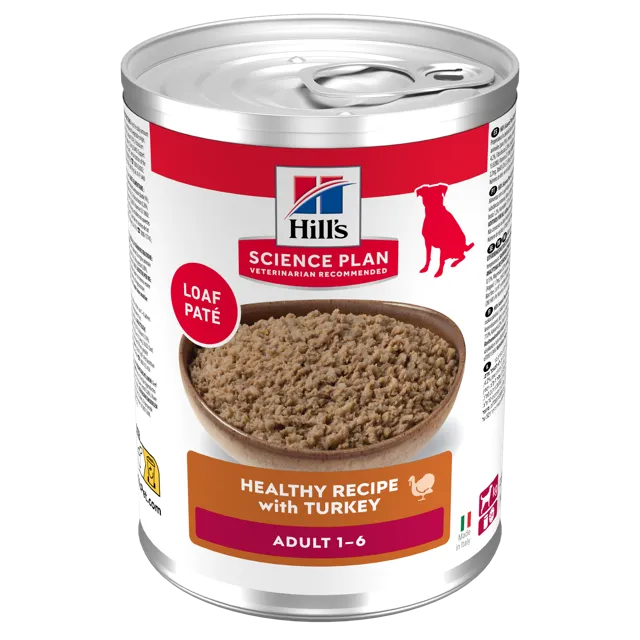
Hill's Science Plan Adult 1-6 – With Turkey

Hill's Science Plan

Hill's Science Plan Adult 1-6: With Turkey review

38.1/100Average
WetAdult

Three tins, three meats, one underlying recipe. Hill's Science Plan Adult 1-6 offers beef, chicken and turkey, each declared at 9% inside a broader animal entry, with the remainder of every list written as legal categories rather than ingredients. The analyses do move between the three, with the turkey the richest and the beef the leanest, and all three settle in our Average band on the strength of what the labels leave unsaid.

Where to buy: coming soon
Live retailer pricing is coming soon. Once we have prices from UK retailers, the best price, cost per day and where to buy will appear here.

Our view

Likely to suit

If your dog has a favourite meat, this line lets you follow it without changing anything else about dinner.

  • Small adult dogs, the size Hill's points these tins at
  • Fussy eaters, since moving between beef, chicken and turkey changes the flavour and leaves the rest of the meal alone
  • Dogs that want a leaner bowl, with the beef tin declaring fat at 3.0%
  • Dogs that need a little more from their food, since the turkey is the richest of the three at 4.2% fat and 96 kcal per 100g
  • Owners who would rather buy a long established name with its own veterinary research behind it than an itemised label

Worth watching

It pays to know what these labels hold back before you build a routine around them.

  • Each tin names its meat at 9% and leaves the remaining animal content undescribed, so none of the three can test for a food allergy
  • The cereals are not identified, and estimated carbohydrate runs from 51.7% to 56.1% of dry matter where the typical adult wet food sits at 15.8%
  • A dog you want to keep well muscled is worth a thought here, since protein is modest for a wet food at between 23.5% and 26.5% of dry matter
  • Oils and fats appear as a category, so the fat in these tins is not tied to any source you can check

Written by our editorial team. Independent guidance, not veterinary advice.

How this scores

How we score
38.1/100Average
Protein and processingGood
Nutritional balanceAverage
TransparencyGood
ValueAverage

The Details

Dog fit

If your dog has a favourite meat, this line lets you follow it without changing anything else about dinner. It pays to know what these labels hold back before you build a routine around them.

Food type

Wet

Life stage

Adult

Breed size

Small

Main protein

Turkey

The score, in context

An Average reading on three tins from a name as established as Hill's needs explaining. Protein and processing and transparency come back Good, with nutritional balance at Average. All three read the same page: five entries in the composition, and exactly one of them is an ingredient anybody could point to.

Adult wet food is a category that scores well on our system, its typical member landing in our Excellent band, and part of how those foods earn it is by printing what is inside them. These tins choose not to, and the estimated carbohydrate share is high for something fed from a tin, so the shortfall is real.

It is not a safety finding. These are made to a fixed nutritional specification by a company that runs its own feeding research, and dogs eat well on them year after year. Our scoring weighs the label, and this label offers five lines.

What's in it

Ingredients, as declared: Meat and animal derivatives (turkey 9%), cereals, minerals, oils and fats, derivatives of vegetable origin.

Named ingredients

Meat and animal derivatives (turkey 9%), cereals, minerals, oils and fats, derivatives of vegetable origin.

Nutritional additives

ADDITIVES PER KG: Nutritional additives: 3b103 (Iron) 10.0mg, 3b202 (Iodine) 0.3mg, 3b405 (Copper) 1.7mg, 3b502 (Manganese) 2.2mg, 3b603 (Zinc) 25.8mg.

Ingredient notes

Every tin reads the same way: meat and animal derivatives with the headline meat named in brackets, then cereals, minerals, oils and fats, and derivatives of vegetable origin. Four of those five are legal umbrella terms. Meat and animal derivatives can be any part of any warm blooded land animal, and cereals any grain. Oils and fats can be fat of any origin, while derivatives of vegetable origin takes in almost any plant material. The fixed point in each recipe is the 9% of beef, chicken or turkey printed on the front, which is also the only thing separating one tin from the next.

That style of labelling is ordinary in big brand wet food and is not a hygiene question. What it does mean is that the maker can adjust the recipe between batches without a word changing on the pack, and that you are buying on reputation rather than on a list. Hill's has more reputation to buy on than most, which is a fair part of why these tins sell as steadily as they do.

The analysis is where the three tins genuinely differ. The chicken tin converts to 26.5% protein of dry matter, the beef to 24.8% and the turkey to 23.5%, all moderate for wet food. Fat runs the other way, at 13.0%, 14.8% and 18.3% of dry matter respectively. Pick the turkey if your dog needs the extra, and the beef if it does not.

Estimated carbohydrate is the figure to look at. The beef tin works out at 56.1% of dry matter and the other two at 51.7%, where 15.8% is typical for adult wet food. Cereals are doing a share of the work here more usually seen in a dry recipe, which is worth knowing if you were choosing wet food specifically to keep starch down.

Calcium converts to between 0.7% and 0.87% of dry matter, a comfortable range for adult maintenance. Iron, iodine, copper, manganese and zinc each carry a printed dose. The figures barely move whichever meat you choose, a quiet sign the three tins share a single formulation.

Moisture is declared at 77.0% across the range. That is what a wet food is, and it is the reason a dog on these tins drinks less and eats more by weight than the same dog on a dry meal.

How this variety differs

Turkey named at 9%, and the richest tin here with fat at 4.2% as declared and 18.3% of dry matter, alongside the lowest protein at 23.5% of dry matter. Energy is highest of the three at 96 kcal per 100g. A dog gets through about 873 grams a day, against 926 on the beef. Turkey is lighter and leaner than chicken by nature, and it often suits a dog gone off poultry in its usual form.

Price and value

Sold in 370 g packs, in beef, chicken and turkey.

No checked per-kilo figure was available for the range when this was written, so no day rate is given below it. For portioning, a 15kg adult dog in moderate condition would work through roughly 873 to 926 grams a day depending on which tin is open. That takes about 840 kcal a day as the maintenance estimate (110 × bodyweight^0.75). Wet food carries its calories in a great deal of water, so daily amounts always look large beside a dry measure.

Nutritional analysis

Declared analysis

Energy
96.2 kcal/100g
Protein

5.4%

Fat

4.2%

Fibre

0.3%

Ash

1.2%

Moisture

77%

Dry weight

Protein

23.5%

Fat

18.3%

Fibre

1.3%

Ash

5.2%

Carbs

51.7%

As-fed composition

Estimated breakdown of the finished product by ingredient category, from the declared ingredient list and ingoing weights. These are estimates, not measurements.

Meat

43.6%

Added water

12%

Carbs

31.8%

Oils

4.7%

Other

7.9%

Pricing & size
Pack size
370 g
Retailer pricing
Coming soon

Live retailer pricing is not yet available for this food. Prices, cost per day and where to buy will appear here once retailer data is live.

Ingredients and nutrition are taken from manufacturer data. Retailer pricing is not yet live for this food.

Related dog food guides

Ranked shortlists that include foods like this one.
All reviews

Featured feeding accessories

All feeding accessories

Brackenwood

Slow Feeder Maze Bowl

Slows fast eaters and eases gulping at mealtimes.

From £12.99· 4 retailers
View

Tarn & Co

Raised Double Diner

Height-set stand for easier, tidier eating.

From £28.99· 3 retailers
View

Reviewed by Off the Leash Editorial

Last updated 28 August 2026