


Heights Farm
Heights Farm Adult Extra Joint Care Grain Free: Duck Vegetable & Potato review
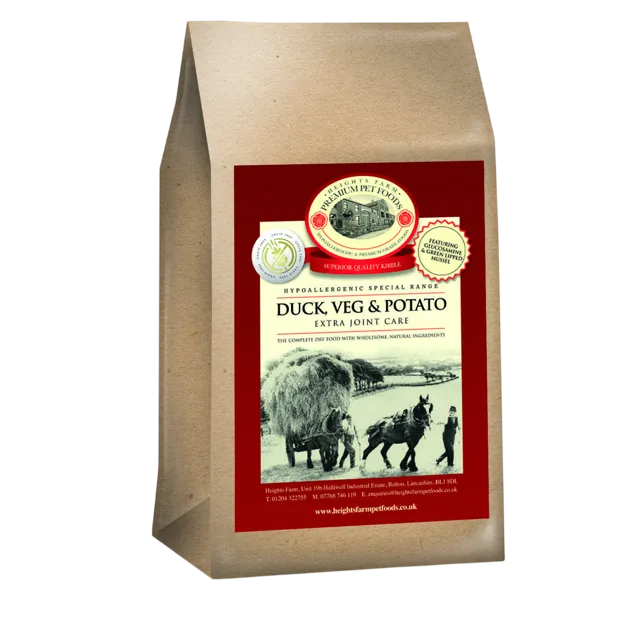
Heights Farm Adult Extra Joint Care Grain Free takes the same joint-minded thinking and drops the cereal, opening each recipe with a named meat meal and putting peas, potatoes and sweet potatoes behind it. Both labels declare a total for their headline animal, a minimum of 35% duck in one and 38% turkey in the other. Both also carry glucosamine, green lipped mussel and a long fruit and vegetable tail. Both reach our Good band, with the duck a shade ahead of the turkey.
Our view
Likely to suit
If cereal does not agree with your dog and the joints need a hand as well, this pairing was put together for you.
- Dogs kept off grain, with peas, potatoes and sweet potatoes carrying the starch instead
- Older dogs whose joints need support, since glucosamine and green lipped mussel appear on both lists
- Hungry, hard-working dogs, with the duck recipe declaring 26% protein and 17% fat
- Owners who want a total for the headline meat printed on the pack, at a minimum of 35% and 38%
Worth watching
A few details on these labels will matter to you if you are feeding around a sensitivity.
- Chicken fat and salmon oil run through both, so neither bag keeps poultry or fish out of the bowl
- The duck is the richer of the pair, so a steady, sofa-loving dog will want the portion kept in check
Written by our editorial team. Independent guidance, not veterinary advice.
How this scores
How we scoreThe Details
Dog fit
If cereal does not agree with your dog and the joints need a hand as well, this pairing was put together for you. A few details on these labels will matter to you if you are feeding around a sensitivity.
Dry
Adult, Senior
Toy, Small, Medium, Large, Giant
Duck
The score, in context
Both recipes reach our Good band, the duck a little ahead of the turkey, and that is where the typical adult dry food is found too. Both are helped by a named meat meal first on the list. The carbohydrate load also sits under the category norm, at 39.4% of dry matter in the duck and 44.4% in the turkey against 46.2% typical. The two finish close enough that the animal is the thing to choose on. The missing figures on the duck's additive table are the kind of small gap that shows up when a label is read closely.
What's in it
Ingredients, as declared: Duck meal, peas, potatoes, chicken fat, freshly prepared duck (min 35% total duck), un-molassed beet pulp, sweet potatoes, mono calcium phosphate, Lucerne, full fat linseed, salmon oil (source of omega 3 fatty acids), dried apple (0.4%), fructose and mannan oligosaccharides, glucosamine, seaweed, orange bioflavonoids (0.1%), milk thistle, dried carrots, green lipped mussel, yucca shidigera, blackcurrant, rosehip, pomegranate, kale, beetroot (min 44% total vegetables).
Named ingredients
Nutritional additives
Natural antioxidants. Nutritional Additives — Vitamin A 20,000iu/kg, Vitamin D 1,900iu/kg, Vitamin E 375mg/kg, L-carnitine 250mg/kg, Iron (iron sulphate monohydrate0 26mg/kg, Iodine (calcium iodate anhydrous) 1.5mg/kg, Copper (cupric sulphate pentahydrate) 9mg/kg, Manganese (manganous oxide) Zinc (zinc sulphate monohydrate) Zinc (zinc chelate of amino acids hydrate) 33mg/kg, Selenium (sodium selenite) 0.12mg/kg _(reproduced verbatim — the manganese and first zinc figures are missing on the page)_
Ingredient notes
Both recipes lead with a meal, duck meal in one and turkey meal in the other, then bring freshly prepared meat of the same species further down and print a total for the two together. The meal is the dependable half of that arrangement. It goes into the mixer dry, where the freshly prepared share is mostly water and shrinks in the oven. The declared totals of 35% and 38% therefore read a little higher than the finished kibble delivers. The analysis bears that out at 28.9% and 27.8% protein on a dry matter basis, still a good level for a dry food.
Peas and potatoes take over from cereal, with sweet potatoes behind them and unmolassed beet pulp for fibre. Potato is plain starch, and a dog who needs energy released more slowly will get that from the sweet potato. Sweet potato is the more nutritious of the two, bringing vitamin A and extra fibre. Lucerne is the other name for alfalfa, and it adds more fibre plus a bit of plant protein. Both packs also carry a minimum of 44% total vegetables. That figure covers the whole plant side of the recipe with the peas and potatoes counted in.
The joint work is done by glucosamine and green lipped mussel, the latter a shellfish carrying its own marine omega 3s and used specifically for ageing joints. Around them sit milk thistle, yucca, seaweed, dried carrots, kale, beetroot, blackcurrant, rosehip and pomegranate, plus fructose and mannan oligosaccharides as prebiotics that feed the useful gut bacteria. These entries sit low on the list and the recipes do not depend on them, but they are a more thoughtful tail than most.
Fat comes from chicken fat with salmon oil and full fat linseed for omega 3, one marine and one plant so the recipe covers both. The duck recipe adds mono calcium phosphate as its calcium and phosphorus source, a mineral supplement rather than a dairy ingredient despite how the name reads.
The turkey's additive table is dosed all the way through: zinc at 128 mg as the sulphate with a further 33 mg as an amino acid chelate. Manganese is at 53 mg, iron at 26 mg, copper at 9 mg, iodine at 1.5 mg and selenium at 0.12 mg per kilo. Vitamin E is at 375 mg and L-carnitine at 250 mg. The duck panel is built the same way and carries the same L-carnitine and vitamin E doses, but its manganese figure and one of its zinc figures are missing from the printed table.
How this variety differs
Duck meal leads, freshly prepared duck follows further down and the label declares a minimum of 35% duck between them. Protein at 26% and fat at 17% make this the richer of the two, and its carbohydrate estimate of 39.4% of dry matter is the lowest in the range. Dried apple at 0.4% and orange bioflavonoids at 0.1% are its own touches, and seniors are named on its label alongside adults.
Price and value
£4.07 a kilo for the duck and £4.00 for the turkey, both sold in 2kg and 15kg bags.
Reckon on roughly 840 kcal a day for a 15kg adult dog in moderate condition (110 × bodyweight^0.75, the standard maintenance estimate). That is about 225 grams of the duck or 218 grams of the turkey, at £0.92 and £0.87 a day. On the duck the label asks 160 to 310 grams for a dog between 25kg and 45kg, and on the turkey 160 to 315 grams. Weigh the first few bowls, then let the shape of your own dog decide.
Nutritional analysis
Declared analysis
26%
17%
3.5%
8%
10%
Dry weight
28.9%
18.9%
3.9%
8.9%
39.4%
As-fed composition
Estimated breakdown of the finished product by ingredient category, from the declared ingredient list and ingoing weights. These are estimates, not measurements.
44.3%
47.4%
0.5%
5.8%
2%
Pricing & size
- Pack size
- 2 kg (£16.50) · 15 kg (£61.00) - the page states "Available in 2kg and 15kg sizes"
- Retailer pricing
- Coming soon
Live retailer pricing is not yet available for this food. Prices, cost per day and where to buy will appear here once retailer data is live.
Ingredients and nutrition are taken from manufacturer data. Retailer pricing is not yet live for this food.
Related dog food guides
Ranked shortlists that include foods like this one.