



Gain
GAIN Supreme review
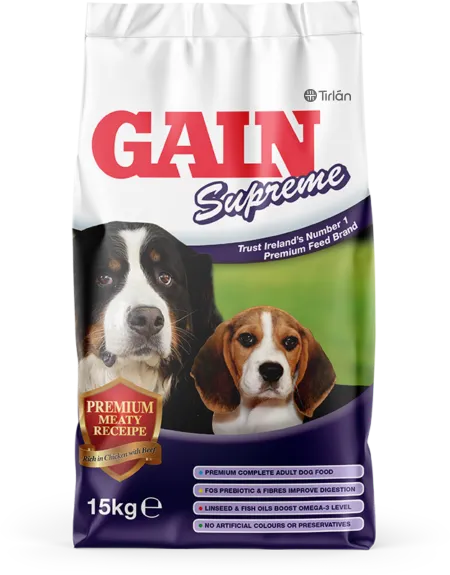
GAIN Supreme is a cereal based adult kibble that names chicken and beef inside an otherwise broadly written label, then leans on fibre to finish the job. Chicken is declared at a minimum of 14% with beef at a minimum of 4%, sugar beet pulp and chicory fructo-oligosaccharides look after the digestive side, and linseed carries the omega 3. It sits in our Poor band, which is far more a story about what the label declines to pin down than about how a settled adult dog does on it.
Our view
Likely to suit
If your dog is a steady, unfussy eater who has never given you a moment's trouble at either end, this is an easy kibble to keep in the cupboard.
- Owners of settled adult dogs that already get on with chicken and beef
- Multi-dog homes at both ends of the size range, because the feeding table covers a 4kg lapdog and a 60kg giant alike
- Dogs whose digestion likes fibre in the bowl, with sugar beet pulp and chicory fructo-oligosaccharides both on the list
- Owners who would rather the omega 3 came in the recipe than out of a bottle, in this case from linseed
Worth watching
This label is written loosely in places, and it is worth knowing where before you open the first bag.
- Cereals open the recipe and no grain is named, so an owner steering a dog away from wheat or maize has nothing to work from
- The meat reads as meat and animal derivatives with chicken and beef named inside it, which leaves room for other species sitting alongside them unnamed
- This is not a fish free bowl, because fish and fish derivatives sit towards the end of the list
- Weigh the carbohydrate if a meatier plate suits your dog better: it reaches 53.8% of dry matter against the 46.2% typical of an adult dry food
Written by our editorial team. Independent guidance, not veterinary advice.
How this scores
How we scoreThe Details
Dog fit
If your dog is a steady, unfussy eater who has never given you a moment's trouble at either end, this is an easy kibble to keep in the cupboard. This label is written loosely in places, and it is worth knowing where before you open the first bag.
Dry
Adult
Toy, Small, Medium, Large, Giant
Chicken
The score, in context
Our bands put this one in Poor, two steps under the Good band that holds the middle of the adult dry shelf. Three things on the label do it: the first ingredient is a whole category instead of a named grain, and most of the meat is described by family and not by species. The carbohydrate share also finishes above the dry food norm. Nutritional balance reads Average, with protein and processing and transparency both reading Poor, and that is the label's doing rather than the bowl's. Fed to an adult dog with a reliable stomach, it does the plain everyday job it was built for.
What's in it
Ingredients, as declared: Cereals, Meat & animal derivatives (min 14% Chicken (min 4% beef), Oils & fats, Derivatives of vegetable origin (min 4%), Sugar beet pulp, (min 15% Chicory FOS), Minerals, Seeds (Linseed), Fish & fish derivatives, Products from the processing of plants
Named ingredients
Ingredient notes
Cereals lead the list, and which grains they are is never stated. The term stretches from good rice and oats all the way down to the plainest grain fractions. Because it is a category and not a name, the grain behind it can change from one production run to the next. Derivatives of vegetable origin at a minimum of 4% and products from the processing of plants are written the same way. That is the single biggest thing this label chooses not to tell you.
The meat line reads as meat and animal derivatives with a minimum of 14% chicken and a minimum of 4% beef named within it. Naming two species is more than plenty of labels of this type manage, and both are digestible, well liked meats. The wording also allows other animal material to sit in the same line unnamed, so the 14% and the 4% are the parts you can count on.
Protein converts to 23.9% of dry matter and fat to 12.0%, with carbohydrate estimated at 53.8% of dry matter where the typical adult dry food runs at 46.2%. Those dry matter figures take moisture at 8%, the usual level for a kibble, because the label does not declare a moisture content of its own.
The fibre thinking is the nicest part of the recipe. Sugar beet pulp carries both soluble and insoluble fibre. Chicory fructo-oligosaccharides sit behind it as a prebiotic. That is the sort of ingredient the good bacteria in the large intestine feed on. The omega 3 here comes from linseed, in the plant form. A dog works more slowly on that than on the marine kind, so allow a coat some time to show it.
The mineral line is a single word with no dosed panel behind it, which leaves zinc, copper and the rest unquantified. Calcium works out at 1.63% of dry matter, comfortable for a grown dog and towards the upper end of what you would want during growth, which only matters if a puppy ever shares the bowl.
Price and value
Sold in a 15kg bag.
As a guide, an adult dog of 15kg in moderate condition eats around 244 grams a day, working from about 840 kcal a day (110 × bodyweight^0.75, the standard maintenance estimate). The label's own table asks 228 grams for a 13kg dog and 305 grams for one of 20kg. That lands close to the estimate above, and where the two differ the waistline decides.
Nutritional analysis
Declared analysis
Estimated using Modified Atwater factors*
22%
11%
2.5%
7%
Dry weight
23.9%
12%
2.7%
7.6%
53.8%
As-fed composition
Estimated breakdown of the finished product by ingredient category, from the declared ingredient list and ingoing weights. These are estimates, not measurements.
96%
4%
Pricing & size
- Pack size
- 15kg
- Retailer pricing
- Coming soon
Live retailer pricing is not yet available for this food. Prices, cost per day and where to buy will appear here once retailer data is live.
Ingredients and nutrition are taken from manufacturer data. Retailer pricing is not yet live for this food.
Related dog food guides
Ranked shortlists that include foods like this one.