



Gain
GAIN Museli review
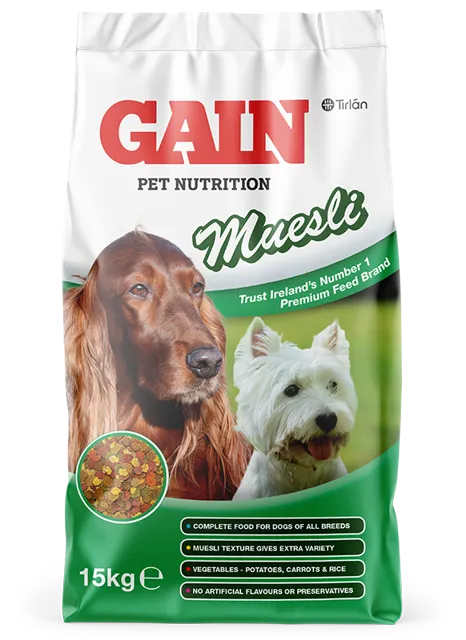
GAIN Museli is a mixed-piece adult food, the sort where an orange piece sits among the browns. The label puts figures against that piece: a minimum of 4% rice in it, and a minimum of 4% potatoes and carrots. Two animals are named as well, chicken and beef, with a 4% minimum printed, which is more than a list of headings alone would give you. The rest stays general, and protein comes in at 22.8% of dry matter with fat at 10.9%. It sits in our Poor band, mostly because so much of the recipe is left unnamed.
Our view
Likely to suit
If your dog takes more interest in a bowl with something to look at, this one is put together for exactly that.
- Adult dogs of any size, since the same bag is fed from toy through to giant
- Owners who want at least part of the recipe named, with chicken, beef, rice, potatoes and carrots all called out on the pack
- Fussier eaters who pick at a uniform bowl and take more notice of a mixed one
- Dogs in steady everyday work, with fat declared at 10.0% and energy at 335 kcal per 100g
Worth watching
There are things this label leaves general, and they are worth knowing before the first bag.
- Both chicken and beef are in the bowl, so check the list if one of those two is out for your dog
- Vegetable protein extracts raises the protein percentage, and the plant behind it is never identified
- Meat and animal derivatives sits above the named chicken, so most of the animal content is not pinned to a species
- Carbohydrate is estimated at 54.8% of dry matter against the 46.2% typical of an adult dry food
Written by our editorial team. Independent guidance, not veterinary advice.
How this scores
How we scoreThe Details
Dog fit
If your dog takes more interest in a bowl with something to look at, this one is put together for exactly that. There are things this label leaves general, and they are worth knowing before the first bag.
Dry
Adult
Toy, Small, Medium, Large, Giant
Chicken
The score, in context
Our reading puts this in our Poor band, well below the Good band where the typical adult dry food finishes, and the named pieces are not quite enough to move it. The weight of the general terms is what counts against it. Cereals, meat and animal derivatives, vegetable protein extracts and derivatives of vegetable origin between them describe most of the bag, and none of the four can be graded by anybody reading the pack. The 4% minimums that are printed are small shares of the whole, welcome as they are. No band can measure your own dog, and one eating well on this and holding condition is telling you something the label cannot.
What's in it
Ingredients, as declared: Cereals (min 4% rice in the orange piece), Meat & animal derivatives, Chicken (min 4% beef), Vegetable protein extracts, Oils & fats, Derivatives of vegetable origin, Vegetables (min 4% potatoes and carrots in the orange piece), Minerals, Products from the processing of plants
Named ingredients
Ingredient notes
The orange piece is the point of the product and the label backs it with figures, a minimum of 4% rice inside it and a minimum of 4% potatoes and carrots. Carrots are a genuinely good thing to find in a dog food, bringing vitamin A, soluble fibre and natural antioxidants, and cooked they are easy for a dog to digest. Potato is starch first and foremost, doing structural work more than nutritional.
Chicken and beef both appear by name with a 4% minimum attached, which is a real disclosure in a recipe of this type. Both are digestible, palatable meats that most dogs do well on. The catch is the heading immediately above them, meat and animal derivatives. That heading covers the fleshy parts of slaughtered warm-blooded land animals and the products of processing the carcass, and it is tied to no species at all.
Vegetable protein extracts is the entry to read twice. It is plant protein of an unnamed kind, used to bring the protein percentage up, and a dog does less with plant protein than with the protein it takes from meat. Because the plant is never given, it also leaves soya, maize and wheat all in play, which matters if any of those is a question for your dog.
Protein 21.0%, fat 10.0%, fibre 3.0% and ash 7.5% are the declared figures. Taking the usual 8% moisture for a kibble to convert it, that is protein at 22.8% of dry matter and carbohydrate at an estimated 54.8%, against 46.2% typical for an adult dry food. The plant side is doing the heavy lifting in this bowl.
Cereals and derivatives of vegetable origin close the picture out, both of them broad enough to move with supply from one batch to the next. Read for what it is, this is an everyday feed with a mixed texture, a couple of named meats and a handful of printed minimums. It is honest about the pieces it chooses to describe.
Price and value
Sold in 3kg and 15kg bags.
A 15kg adult dog in moderate condition would take about 251 grams a day on this recipe, working from around 840 kcal a day (110 × bodyweight^0.75, the standard maintenance estimate). The feeding table on the pack puts a 7kg dog at 150 grams and a 50kg dog at 625 grams, and your dog's shape should settle anything in between.
Nutritional analysis
Declared analysis
Estimated using Modified Atwater factors*
21%
10%
3%
7.5%
Dry weight
22.8%
10.9%
3.3%
8.2%
54.8%
As-fed composition
Estimated breakdown of the finished product by ingredient category, from the declared ingredient list and ingoing weights. These are estimates, not measurements.
40.7%
52.7%
1.7%
3.4%
1.5%
Pricing & size
- Pack size
- 3kg & 15kg
- Retailer pricing
- Coming soon
Live retailer pricing is not yet available for this food. Prices, cost per day and where to buy will appear here once retailer data is live.
Ingredients and nutrition are taken from manufacturer data. Retailer pricing is not yet live for this food.
Related dog food guides
Ranked shortlists that include foods like this one.