
Skip to content
Off the Leash
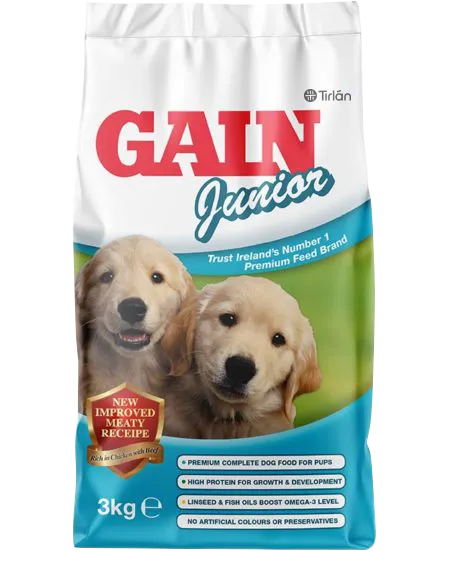
GAIN Junior – —

Gain

GAIN Junior review

28.6/100Poor
DryPuppy

GAIN Junior is one kibble meant to carry a dog through the whole growing stage, and it describes itself in broad terms. Cereals lead, meat and animal derivatives are declared at a minimum of 20%, and chicken, beef, fish and linseed all get a mention without much detail attached. Protein is declared at 28.0% and fat at 16.0%, chicory FOS is in there for the gut, calcium converts to 1.63% of dry matter, and the food lands in our Poor band.

Where to buy: coming soon
Live retailer pricing is coming soon. Once we have prices from UK retailers, the best price, cost per day and where to buy will appear here.

Our view

Likely to suit

If you are after one straightforward bag to see a pup through the growing months, this is built to be exactly that.

  • Small and medium breed puppies, with calcium converting to 1.63% of dry matter, inside the range growth needs
  • Owners who would rather keep one bag on the go through the whole junior stage than change foods partway
  • Pups that do well on a cereal-based kibble, with chicory FOS included as a prebiotic for the gut
  • Steady growers, at an estimated 367 kcal per 100g against the 376 typical of a puppy kibble
  • Owners who prefer a moderate fat level in the bowl, declared here at 16.0%

Worth watching

This label leaves a fair amount unsaid, and you will want to know what before you choose it.

  • Cereals, vegetable protein extracts and derivatives of vegetable origin are all broad headings, so the exact plant ingredients behind them can move between batches
  • The animal content is given as meat and animal derivatives with chicken, beef and fish named around it, so a pup on a strict exclusion trial cannot be run on this bag
  • Moisture is not printed, so the dry matter column works from the standard assumption for a dried food
  • Rearing plans for large and giant breeds usually work to a lower calcium level than this, so a big-growing pup wants it checked against your vet's growth plan
  • No separate additive panel is published, so the vitamin and trace element doses are not there to read

Written by our editorial team. Independent guidance, not veterinary advice.

How this scores

How we score
28.6/100Poor
Protein and processingPoor
Nutritional balanceGood
TransparencyPoor
ValuePoor

The Details

Dog fit

If you are after one straightforward bag to see a pup through the growing months, this is built to be exactly that. This label leaves a fair amount unsaid, and you will want to know what before you choose it.

Food type

Dry

Life stage

Puppy

Breed size

Toy, Small, Medium, Large, Giant

The score, in context

GAIN Junior sits in our Poor band, some way below the middle of the puppy kibble field, which falls in our Good band. The reason is not hard to find. Protein and processing and transparency both read Poor, and each of them traces back to the same habit: a composition written in category names rather than named ingredients.

Where the label does commit to a figure it reads sensibly enough for a growing dog. Protein at 28.0% is respectable, the calcium conversion lands inside the growth range, and the energy figure is close to the middle of the class. The description around those numbers is what keeps the food where it is.

What's in it

Ingredients, as declared: Cereals, Meat & animal derivatives (min 20%), Chicken (min 4% beef), Vegetable protein extracts, Oils & fats, Derivatives of vegetable origin (min 4%), Sugar beet pulp, (min 20% Chicory FOS), Minerals, Seeds (Linseed), Fish & fish derivatives, Products from the processing of plants

Named ingredients

Cereals, Meat & animal derivatives (min 20%), Chicken (min 4% beef), Vegetable protein extracts, Oils & fats, Derivatives of vegetable origin (min 4%), Sugar beet pulp, (min 20% Chicory FOS), Minerals, Seeds (Linseed), Fish & fish derivatives, Products from the processing of plants
Ingredient notes

Cereals head the list, and that one word covers everything from the best grains to the poorest. The wording is no proof of a poor ingredient in itself, and decent foods use broad terms to protect a recipe. It does mean the grain can move from one batch to the next with nothing on the bag to tell you.

The animal content follows as meat and animal derivatives at a declared minimum of 20%, with chicken named and beef mentioned alongside it, and fish and fish derivatives appear further down. Those entries cover the meat in the bag between them, given by category and with no species share attached. For most pups that simply means knowing less than you might like. For a pup with a suspected intolerance it matters a great deal more, because you cannot isolate what has never been named.

In the middle of the list come vegetable protein extracts and derivatives of vegetable origin. Meat gives a growing dog an amino acid profile that plant proteins do not match, so their presence shapes how much of that declared 28.0% is doing full-value work. Sugar beet pulp is an easily tolerated fibre, with linseed adding plant omega 3 beside it.

The brightest entry on the list is the chicory FOS. Fructo-oligosaccharide is a prebiotic. It feeds the helpful bacteria a dog already carries in its large intestine, and chicory root is where it usually comes from. In a food aimed at young digestions that is a genuinely useful thing to find.

Protein at 28.0%, fat at 16.0%, fibre at 2.5% and ash at 7.5% are declared as fed. Moisture is not, so the dry matter figures shown work from the 8% standard assumed for a dried food. On that basis protein reads 30.4%, fat 17.4% and carbohydrate an estimated 41.3% of dry matter, close to the 39.0% typical of the class.

On the same basis calcium converts to 1.63% of dry matter. That is inside the range a growing dog needs, and well matched to a small or medium breed pup. It runs above where large and giant breed feeding plans usually settle. If your pup is going to be a big one, put it to your vet. Energy is our own estimate, at 367 kcal per 100g, since the label declares none.

Price and value

Sold in 3kg bags.

How much of that bag a pup gets through changes every few weeks, because a growing dog eats towards the size they are becoming rather than the size they are. Start from the guide on the pack, weigh the portion out properly, and step it up or back as your pup's shape asks.

Nutritional analysis

Declared analysis

Energy
367 kcal/100g

Estimated using Modified Atwater factors*

Protein

28%

Fat

16%

Fibre

2.5%

Ash

7.5%

Dry weight

Protein

30.4%

Fat

17.4%

Fibre

2.7%

Ash

8.2%

Carbs

41.3%

As-fed composition

Estimated breakdown of the finished product by ingredient category, from the declared ingredient list and ingoing weights. These are estimates, not measurements.

Meat

40.3%

Carbs

51.7%

Oils

4.1%

Other

3.9%

Pricing & size
Pack size
3kg
Retailer pricing
Coming soon

Live retailer pricing is not yet available for this food. Prices, cost per day and where to buy will appear here once retailer data is live.

Ingredients and nutrition are taken from manufacturer data. Retailer pricing is not yet live for this food.

Related dog food guides

Ranked shortlists that include foods like this one.
All reviews

Featured feeding accessories

All feeding accessories

Brackenwood

Slow Feeder Maze Bowl

Slows fast eaters and eases gulping at mealtimes.

From £12.99· 4 retailers
View

Tarn & Co

Raised Double Diner

Height-set stand for easier, tidier eating.

From £28.99· 3 retailers
View

Reviewed by Off the Leash Editorial

Last updated 28 August 2026