



Gain
GAIN Crunchy review
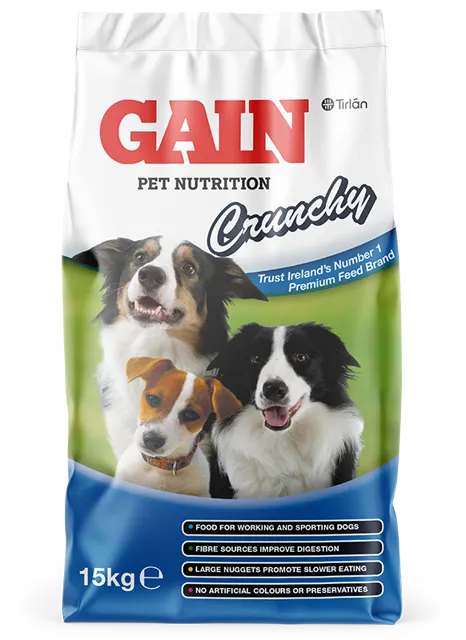
GAIN Crunchy is a plain adult kibble that keeps its whole recipe inside the legal category headings: cereals, meat and animal derivatives, derivatives of vegetable origin, oils and fats, and a line for plant processing. No species is named, no percentage sits against a single item, and one bag is written for adults from toy through to giant. Protein lands at 21.7% of dry matter with fat at 9.8%, gentle figures for a dog with a settled routine. It sits in our Poor band, and that reading comes from what the list keeps back rather than from anything the analysis shows.
Our view
Likely to suit
If your dog has eaten a simple everyday kibble happily for years, this is squarely that sort of food.
- Multi-dog homes, since the one recipe is written for adult dogs from toy right through to giant
- Steady adult dogs in a quiet routine, with fat declared at 9.0% and energy at 328 kcal per 100g against the 357 typical of an adult dry food
- Dogs that need to keep an eye on the waistline, where a leaner kibble and a measured scoop matter more than any single ingredient
- Owners whose dog has never reacted to a food, since there is nothing on this list they would need ruled in or out
Worth watching
A label this brief leaves a few things for you to know up front.
- Neither an animal nor a grain is named anywhere, so there is nothing here to anchor a test diet on if you suspect a food trigger
- The plant side carries a good deal of this bowl, with carbohydrate estimated at 56.5% of dry matter against the 46.2% typical of an adult dry food
- Protein converts to 21.7% of dry matter, which is gentle for a dog in hard work or one building muscle
- A category heading gives the recipe room to shift between batches, which a dog with a delicate stomach can sometimes notice
Written by our editorial team. Independent guidance, not veterinary advice.
How this scores
How we scoreThe Details
Dog fit
If your dog has eaten a simple everyday kibble happily for years, this is squarely that sort of food. A label this brief leaves a few things for you to know up front.
Dry
Adult
Toy, Small, Medium, Large, Giant
The score, in context
Our bands put this one in Poor territory, two bands under the Good band where the typical adult dry food settles. The packet itself explains why. Nothing is named, so there is no meat and no grain to credit, protein finishes modest once the moisture comes out, and carbohydrate runs above what a dry food usually carries. What a band cannot tell you is how a particular dog gets on, and a great many dogs do perfectly well on plain food built like this.
What's in it
Ingredients, as declared: Cereals, Meat & animal derivatives, Derivatives of vegetable origin, Oils & fats, Products from the processing of plants.
Named ingredients
Ingredient notes
Cereals is the widest heading the labelling rules allow on the grain side. It stretches across wheat, maize, barley, rice and oats in any combination. The grain in this bag might be a good one or a plain one, and it might be a different one next season. The wording itself gives no way to tell.
Meat and animal derivatives is the matching term on the animal side. In law it takes in the fleshy parts of slaughtered warm-blooded land animals, along with whatever comes off the carcass in processing. It can be honest muscle and organ, or something a good deal plainer. One thing it does settle is that the meat here comes from land animals, since fish falls outside the definition. Oils and fats is left open on its source, so that entry stays a question mark.
The declared analysis is consistent with a cereal-led everyday food: protein 20.0%, fat 9.0%, fibre 3.0% and ash 8.0%. Moisture is not printed, so those conversions assume the usual 8% for a kibble. Protein comes out at 21.7% of dry matter, fat at 9.8% and carbohydrate at an estimated 56.5%, against the 46.2% an adult dry food typically runs.
Ash at 8.7% of dry matter says a reasonable mineral load is in there, though no vitamin or trace mineral dosing is printed alongside the list, so there is nothing on that side to read. Energy comes in at 328 kcal per 100g, a little under the 357 typical of a dry food, which is part of why the portions on the bag look generous.
Taken for what it is, this is a workaday feed with a big following and a very short story. The label asks you to trust the maker rather than to read the recipe, and the whole category it sits in works the same way.
Price and value
Sold in 9kg, 15kg and 18kg bags.
For a 15kg adult dog in moderate condition, expect roughly 256 grams a day, based on about 840 kcal daily (110 × bodyweight^0.75, the standard maintenance estimate). The bag's own table asks 315 grams for a 20kg dog and 430 grams for a 30kg dog. Where the two differ, go by your dog's waistline.
Nutritional analysis
Declared analysis
Estimated using Modified Atwater factors*
20%
9%
3%
8%
Dry weight
21.7%
9.8%
3.3%
8.7%
56.5%
As-fed composition
Estimated breakdown of the finished product by ingredient category, from the declared ingredient list and ingoing weights. These are estimates, not measurements.
28.3%
61.9%
6%
3.9%
Pricing & size
- Pack size
- 9kg, 15kg & 18kg
- Retailer pricing
- Coming soon
Live retailer pricing is not yet available for this food. Prices, cost per day and where to buy will appear here once retailer data is live.
Ingredients and nutrition are taken from manufacturer data. Retailer pricing is not yet live for this food.
Related dog food guides
Ranked shortlists that include foods like this one.