



Earls
Earls Complete review
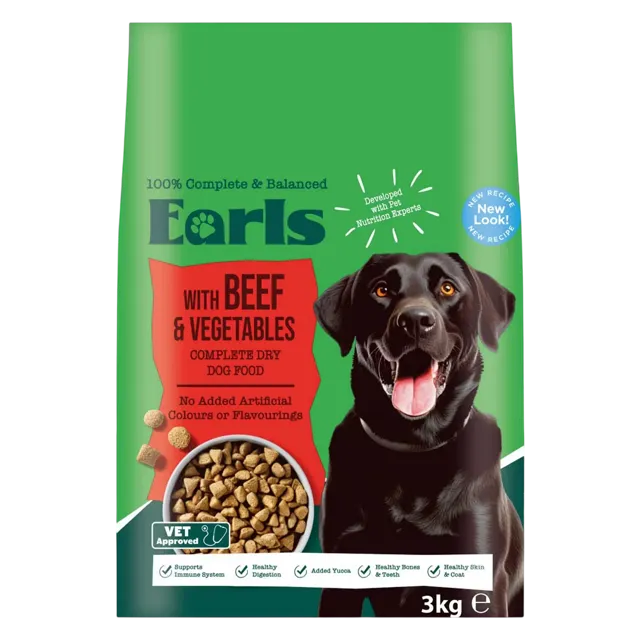
Earls Complete is a maize based everyday food for adult dogs, listing cereals at 40% wholegrain maize and meat and animal derivatives at 24%, of which 4% is named as beef. Oils and fats, various sugars and derivatives of vegetable origin follow, and the vitamin and mineral panel is printed in full with a figure against every entry. It sits in our Poor band, which follows from how much of the label is written in category terms instead of named ingredients. It is what it says on the front, a plain complete food for grown dogs.
Our view
Likely to suit
Some owners want a straightforward bag with no story attached, and this is squarely that.
- Adult dogs with settled, unfussy digestion that have never needed a specialist list
- Owners who like the vitamin and mineral dosing printed out, with eight entries declared down to selenium
- Any size of dog in the house, since the feeding label starts at toy and finishes at giant
- Dogs that need tempting to the bowl, since sugars and hydrolysed yeast are there to make it taste inviting
- Anyone who wants a small 3kg bag rather than a sack to lift
Worth watching
Most of this label is written in categories, and that carries consequences worth understanding.
- Only 4% beef is named inside the 24% meat and animal derivatives, so the animal content is mostly unidentified and the food cannot support an exclusion trial
- Various sugars are declared as an ingredient, which is unusual on a dry food and worth knowing if you keep sugar out of your dog's diet
- Oils and fats and derivatives of vegetable origin are both umbrella terms, so those sources are not pinned down for the reader
- Ash converts to 10.3% of dry matter, on the high side for a dry food, which reflects how much mineral matter the recipe carries
- Moisture is not declared, so the dry matter figures rest on an assumed 8%
Written by our editorial team. Independent guidance, not veterinary advice.
How this scores
How we scoreThe Details
Dog fit
Some owners want a straightforward bag with no story attached, and this is squarely that. Most of this label is written in categories, and that carries consequences worth understanding.
Dry
Adult
Toy, Small, Medium, Large, Giant
Beef
The score, in context
Earls Complete reads in our Poor band, with the typical adult dry food two bands clear of it in our Good band. What the recipe is built from drives almost all of that reading. Cereals, meat and animal derivatives, oils and fats and derivatives of vegetable origin are all category headings. A heading of that kind can cover anything from the very good to the very ordinary, and the reader never knows which. Add declared sugars and a carbohydrate estimate of 56.0% of dry matter against the 46.2% typical, and nutritional balance reads Poor alongside protein and processing, with transparency the one pillar reading Excellent. Protein at 23.9% of dry matter is respectable and the mineral panel is dosed in full, so there is substance behind the category terms. The label simply does not let you see it.
What's in it
Ingredients, as declared: Cereals (40% Wholegrain Maize), Meat and Animal Derivatives 24% (Including 4% Beef), Oils and Fats, Various Sugars, Minerals, Derivatives of Vegetable Origin, Vegetables (1.25% Dried Peas), Seeds (Linseeds 0.06%), Hydrolysed Yeast and Chicory Extracts (0.003%)
Named ingredients
Nutritional additives
Vitamin a 14475 IU, Vitamin D3 1689 IU, Zinc (Zinc Oxide) 77mg, Iron (Iron (II) Sulphate Monohydrate) 31mg, Manganese (Manganese (II) Oxide) 29mg, Copper (Copper (II) Sulphate Pentahydrate) 3.68mg, Iodine (Calcium Iodate Anhydrous) 0.94mg, Selenium (Sodium Selenite) 0.08mg.
Ingredient notes
Cereals at 40% wholegrain maize is the opening entry, and it is half specific. Most labels do not go that far, and here the maize is named with a figure against it. The word cereals still means other grains can sit alongside it without being listed. Maize is a dense energy source and is well digested once cooked, and wholegrain is the better form of it.
Meat and animal derivatives at 24% is the entry that decides how you read the food. The legal definition covers the fleshy parts and processing derivatives of warm blooded land animals, which spans everything from good material to the very ordinary, and only 4% of it is pinned to beef. There is nothing here that says the meat is poor and equally nothing that says it is not, which is exactly the difficulty with the term.
Various sugars deserves its own line. Sugar goes into dog food for the same reason it goes into ours, because it makes the bowl more appealing, and it is not an ingredient most nutritionists want to see on a daily list. That matters most if your dog is carrying a little extra weight.
The small entries are more specific than the large ones. Dried peas at 1.25% bring a little fibre and plant nutrition, and linseeds at 0.06% are a token amount of plant omega 3. Hydrolysed yeast with chicory extracts at 0.003% is the prebiotic gesture here. Chicory carries inulin, and gut bacteria live on it. At those percentages none of them changes the food much, but the intention behind them is the right one.
The vitamin and mineral declaration is the strongest part of the label. Vitamin A at 14475 IU and vitamin D3 at 1689 IU open it. Then come zinc at 77mg, iron at 31mg, manganese at 29mg, copper at 3.68mg, iodine at 0.94mg and selenium at 0.08mg, every one of them dosed in print. Sodium selenite is the selenium here. Two forms are allowed in pet food. This is the commoner and the less readily absorbed, and it is what the whole category tends to use.
The analysis reads better than the ingredients list. Protein converts to 23.9% of dry matter and fat to 7.6%, with carbohydrate estimated at 56.0% of dry matter against the 46.2% typical for adult dry food, and energy declared at 332 kcal per 100g. Because moisture is absent from the label, those dry matter conversions are worked from an assumed 8%.
Price and value
£0.95 a kilo, sold in a 3kg bag.
As a guide, a 15kg adult dog in moderate condition would eat about 253 grams a day, which comes to £0.24 a day. That is based on around 840 kcal a day (110 × bodyweight^0.75, the standard maintenance estimate). On the same energy basis a 20kg dog would take 282 to 345 grams, and either way your dog's waistline has the final word.
Nutritional analysis
Declared analysis
22%
7%
2%
9.5%
Dry weight
23.9%
7.6%
2.2%
10.3%
56%
As-fed composition
Estimated breakdown of the finished product by ingredient category, from the declared ingredient list and ingoing weights. These are estimates, not measurements.
24%
56.1%
2.4%
11.4%
6.1%
Pricing & size
- Pack size
- 3 kg bag
- Retailer pricing
- Coming soon
Live retailer pricing is not yet available for this food. Prices, cost per day and where to buy will appear here once retailer data is live.
Ingredients and nutrition are taken from manufacturer data. Retailer pricing is not yet live for this food.
Related dog food guides
Ranked shortlists that include foods like this one.