


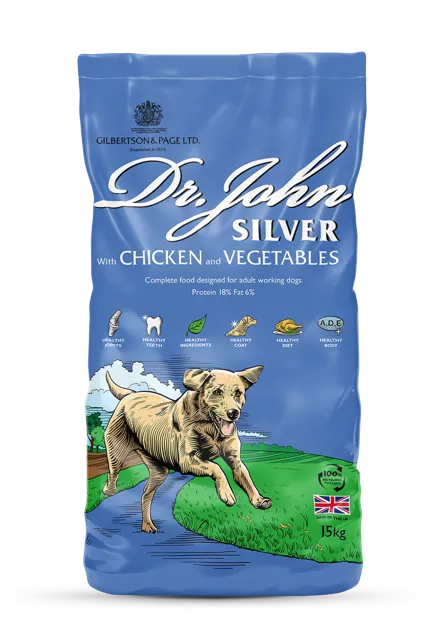

Dr John
Dr John Silver review
Dr John Silver is a pair of light, low fat everyday recipes for adult and senior dogs. The original leads on wheat with poultry meal declaring 11% chicken, and the Beef with Vegetables version keeps the same wheat first shape with a meat meal declaring 11% beef. Both hold fat at 6.0%, both lean on cereal for their energy, and both sit in our Average band. That reading is about how thin the animal share is, not about the bowl in front of your dog.
Our view
Likely to suit
For a dog whose weight creeps up on richer food, a lighter bowl has an obvious appeal.
- Less active adult and senior dogs, with fat declared at 6.0% in both recipes
- Dogs that have eaten wheat all their lives without a hint of bother
- Households with several dogs of different sizes, since one label covers toy through to giant
- Owners who want a choice of animal, with a poultry version and a beef version on the same build
Worth watching
The labels leave a few things unsaid, and those are the ones to know about.
- Both recipes open on wheat, so a wheat intolerance rules them out
- Neither meat entry names its species beyond the declared 11%, so neither can support an exclusion trial
- Chicken fat and chicken gravy appear in the beef recipe too, so it is not a chicken free food
- Most of the work here falls to the plant side, with carbohydrate between 63.6% and 65.4% of dry matter against the 46.2% typical for adult dry food
- The fat level suits a quiet dog, and one in genuine work will be asking for more than these bowls give
Written by our editorial team. Independent guidance, not veterinary advice.
How this scores
How we scoreThe Details
Dog fit
For a dog whose weight creeps up on richer food, a lighter bowl has an obvious appeal. The labels leave a few things unsaid, and those are the ones to know about.
Dry
Adult, Senior
Toy, Small, Medium, Large, Giant
Chicken
The score, in context
Both recipes read in our Average band while the typical adult dry food reads in our Good band, and the reason is the same in each case. Protein converts to 19.8% of dry matter in the poultry recipe and 19.6% in the beef, fat is held at 6.0% in both, and carbohydrate reaches 65.4% and 63.6% of dry matter respectively. The analysis describes a cereal led food with a meat contribution, not a meat led one. Nutritional balance reads Poor, with protein and processing and transparency both Average, the last of those held where it is because the meat terms stay general. For a small, steady, older dog on a light bowl this is still serviceable everyday food, and it is honest about being simple.
What's in it
Ingredients, as declared: Wheat, poultry meal (11% chicken), maize, vegetables (4% peas), chicken gravy, chicken fat, minerals, linseed, yucca extract.
Named ingredients
Ingredient notes
Wheat opens both lists, which sets the shape of everything that follows. It forms a biscuit well, and that is why it turns up at the front of so many everyday kibbles. When a dog proves intolerant of its food, wheat is usually the culprit. If yours has ever reacted to a kibble, wheat is the first thing to consider.
The animal entries are where the two recipes part company on paper and meet in practice. The poultry version uses poultry meal with 11% chicken named inside it, and the beef version uses meat meal with 11% beef named inside it. In both cases the meal is dried and concentrated, which is efficient, but the category term leaves the remaining animal content unidentified. The beef recipe then adds chicken fat and chicken gravy on top of it.
Peas at 4% arrive inside a vegetables heading in both recipes, bringing a little fibre, plant protein and a spread of micronutrients, with the rest of that heading left open. Linseed follows, and it is the most useful of the small entries, supplying plant omega 3 and fibre in one go.
Yucca extract closes both lists. It is not there for nutrition at all, but for what owners tend to notice in the garden, and on a high cereal food that is not a trivial contribution.
Energy is estimated at 322 kcal per 100g for the poultry and 319 for the beef, both below the 357 typical for adult dry food, so bowls run a little fuller. Fibre converts to 2.7% of dry matter in both, and ash from 5.5% in the poultry up to 7.6% in the beef.
How this variety differs
Poultry meal with 11% chicken behind the wheat, with maize third and 4% peas inside a vegetables entry. Chicken gravy and chicken fat follow, so poultry runs through the whole recipe. Of the pair this one runs higher on carbohydrate, at 65.4% of dry matter, and lower on ash at 5.5%, with energy estimated at 322 kcal per 100g.
Price and value
£1.23 a kilo for the poultry recipe and £1.13 a kilo for the beef. The poultry comes in 4kg and 15kg, the beef in 15kg only.
As a guide, take a 15kg adult dog in moderate condition on about 840 kcal a day (110 × bodyweight^0.75, the standard maintenance estimate). That is around 261 grams a day of the poultry or 263 of the beef. It comes to £0.32 and £0.30 a day. The labels put a dog of 10kg to 20kg on 200 to 370 grams, though condition tells you more than the chart does.
Nutritional analysis
Declared analysis
Estimated using Modified Atwater factors*
18%
6%
2.5%
5%
9%
Dry weight
19.8%
6.6%
2.7%
5.5%
65.4%
As-fed composition
Estimated breakdown of the finished product by ingredient category, from the declared ingredient list and ingoing weights. These are estimates, not measurements.
32.5%
55.7%
6.5%
2.3%
3.1%
Pricing & size
- Pack size
- 15kg or 4kg
- Retailer pricing
- Coming soon
Live retailer pricing is not yet available for this food. Prices, cost per day and where to buy will appear here once retailer data is live.
Ingredients and nutrition are taken from manufacturer data. Retailer pricing is not yet live for this food.
Related dog food guides
Ranked shortlists that include foods like this one.