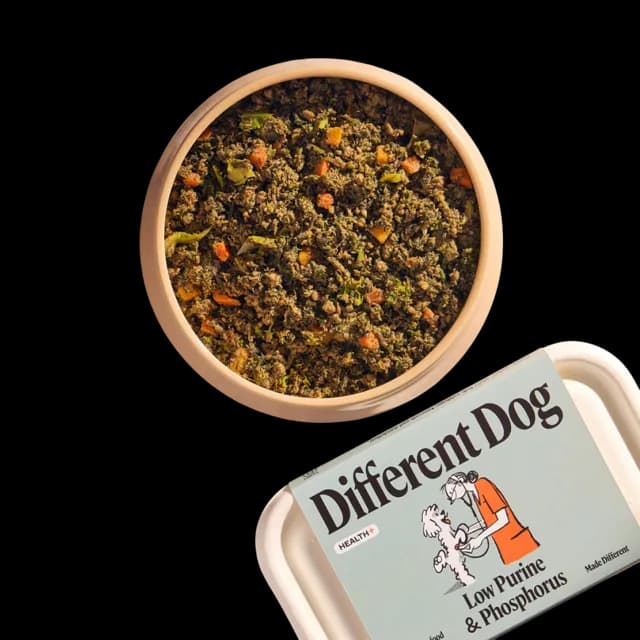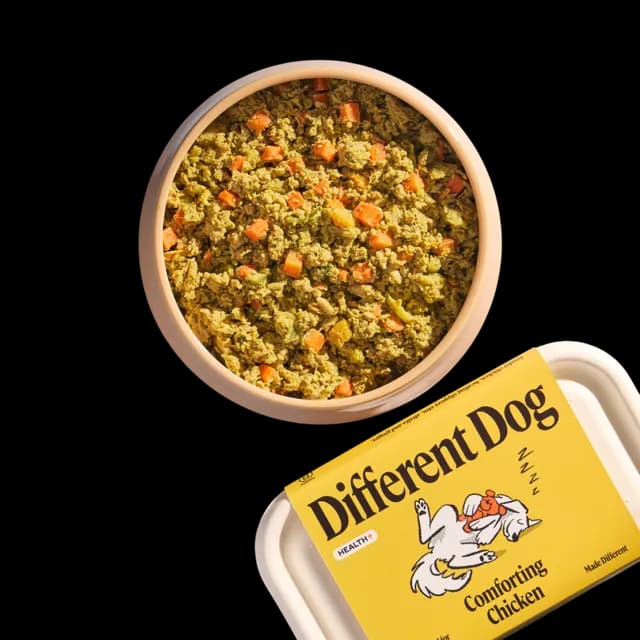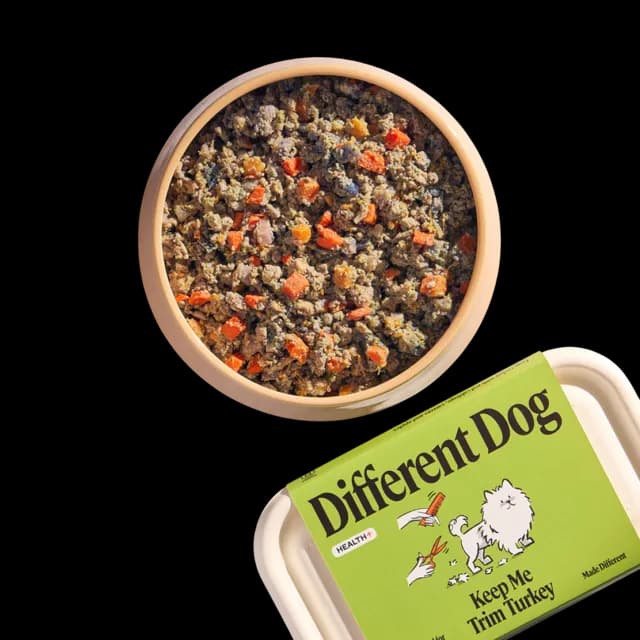



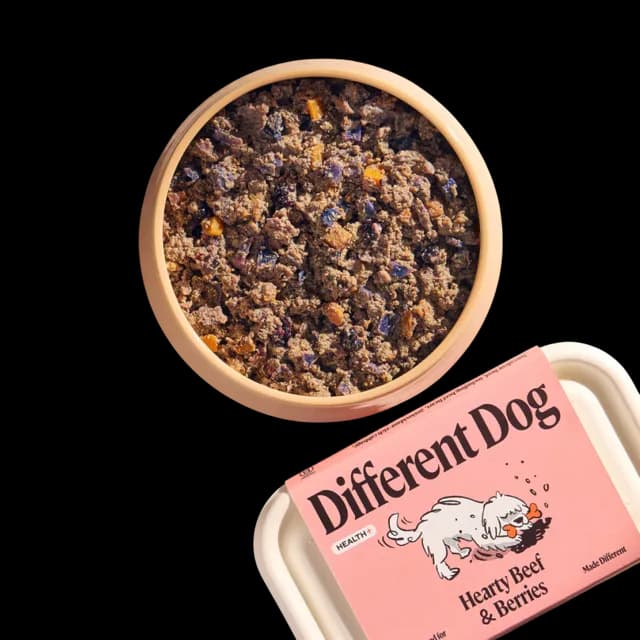
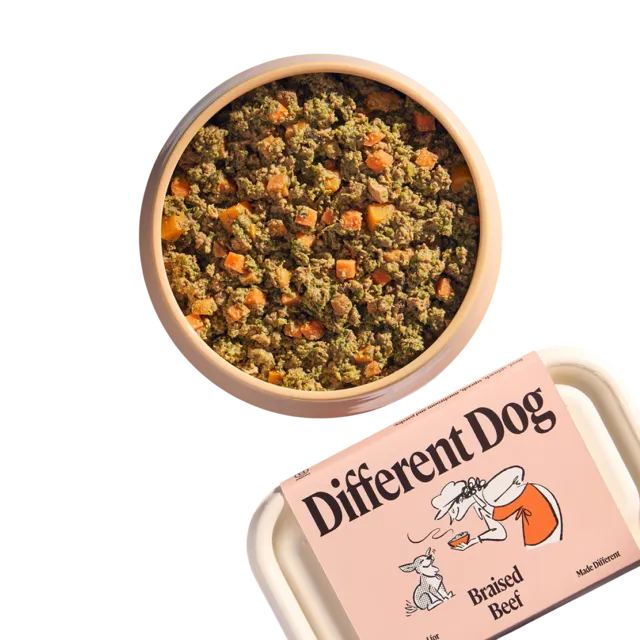

Different Dog
Different Dog: Braised Beef review
Flavour
Different Dog cooks human-quality British meat into nine recipes with names that read like a menu rather than a specification. Every one of them carries 60% animal, and eight of the nine break that share open into the cuts and organs it is made from, right down to a 1% dried pork rind. Behind the meat come fresh vegetables and fruit at printed percentages. Scottish salmon oil follows, then a standing tail of chia, kelp seaweed and turmeric at 0.02%. Our Outstanding band holds all nine recipes.
Our view
Likely to suit
This is proper home cooking arriving by post, and the labels read like recipes because that is more or less what they are.
- Dogs that have quietly gone off dry food, since gently cooked meat smells and tastes like the meal it actually is
- Owners who rotate, with seven headline meats spread across the nine recipes
- Puppies, adults and senior dogs alike, since every recipe is listed for all three stages
- A dog steering around the usual meats, with pork and venison both on the menu
- Owners happy to have organs in the bowl and no wish to handle them, since heart, liver, kidney and gizzard are itemised inside the meat shares
Worth watching
Fresh food asks a little of your fridge and a little of your reading, and both are easy once you know what to expect.
- Scottish salmon oil runs through the range and the Turkey Fricassee adds chicken gizzard, so fish and chicken are hard to steer around here
- Pots keep in the fridge or freezer and want using within a day or two once opened
- None of the nine declares calcium, so ask Different Dog for that figure before you put a large-breed puppy on it
Written by our editorial team. Independent guidance, not veterinary advice.
How this scores
How we scoreThe Details
Dog fit
This is proper home cooking arriving by post, and the labels read like recipes because that is more or less what they are. Fresh food asks a little of your fridge and a little of your reading, and both are easy once you know what to expect.
Fresh
Puppy, Adult, Senior
Toy, Small, Medium, Large, Giant
Beef
The score, in context
Every one of the nine recipes lands in our Outstanding band, and so does the typical fresh food, which tells you what sort of field this range is competing in. The Venison & Thyme leads it on our scoring and the Atlantic Salmon trails the rest, with the seven in between packed so closely that the ordering is academic.
Protein and processing reads Outstanding on all nine recipes, and so do nutritional balance and transparency, with value in step. That is the mark of a range getting its meat share, its plant list, its labelling and its analysis right together, with no single one carrying it. Choose on the animal and the vegetables that suit your dog, because nothing in the scoring will choose for you.
What's in it
Ingredients, as declared: Human-Quality British Beef (60%) [Beef Forequarter and Hindquarter (20%), Fresh Beef Heart (26%), Fresh Beef Kidney (7%), Fresh Beef Liver (5%)], Spinach Leaf (14%), Carrot (8%), Butternut Squash (5%), Apple (5%), Button Mushrooms (3%), Vitamins & Minerals, Scottish Salmon Oil (1.2%), Flat Leaf Parsley (0.7%), Brewer's Yeast (0.3%), Chia Seeds (0.3%), Kelp Seaweed (0.3%), Turmeric (0.02%)
Named ingredients
Nutritional additives
_(the page labels this "NUTRITIONAL ADDITIVES (PER KG)")_: Vitamin A 2500IU, Vitamin D3 400IU, Vitamin E 50mg, Zinc (as Zinc chelate of protein hydrolysates) 18mg, Iron (as Iron (II) chelate of protein hydrolysates) 15mg, Manganese (as Manganese chelate of protein hydrolysates) 7.5mg, Iodine (as Calcium iodate, anhydrous) 0.025mg
Ingredient notes
The meat share is the same size everywhere and different in shape each time. Braised Beef splits its 60% into 20% forequarter and hindquarter, 26% heart, 7% kidney and 5% liver. Chicken Casserole runs 33% thigh, 20% gizzard and 7% liver. Lamb takes 30% prime cuts, 25% heart and 5% liver, and Pork Ragu adds a 1% dried pork rind to its 30% pork, 24% heart and 5% liver. Only the Venison & Thyme keeps its 60% as one undivided entry.
Organs do a great deal of work in these recipes, and that is deliberate. Heart is a hard-working muscle and gizzard is lean, chewy poultry muscle. For vitamin B12 and vitamin A, liver has few natural equals in a dog's bowl, and the same goes for copper and selenium. Feeding a bowl with a quarter of it in heart is closer to how a dog would eat an animal than any fillet-only recipe manages.
The plant side is generous and named to the gram. A lead vegetable takes 14% or 15% on most recipes, spinach, cabbage, red cabbage, broccoli or swede depending on the dish, then a root at 8%, a fruit at 5% and button mushrooms at 3%. What follows from that is a very low starch load. Carbohydrate is estimated between 0.0% and 4.4% as fed, converting to no more than 15.7% of dry matter and to nothing measurable at all on the two chicken recipes. Typical for fresh food is 19.3%.
Water and richness both move a good deal across the range. Moisture runs from 68.0% to 76.2%, energy from 111 to 192 kcal per 100g, protein from 37.3% to 57.1% of dry matter and fat from 19.3% to 44.4%. That is a wide spread for one range and a useful one, because it means a swap between recipes is a real change of portion size rather than a change of flavour alone.
Each label finishes with a considered little package. Scottish salmon oil comes in at 1.2% for omega 3, with chia seeds and kelp seaweed at 0.3% apiece and brewer's yeast on a few of the recipes for its B vitamins. Turmeric at 0.02% is seasoning. Kelp brings iodine and a wide sweep of trace minerals, and it is used in the tiny quantities that ingredient calls for.
The added panel is dosed in print and built on chelates, the mineral form usually chosen for absorption. Vitamin A at 2500 IU, vitamin E at 50 mg, zinc at 18 mg, iron at 15 mg and manganese at 7.5 mg run through the range. Vitamin D3 at 400 IU, copper at 4.5 mg and iodine at 0.025 mg appear on most of them. The panels do vary slightly recipe to recipe, with no vitamin D3 printed on the Atlantic Salmon and no copper on the Braised Beef, so it is worth reading the one you plan to feed.
How this variety differs
British beef at 60%, and the biggest organ share in the range: 26% heart, 7% kidney and 5% liver against 20% forequarter and hindquarter. Spinach leads the plants at 14% with carrot at 8%. Fat converts to 40.3% of dry matter and the pot reads 184 kcal per 100g. Richer than most of the range, then, and the portions come down to match.
Price and value
£15.20 a kilo on eight of the nine recipes, with the Venison & Thyme at £7.90. Pots come in 250 g, 600 g and 1000 g.
A 15kg adult dog in moderate condition works through roughly 438 to 757 grams a day depending on the recipe. That rests on a daily energy target of about 840 kcal (110 × bodyweight^0.75, the standard maintenance estimate). On those figures a day runs from £4.58 on the Venison & Thyme up to £11.50 on the Pork Ragu. That spread follows the per-kilo figures and the energy density together, since the lighter recipes fill more of the bowl.
Nutritional analysis
Declared analysis
12.3%
12.9%
2.2%
1.6%
68%
Dry weight
38.4%
40.3%
6.9%
5%
9.4%
As-fed composition
Estimated breakdown of the finished product by ingredient category, from the declared ingredient list and ingoing weights. These are estimates, not measurements.
60%
1.3%
32.3%
1.2%
5.2%
Pricing & size
- Pack size
- 250 g · 600 g · 1000 g pots
- Retailer pricing
- Coming soon
Live retailer pricing is not yet available for this food. Prices, cost per day and where to buy will appear here once retailer data is live.
Ingredients and nutrition are taken from manufacturer data. Retailer pricing is not yet live for this food.
Related dog food guides
Ranked shortlists that include foods like this one.
Compare this food
Weighed head-to-head against a similar food we've reviewed.