



Chapel Farm
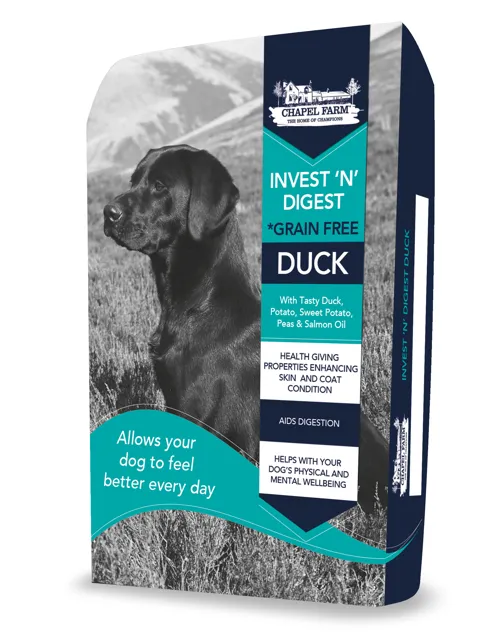
Chapel Farm Invest 'N' Digest Grain Free: Duck review
Flavour
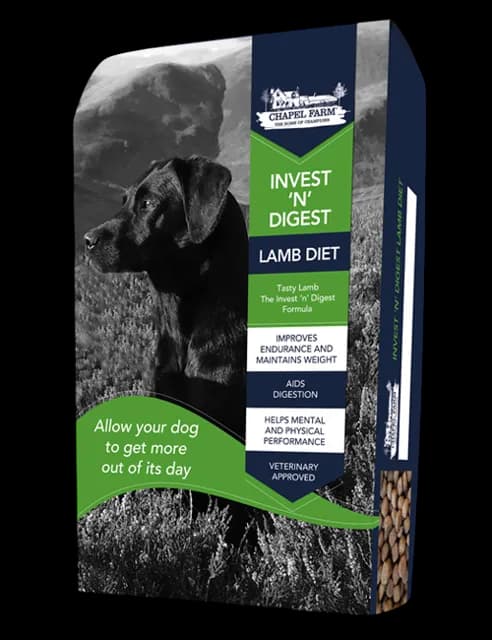
Chapel Farm Invest 'N' Digest Grain Free is a digestion-first pair of recipes built around a simple idea. Keep the ingredient list short, keep the grains out, and feed the gut as well as the dog. The original recipe holds salmon as its only animal ingredient, the duck version leads with duck at 34%, and both carry chicory and yeast-derived prebiotics with taurine dosed at 1000 mg per kilo. The pair sit together in our Good band.
Our view
Likely to suit
If your dog's stomach writes the shopping list in your house, this range speaks its language.
- Dogs whose digestion needs a hand, since FOS and MOS are both on the label as prebiotics
- Elimination feeders, because the salmon recipe names no animal beyond fish anywhere on its list
- Grain-avoiding households, since sweet potato, potato and peas carry every bit of the starch
- Owners of maturing dogs, as the salmon recipe's label covers senior feeding alongside adult
Worth watching
The two recipes are less interchangeable than the shared name might lead you to expect.
- The duck version brings poultry fat of unnamed species and a little salmon oil with it, so only the salmon recipe can support a strict single-protein trial
- Starch runs to nearly half the dry matter in both recipes, a balance that suits steady dogs better than hard-working ones
- The salmon arrives dried, hydrolysed and as gravy rather than fresh, so the headline reads differently from the fresh-meat feel some owners expect
Written by our editorial team. Independent guidance, not veterinary advice.
How this scores
How we scoreThe Details
Dog fit
If your dog's stomach writes the shopping list in your house, this range speaks its language. The two recipes are less interchangeable than the shared name might lead you to expect.
Dry
Adult
Small
Duck
The score, in context
The two recipes keep step on our scale, both of them inside our Good band and matching the typical adult dry food. The duck's edge shows in its pillar readings, where protein and processing and nutritional balance both come out Good against the salmon's Average, with value in step with each recipe's overall placing. Neither is chasing headlines; both are middle-order foods with a clear digestive brief.
What's in it
Ingredients, as declared: Duck (34%, of which dried duck 26% and fresh duck 8%), dried sweet potatoes (16%), dried potato flakes (16%), dried peas (16%), poultry fat, vegetable stock, linseed, dried beet pulp, dried brewer's yeast, minerals, salmon oil (0.5%), yeast hydrolysate (a natural source of MOS and beta glucans) (0.5%), dried chicory (a natural source of FOS and inulin) (0.5%), Yucca schidigera (0.03%).
Named ingredients
Nutritional additives
Additives — Natural antioxidants. Nutritional Additives: | Additive | Per kg | |---|---| | Vitamin A (3a672a) | 20,000iu/kg | | Vitamin D3 (3a671) | 1,500iu/kg | | Vitamin E (3a700) | 150mg/kg | | Taurine | 1000mg/kg | | L – carnitine | 500mg/kg | | Iron (Iron sulphate, monohydrate) | 50mg/kg | | Copper (Copper sulphate, pentahydrate) | 13mg/kg | | Zinc (Zinc sulphate, monohydrate) | 62.5mg/kg | | Manganese (Manganese oxide) | 30mg/kg | | Iodine (Calcium iodate anhydrous) | 1.5mg/kg |
Ingredient notes
The original recipe does something genuinely uncommon: from the salmon at 30% down through potato protein and beet pulp, no second animal appears anywhere. That salmon is supplied dried at 17%, hydrolysed at 7% and as gravy at 6%, working forms rather than fresh fillet, and dried fish holds its protein through cooking far better than fresh would.
The duck recipe reads similarly but is built differently: duck at 34% splits into 26% dried and 8% fresh, then poultry fat, vegetable stock and a 0.5% ration of salmon oil follow. Those last entries are why it cannot make the single-animal claim its sibling can.
Sweet potato, potato flakes and peas at matching shares carry the starch in both recipes. Estimated carbohydrate finishes at 46.9% and 44.6% of dry matter, either side of the 46.2% typical for adult dry food. This is a carbohydrate-forward construction, softened by the quality of the sources.
The digestive brief is delivered through dried chicory at 0.5%, a natural source of FOS and inulin, and a yeast hydrolysate bringing MOS and beta glucans, both prebiotics that feed the gut's resident good bacteria. Beet pulp adds the gentle fibre such recipes lean on.
The additive panel is dosed in print on both bags, with taurine at 1000 mg per kilo and L-carnitine included, at 100 mg in the salmon and 500 mg in the duck. Salmon oil at a full 7% gives the original recipe a generous omega 3 allowance, the kind that tends to show up in skin and coat.
How this variety differs
Duck leads at 34% with a mostly dried supply that survives cooking well, and the kibble is pitched at small breeds. It trades the strict fish-only card for more variety on its animal side, with poultry fat and a trace of salmon oil in support.
Price and value
Both recipes are £3.33 a kilo and come in 12kg bags.
Day to day, a 15kg adult dog in moderate condition would need about 243 grams of the salmon recipe (£0.81 a day) or 235 grams of the duck (£0.78). Those figures are built on the standard maintenance estimate of around 840 kcal (110 × bodyweight^0.75) and on label energy values that are themselves estimates.
Nutritional analysis
Declared analysis
Estimated using Modified Atwater factors*
27%
14%
3%
7%
Dry weight
29.3%
15.2%
3.3%
7.6%
44.6%
As-fed composition
Estimated breakdown of the finished product by ingredient category, from the declared ingredient list and ingoing weights. These are estimates, not measurements.
34%
6%
50.5%
0.5%
5.1%
3.8%
Pricing & size
- Pack size
- 12 kg
- Retailer pricing
- Coming soon
Live retailer pricing is not yet available for this food. Prices, cost per day and where to buy will appear here once retailer data is live.
Ingredients and nutrition are taken from manufacturer data. Retailer pricing is not yet live for this food.
Related dog food guides
Ranked shortlists that include foods like this one.