


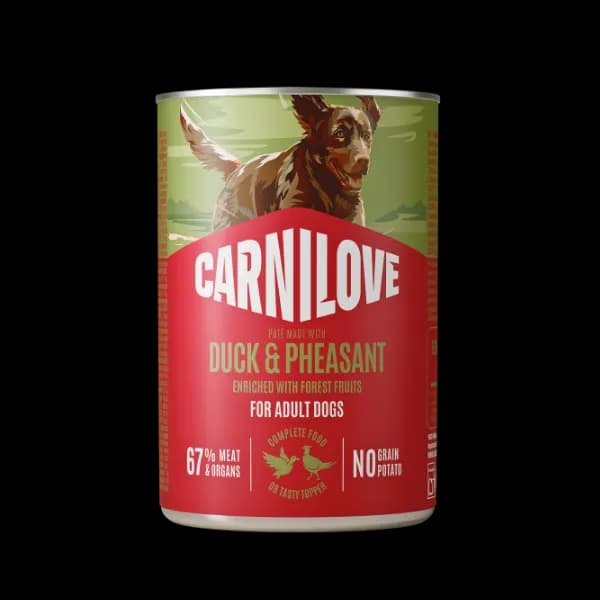

Carnilove
Carnilove True Fresh Adult Small Breed review
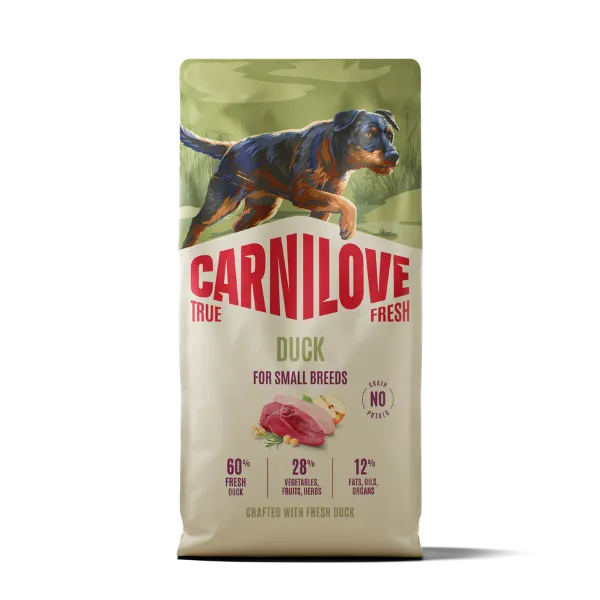
Carnilove True Fresh Adult Small Breed shrinks the fresh-duck formula down to little-dog scale and turns the richness up a notch. Duck goes in fresh at 60%, beef fat rises to 7% to reach the energy density small engines run on, and the grain-free base of peas, lentils and chickpeas stays in place. Our Good band is where it finishes.
Our view
Likely to suit
If yours is a small dog living life at a fast idle, this recipe is fuelled accordingly.
- Small breed adults with proper energy needs, fed by a denser biscuit at 379 kcal per 100g
- Dogs that get on better with duck than with chicken, since duck is the named meat leading the bowl at 60%
- Owners avoiding grain, with the starch coming from peas, chickpeas and red lentils
- Houses with fussy small eaters, because hydrolysed liver is there to make the bowl hard to refuse
Worth watching
Take a moment over these points before your first order.
- Beef fat, salmon oil and egg all travel with the duck, ruling this out as a strict one-animal recipe
- At 18% fat it is a rich little biscuit, so a leisurely lapdog will need the portion kept honest
Written by our editorial team. Independent guidance, not veterinary advice.
How this scores
How we scoreThe Details
Dog fit
If yours is a small dog living life at a fast idle, this recipe is fuelled accordingly. Take a moment over these points before your first order.
Dry
Adult
Small
Duck
The score, in context
On our scale this food reaches the Good band. Most adult dry foods finish in that band as well. What marks this one out on the label is a named fresh meat at a genuine majority, restrained carbohydrate and additives declared down to the milligram.
What's in it
Ingredients, as declared: fresh duck (60%), yellow peas, beef fat (7%), hydrolysed liver (3%), chickpeas (3%), pumpkin (3%), red lentils, dried apple pulp (2.3.%), salmon oil (2%), linseed, carrots, egg shells, potassium chloride, pea flour, dried sea buckthorn (0.2%), dried ginger root (0.1%), dried blueberries (0.1%), dried rosemary (0.1%), dried cranberries (0.1%), dried thyme (0.1%), hydrolysed crustacean shells (source of glucosamine, 0.022%), chicory root (source of fructo-oligosaccharides, 0.0163%), cartilage extract (source of chondroitin, 0.014%), brewer's yeast (source of mannan-oligosaccharides, 0.013%), Mojave yucca (0.0085%).
Named ingredients
Nutritional additives
- **Nutritional additives per 1kg:** vitamin A (3a672a) 20,000 IU, vitamin D3 (3a671) 1,575 IU, vitamin E (3a700) 530 mg, choline chloride (3a890) 2,400 mg, taurine (3a370) 1,500 mg, vitamin B1 (3a821) 4.7 mg, vitamin B2 (3a825i) 8.1 mg, biotin (3a880) 0.5 mg, folic acid (3a316) 0.43 mg, vitamin B6 (3a831) 8.5 mg, calcium-D-pantothenate (3a841) 17.1 mg, niacinamide (3a315) 55.8 mg, vitamin B12 (3a835) 0.3 mg, zinc (3b612) 86.8 mg, iron (3b107) 62.3 mg, manganese (3b505) 30.4 mg, potassium iodide (3b201) 1.07 mg, copper (3b407) 12.7 mg. - **Technological additives:** tocopherol extracts from vegetable oil (1b306(i)), ascorbyl palmitate (1b304), rosemary extract (1b392).
Ingredient notes
Fresh duck at 60% gives the recipe its identity, and because small breed foods are often built on vaguer poultry terms, a named bird at that level is worth something. As with any all-fresh recipe, the oven takes the water out, leaving finished protein at 32.2% of dry matter, a solid mid-table figure.
The energy story is the real small-breed tailoring. Beef fat at 7% pushes fat to 18% as fed and the density to 379 kcal per 100g, so small stomachs can take on enough fuel in few mouthfuls. Salmon oil at 2% rides along for omega 3s.
Peas, chickpeas, red lentils and pea flour bind the kibble with no cereal at all, and the estimated carbohydrate lands at 35.3% of dry matter, comfortably under the 46.2% typical for adult dry food.
Egg shells provide calcium from a food source rather than a bare mineral, dried apple pulp and pumpkin add fibre, and hydrolysed liver at 3% does the flavour work. The trailing berries and herbs are printed at trace fractions and are best read as garnish.
Glucosamine and chondroitin make the label at 0.022% and 0.014% respectively, amounts to note rather than count on. The dosing that matters is in the additive panel, where taurine stands at 1,500 mg per kilo and every vitamin and trace element carries a figure.
Price and value
£6.66 a kilo, with 1.5kg, 4kg and 12kg bags to choose from.
As a yardstick, a 15kg adult dog in moderate condition would need about 222 grams a day, or £1.48, using the standard maintenance estimate of roughly 840 kcal (110 × bodyweight^0.75). The label's own guide for a 3kg to 6kg small breed asks 65 to 110 grams a day, a fraction of that.
Nutritional analysis
Declared analysis
29%
18%
3.8%
7.5%
10%
Dry weight
32.2%
20%
4.2%
8.3%
35.3%
As-fed composition
Estimated breakdown of the finished product by ingredient category, from the declared ingredient list and ingoing weights. These are estimates, not measurements.
64%
18.1%
6.3%
9%
2.5%
Pricing & size
- Pack size
- 4.0kg, 1.5kg, 12kg
- Retailer pricing
- Coming soon
Live retailer pricing is not yet available for this food. Prices, cost per day and where to buy will appear here once retailer data is live.
Ingredients and nutrition are taken from manufacturer data. Retailer pricing is not yet live for this food.
Related dog food guides
Ranked shortlists that include foods like this one.