



Calibra
Calibra Dog Premium Line Beef 12x1240g review
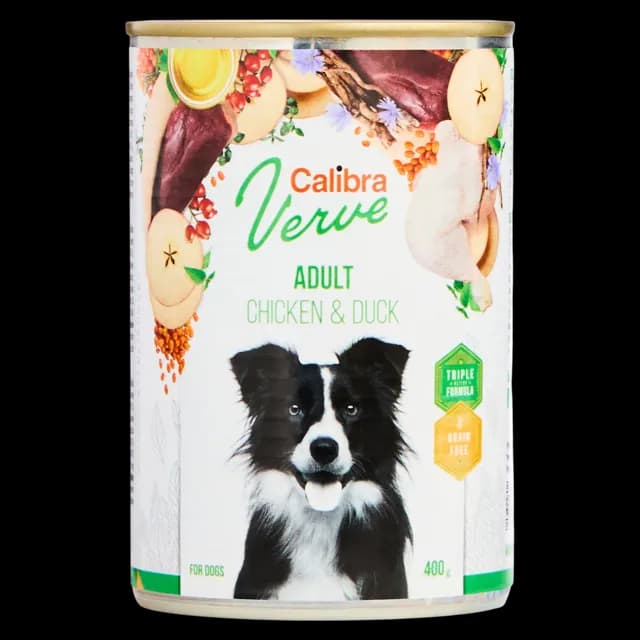
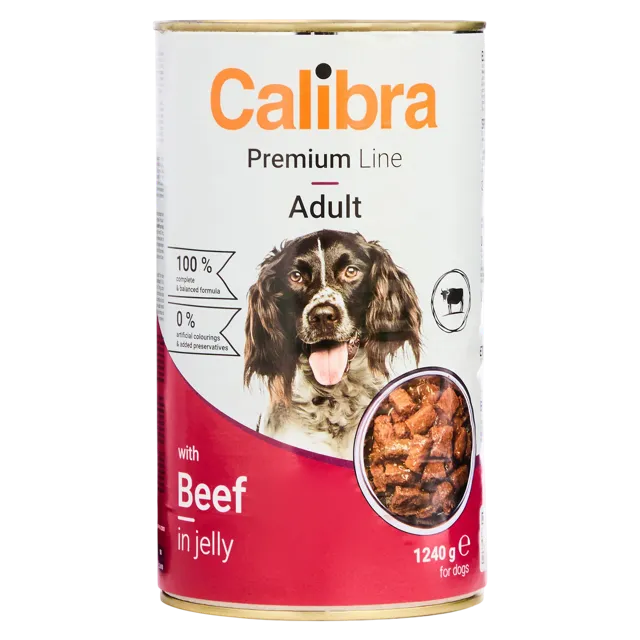
This is Calibra's catering size beef tin, 1240g of traditional chunks at a time. Beef is named at 8% inside a chunk mix declared as meat and animal derivatives at 68%, and behind that sit cereals, vegetable protein extracts, minerals and various sugars. It lands in our Average band because the label names so little of the recipe. Nothing in the tin itself is troubling.
Our view
Likely to suit
If you feed more than one mouth, or one very large one, a tin this size changes the shape of the week.
- Households feeding several dogs at once, since a single tin covers a lot of bowls
- Owners of big dogs who would rather open one large tin than a row of small ones
- Dogs that like a generous, filling dinner, since each gram of these chunks carries less energy than most wet food does
- Beef eaters, with beef the one animal this label pins down by name
- Dogs that drink sparingly, as most of what goes in the bowl arrives as moisture
Worth watching
Category terms describe most of this recipe, so it helps to know what they leave open.
- Beef is declared at 8% while the rest of the chunk mix is listed as meat and animal derivatives, so this tin cannot anchor an elimination diet
- No cereal is named here, and the grain can change while the label stays the same
- Various sugars appear on the list, worth knowing if you keep added sugar out of your dog's bowl
- The chunk figure is printed with a tolerance of plus or minus 50% in the finished tin, so the meat share moves within that window
- No energy figure is declared, so the 75 kcal per 100g in the table is our own estimate
Written by our editorial team. Independent guidance, not veterinary advice.
How this scores
How we scoreThe Details
Dog fit
If you feed more than one mouth, or one very large one, a tin this size changes the shape of the week. Category terms describe most of this recipe, so it helps to know what they leave open.
Wet
Adult
Toy, Small, Medium, Large, Giant
Beef
The score, in context
Our Average placing here is a labelling story more than a nutrition one. Protein and processing reads Poor against an ingredient list written almost entirely in category terms, with beef the only entry given a percentage of its own, while nutritional balance reads Excellent and transparency Good. The estimated carbohydrate adds to it, converting to 28.2% of dry matter where the typical adult wet food runs at 15.8%.
Set that typical wet food beside this tin and the distance looks large, since our scoring places it in the Excellent band. None of that is a safety verdict. Tins built like this have fed dogs happily for decades, and what the score reflects is how much the maker chooses to show you.
What's in it
Ingredients, as declared: meat and animal derivatives (68 % in chunks*, of which 8 % beef), cereals, vegetable protein extracts, minerals, various sugars. *Chunks typically ± 50 % in finished product
Named ingredients
Nutritional additives
| Additive | per 1 kg | |---|---| | vitamin A | 1100 IU | | vitamin D3 | 140 IU | | vitamin E | 10 mg | | copper (as copper (II) sulphate pentahydrate) | 1.8 mg | | zinc (as zinc sulphate monohydrate) | 10 mg | | manganese (as manganese (II) oxide) | 2 mg | | Iodine (as calcium iodate, anhydrous) | 0.1 mg |
Ingredient notes
The working list is short and most of it is legal shorthand. Meat and animal derivatives can cover any part of any warm blooded land animal, in any proportion, and it can be excellent material or ordinary material without the wording changing. What is fixed is the beef at 8%, which is the one animal figure you can hold the maker to.
Cereals and vegetable protein extracts do the rest of the heavy lifting. Neither term says what it is, and the vegetable protein extract matters most. Protein reads 7.0% as fed, which converts to 37.8% of dry matter and looks respectable on paper. Some of that total is plant protein, though, and dogs make less of plant protein than they do of meat protein.
Various sugars are on the list too. Sugar goes into food because dogs enjoy it, and seeing it declared on a wet label is uncommon enough to be worth a mention. It is not a reason to worry about a dog that is thriving, though it is one of the things a scoring system notices.
Every entry in the short added panel carries a dose: vitamin A, vitamin D3 and vitamin E, with copper, zinc, manganese and iodine behind them. No calcium figure is declared anywhere on the label, so there is nothing to read on that front. Fat sits at 3.8% as fed, converting to 20.5% of dry matter, which is moderate for a wet food and easy going for a dog that finds richer tins too much.
Price and value
£1.95 a kilo, in 1240g tins, sold in cases of 12.
As a guide, a 15kg adult dog in moderate condition would eat around 1120 grams a day, which works out at about £2.18. The basis is roughly 840 kcal a day (110 × bodyweight^0.75, the standard maintenance estimate). The energy behind that sum is our own estimate at 75 kcal per 100g, since the label prints none, and the light energy density is why the daily amount looks so large.
Nutritional analysis
Declared analysis
Estimated using Modified Atwater factors*
7%
3.8%
0.5%
2%
81.5%
Dry weight
37.8%
20.5%
2.7%
10.8%
28.2%
As-fed composition
Estimated breakdown of the finished product by ingredient category, from the declared ingredient list and ingoing weights. These are estimates, not measurements.
9.7%
30%
59.3%
1%
Pricing & size
- Pack size
- 12x1240g
- Retailer pricing
- Coming soon
Live retailer pricing is not yet available for this food. Prices, cost per day and where to buy will appear here once retailer data is live.
Ingredients and nutrition are taken from manufacturer data. Retailer pricing is not yet live for this food.
Related dog food guides
Ranked shortlists that include foods like this one.