


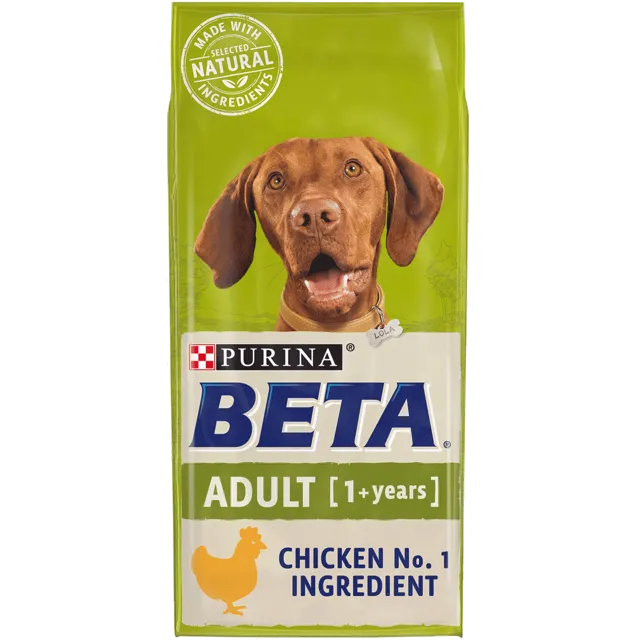

Beta
Beta Sensitive review
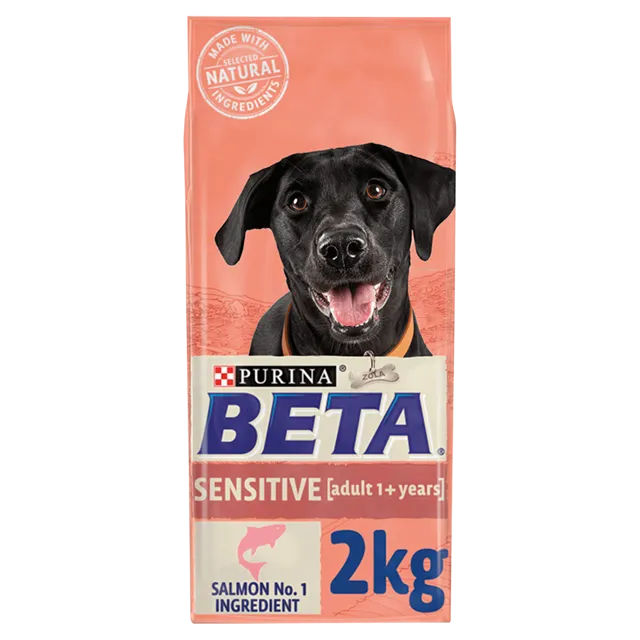
Beta Sensitive is a salmon-flavoured supermarket staple built for delicate stomachs on a familiar cereal base. Salmon meal at 17% is the named protein, wheat, corn and rice carry the bulk, and a chicory prebiotic plus fish oil supply the digestive and coat touches. It finishes in our Average band, a reading driven by anonymous entries and cereal-heavy construction rather than by anything that should unsettle a dog already doing well on it.
Our view
Likely to suit
If your dog's stomach appreciates routine, this is an easy recipe to keep on the shelf week after week.
- Dogs with touchy digestion, since a fish protein sits here alongside beet pulp and chicory root as a prebiotic
- Owners who want a widely stocked kibble they can pick up on the weekly shop
- Households feeding several sizes of dog from one bag, with toy through to giant breeds all on the label
- Salmon-keen dogs, with fish oil behind the salmon meal for skin and coat support
Worth watching
Before you commit, run your eye over a couple of label details.
- Wheat and soya both appear high on the list, worth knowing if your dog's sensitivity has ever pointed towards grains or legumes
- Neither the animal fats nor the digest carries a species name, so the recipe is out as the base of a strict elimination diet
- Salmon is the only animal named on the list, but at 17% it leaves the cereals doing most of the carrying
Written by our editorial team. Independent guidance, not veterinary advice.
How this scores
How we scoreThe Details
Dog fit
If your dog's stomach appreciates routine, this is an easy recipe to keep on the shelf week after week. Before you commit, run your eye over a couple of label details.
Dry
Adult
Toy, Small, Medium, Large, Giant
Salmon
The score, in context
Beta Sensitive finishes in our Average band; the typical adult dry food, for comparison, earns a Good from us. The gap comes from construction rather than danger. Cereals supply more of the bowl than salmon does, several entries name no species, and the trace minerals arrive in their plainer sulphate forms. None of that stops a dog thriving on it, and plenty do, but it explains why the label reads the way it does.
What's in it
Ingredients, as declared: Salmon meal (17%), Wheat*, Corn*, Rice* (14%), Soya meal, Animal fats, Dried beet pulp, Corn protein meal, Dried chicory root*1 (1%), Digest, Minerals, Fish oil, Dried carrot* (0.07%), Dried spinach* (0.07%), Dried parsley* (0.07%), *Natural ingredients, 1Natural prebiotic
Named ingredients
Nutritional additives
- Nutritional additives - IU/kg: - Vit A: 13500 - Vit D3: 780 - Vit E: 64 - mg/kg: - Iron (II) sulphate monohydrate: (Fe: 56) - Calcium iodate anhydrous: (I: 1.3) - Copper (II) sulphate pentahydrate: (Cu: 6.2) - Manganous sulphate monohydrate: (Mn: 4.2) - Zinc sulphate monohydrate: (Zn: 79) - Sodium selenite: (Se: 0.13) - Antioxidants
Ingredient notes
Salmon meal at 17% leads the label, and meal is the concentrated, water-off form of fish, so it works harder than a fresh-fish entry of the same size would. Behind it, though, wheat, corn and rice at 14% supply most of the bowl, and the estimated carbohydrate of 47.8% of dry matter against a typical 46.2% tells that story plainly.
Wheat sits second on the list. Most dogs handle it without incident, but it is one of the cereals more often implicated when intolerance does show up, which is worth weighing on a food bought for its sensitive positioning. Soya meal, a plant protein used to lift the total, carries a similar reputation.
Dried chicory root at 1% is the recipe's prebiotic, feeding the gut's friendly bacteria, and dried beet pulp adds gentle fibre. These are the entries doing the sensitive-stomach work, and they are sensible choices.
Fish oil brings omega 3 support for skin and coat. The animal fats and the digest, by contrast, are unnamed, which only matters if you need to know exactly which animals your dog is eating.
The added minerals are dosed in print, zinc at 79 mg and iron at 56 mg per kilo among them. They come as sulphates, where some makers now favour the chelated forms, and the selenium is the standard sodium selenite.
Price and value
Sold in 2kg and 14kg bags.
As a guide, a 15kg adult dog in moderate condition gets through about 221 grams a day on this recipe. The target is roughly 840 kcal a day (110 × bodyweight^0.75, the standard maintenance estimate). The bag's own table asks 215 grams for a 14kg dog, so the two agree closely.
Nutritional analysis
Declared analysis
25%
14%
2.5%
6%
9%
Dry weight
27.5%
15.4%
2.7%
6.6%
47.8%
As-fed composition
Estimated breakdown of the finished product by ingredient category, from the declared ingredient list and ingoing weights. These are estimates, not measurements.
19.1%
68.3%
1.1%
4.3%
7.1%
Pricing & size
- Pack size
- 2kg, 14kg
- Retailer pricing
- Coming soon
Live retailer pricing is not yet available for this food. Prices, cost per day and where to buy will appear here once retailer data is live.
Ingredients and nutrition are taken from manufacturer data. Retailer pricing is not yet live for this food.
Related dog food guides
Ranked shortlists that include foods like this one.