

Almo Nature
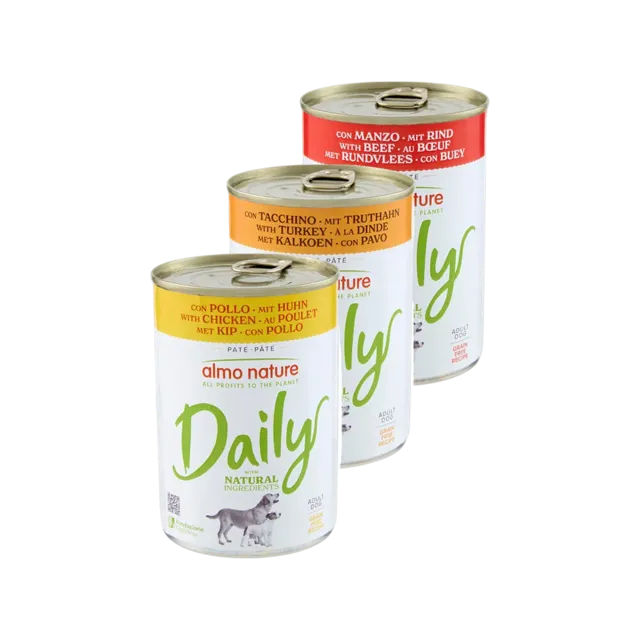
Almo Nature Daily Adult: Turkey review
Almo Nature Daily Adult is a three-line tin: meat and animal derivatives with the headline animal named at 4%, minerals, and a whisper of rosemary. Beef, chicken and turkey are the three choices, and beyond that one word the recipe underneath them is identical. It settles in our Average band, which comes down to how little the label commits to. The analysis is leaner on starch and richer in fat than most wet food manages.
Our view
Likely to suit
If your dog simply wants a soft, savoury bowl and you are not chasing a full ingredient breakdown, this does that job.
- Dogs that do best with almost no starch in the bowl, since estimated carbohydrate converts to just 2.8% of dry matter
- Dogs that need the water as much as the food, as these tins run to 82.0% moisture
- Fussy eaters, because a soft meat loaf like this warms easily and stirs through whatever they are already having
- Owners who want a change of flavour without a change of recipe, with beef, chicken and turkey built the same way
- Dogs that take their energy from fat, with fat converting to 36.1% of dry matter
- Adult dogs of any size, as the tin carries no breed or build conditions
Worth watching
There is not much on this label, so what it leaves out is what you need to know.
- The named animal is only 4% of the tin and the rest of the meat is written as meat and animal derivatives, so none of the three can anchor an elimination diet
- Because those derivatives go unnamed, the beef tin may still carry poultry and the chicken tin may still carry red meat
- Cassia gum sits in the additive panel as a thickener, which some owners prefer to steer around in wet food
- The label declares no energy figure, so the calories and the portion guides here are our own estimate
Written by our editorial team. Independent guidance, not veterinary advice.
How this scores
How we scoreThe Details
Dog fit
If your dog simply wants a soft, savoury bowl and you are not chasing a full ingredient breakdown, this does that job. There is not much on this label, so what it leaves out is what you need to know.
Wet
Adult
Turkey
The score, in context
The three tins land together in our Average band, and nothing in the analysis explains why. Protein converts to 47.2% of dry matter, fat to 36.1%, and estimated carbohydrate to 2.8% where the typical adult wet food runs at 15.8%. What pulls the placement down is that the label describes almost nothing. A recipe that names one animal at 4% and hands the rest to a category term gives a scoring system very little it can reward. Nutritional balance reads Outstanding, while protein and processing and transparency both read Good.
For context, the shelf these tins sit on is a strong one, and the typical adult wet food occupies our Excellent band because wet recipes tend to be meat-led and low in starch. By its analysis this is both of those things. It simply will not say so on the ingredient list, and that gap between what the food appears to be and what the label is willing to confirm is the whole story of the placement.
What's in it
Ingredients, as declared: meat and animal derivatives (4% turkey), minerals, 0.02% rosemary.
Named ingredients
Nutritional additives
Vitamin D3: 200 IU, iodine: 0.15 mg, manganese: 0.62 mg, zinc: 6.56 mg, cassia gum: 2.6 g.
Ingredient notes
Three entries make up the entire list. Meat and animal derivatives is the legal category covering the fleshy parts and by-products of warm-blooded land animals. That stretches from prime cuts to the least glamorous trimmings, and the label does not say where in that range this tin falls. The named animal at 4% is the only species pinned down, and it is the only thing separating one tin from the next.
That is not the hygiene worry it is sometimes made out to be. Plenty of decent European wet foods use category terms because labelling customs at home differ from ours. The analysis here is honestly meat-shaped: protein at 47.2% of dry matter with fat at 36.1% describes a rich, savoury loaf. What you cannot do is read it. That is a fair thing to weigh up, and nothing to be alarmed about.
Rosemary at 0.02% closes the list. At that level it is working as a natural antioxidant, keeping the fats in the tin from turning, rather than as a herb with anything of its own to contribute.
The added panel is short and printed in full: vitamin D3 at 200 IU with iodine, manganese and zinc each dosed beside it. Cassia gum appears in the same panel at 2.6 g, and it is a thickener, the ingredient that gives a wet food its set. It is common in tinned food and it is also one of the more debated entries in the category, so it is worth knowing that it is in there.
How this variety differs
Turkey is the named 4% in this tin, the poultry many owners reach for once chicken has stopped being interesting. The analysis matches the other two exactly, so the change here is one of name and taste rather than of nutrition.
Price and value
£4.97 a kilo, in 400 g tins sold by the case of 24.
As a guide, a 15kg adult dog in moderate condition would get through about 968 grams a day, which comes to £4.81, assuming around 840 kcal a day (110 × bodyweight^0.75, the standard maintenance estimate). No energy figure is declared on the tin, so that portion rests on our estimate of 87 kcal per 100g.
Nutritional analysis
Declared analysis
Estimated using Modified Atwater factors*
8.5%
6.5%
0.5%
2%
82%
Dry weight
47.2%
36.1%
2.8%
11.1%
2.8%
As-fed composition
Estimated breakdown of the finished product by ingredient category, from the declared ingredient list and ingoing weights. These are estimates, not measurements.
63.8%
17%
19.2%
Pricing & size
- Pack size
- 24 × 400 g
- Retailer pricing
- Coming soon
Live retailer pricing is not yet available for this food. Prices, cost per day and where to buy will appear here once retailer data is live.
Ingredients and nutrition are taken from manufacturer data. Retailer pricing is not yet live for this food.
Related dog food guides
Ranked shortlists that include foods like this one.