

Able
Able Puppy: Chicken and Duck review
Flavour
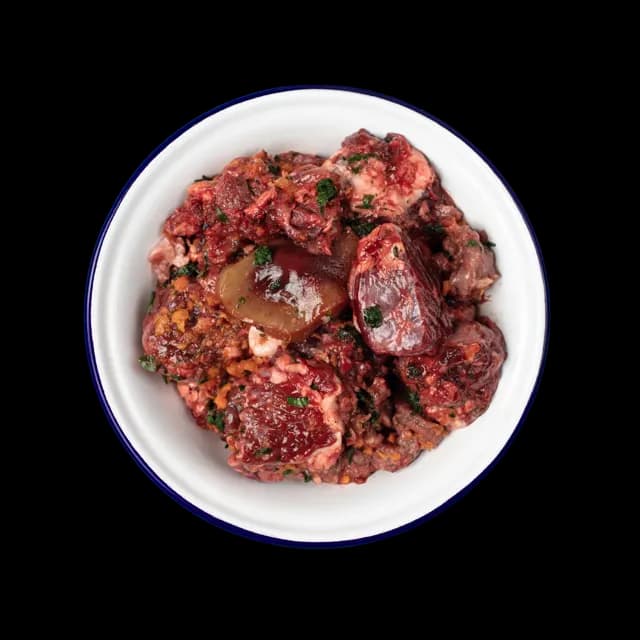
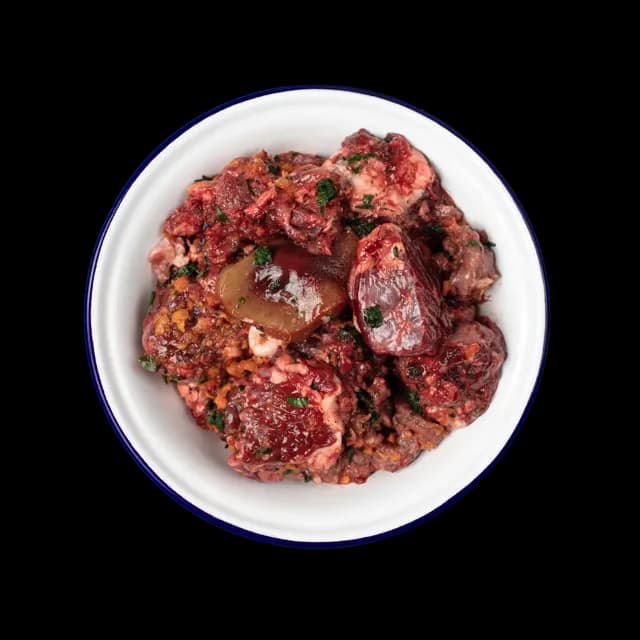
Able Puppy is a short menu of six raw recipes for the first year, all built to the same plan. Named animals make up 80% of each one, with bone and organ meats counted inside that figure. The balance is vegetables led by carrot, and behind them come flaxseed meal, kelp and cod liver oil, with a scatter of berries and botanicals to finish. No grain appears, and no added vitamin and mineral premix either, Able's argument being that whole ingredients handle the micronutrition. Our Outstanding band holds every recipe here. Between them they cover red meat and poultry, with recipes that mix the two.
Our view
Likely to suit
A first year on raw goes best when the menu is small enough to learn and varied enough to keep a young dog interested.
- Owners starting a young dog on raw who want a short menu instead of a wall of options
- Puppies destined for a rotation, since the six recipes are built alike and differ only in the animals inside them
- Homes avoiding cereal altogether, because vegetables and a spoonful of flaxseed fill the space around the meat
- Owners feeding one dog or several, with single portions and multipack boxes both on the shelf and two grinds to choose from
Worth watching
None of this is difficult, but a young dog on raw comes with a few things worth knowing about first.
- Every recipe carries cod liver oil, so fish is present in all six even where the name suggests otherwise
- Calcium is left to the ground bone and no figure for it is printed, which is worth raising with your vet if the dog eating it will grow into a large or giant breed
Written by our editorial team. Independent guidance, not veterinary advice.
How this scores
How we scoreThe Details
Dog fit
A first year on raw goes best when the menu is small enough to learn and varied enough to keep a young dog interested. None of this is difficult, but a young dog on raw comes with a few things worth knowing about first.
Raw
Puppy
Toy, Small, Medium, Large, Giant
Chicken
The score, in context
All six recipes reach our Outstanding band, so the choice between them comes down to the animals and not the placing. It is worth saying what that means in this category: raw sets the highest bar we score against, and the typical raw food for growing dogs carries the same band word. Holding it six times over is the accomplishment, since nobody here is clearing the field. Protein and processing reads Outstanding on all six and transparency Excellent throughout, while value sits at Outstanding on every recipe and nutritional balance reads Outstanding on most of the menu.
What's in it
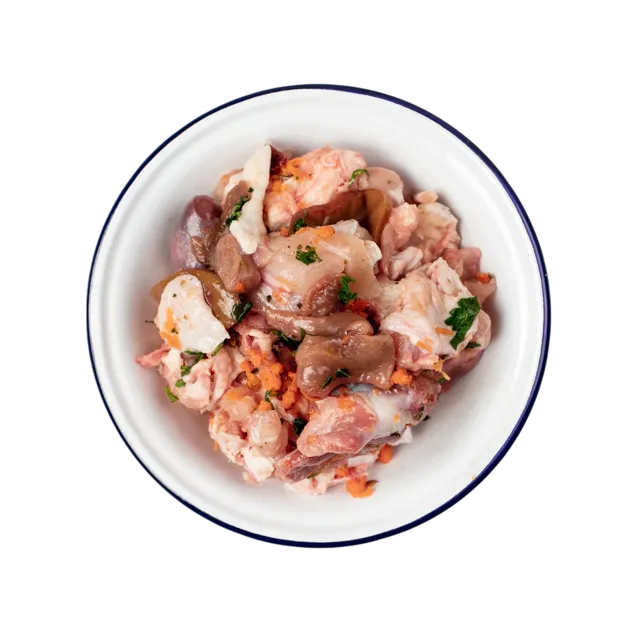
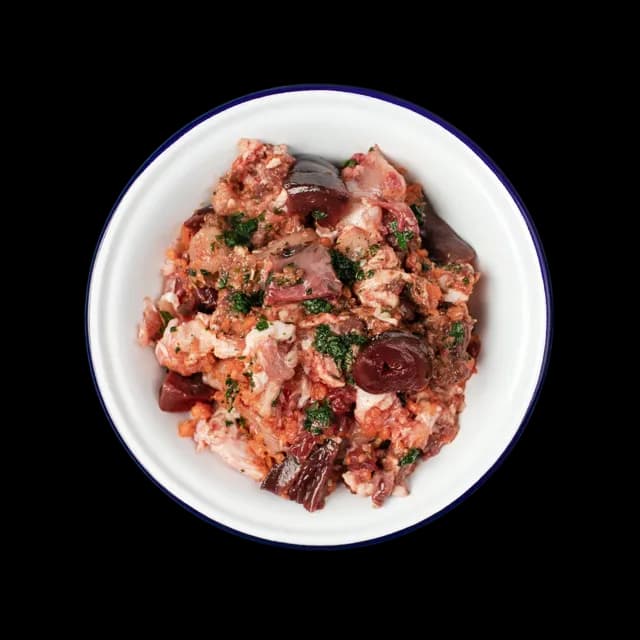
Ingredients, as declared: Chicken 75% (Gizzards 40%, Drumsticks 35%), Duck Liver 5%, Carrot 9.6%, Butternut Squash 2.5%, Broccoli 2.5%, Kale 2.5%, Flaxseed Meal 2%, Kelp Meal 0.2%, Cod Liver Oil 0.15%, Wheatgerm Oil 0.15%, Cranberries 0.15%, Blueberries 0.15%, Botanicals 0.1% (Turmeric, Spirulina Powder, Green Lipped Mussel Powder, Chicory Root Powder, Spinach Powder, Bilberry Powder, Gingko Biloba Powder).
Named ingredients
Nutritional additives
No separate "nutritional additives" panel is published — Able states its micronutrients come from the whole-food ingredients in the composition above: > Kelp is added in precise quantities to meet the iodine requirements essential for proper thyroid function. Wheatgerm oil provides vitamin E and cod liver oil is added to provide vitamin D. Fibre is provided by flaxseed. Cranberries and blueberries are included in small quantities for their antioxidant properties and high levels of vitamin C. > > The B-complex vitamins in the duck liver include B1 (thiamine), B2 (riboflavin), B3 (niacin), B5 (pantothenic acid), B6 (pyridoxine) and B9 (folic acid). These vitamins help break down carbohydrates, fats and proteins, which provide the body with energy.
Ingredient notes
One construction, six casts. The animal share is 80% on every label, and the vegetable fraction behind it runs carrot, butternut squash, broccoli and kale. Behind those sit flaxseed meal for fibre and omega fats, kelp meal, the two oils and a few berries. Some of these labels itemise every cut and percentage while others summarise in a line, so the amount of detail you get varies by recipe.
Bone and offal sit inside the meat figure. Ribs and drumsticks bring the bone that supplies calcium, hearts and gizzards bring dense working muscle, and liver appears in nearly every recipe, which is where a good deal of an animal's micronutrition actually lives.
Nothing on these labels is a synthetic vitamin blend. Able describes kelp as its iodine source, wheatgerm oil as its vitamin E, cod liver oil as its vitamin D and the liver as its B vitamins. The recipes are built so that those ingredients are always present. It is a whole-food approach with the organ meats doing the heavy lifting, and it does mean there are no printed doses to check against.
That cod liver oil deserves its own line, because it makes every recipe here a fish-containing one. It earns its place for the vitamin D and the omega 3 fats, and for most young dogs it is simply a bonus. For a household keeping fish out of the bowl, it is the detail to register before ordering.
The tail of the list is deliberately small. The botanicals are printed at 0.1%: green lipped mussel powder, spirulina, turmeric and several berry and root powders. Cranberries and blueberries sit just ahead of them at 0.15%. Able prints the percentages, and that is the honest way to present flourishes on a recipe whose weight sits in its meat.
Carbohydrate on these labels is estimated by difference rather than measured, and with no starch ingredient anywhere the figure absorbs everything the analysis left unaccounted. Two of the six estimate at zero and the others spread out from there. Where a figure looks out of step with the list, as it does on the Beef and Lamb with Duck, the ingredients are the better guide.
How this variety differs
Lightest of the six at 124 kcal per 100g, which means the biggest bowl and a gentle way in for a dog new to raw. Chicken gizzards at 40% and drumsticks at 35% carry the bulk of it, and the organ share is duck liver at 5%.
Price and value
Each of the six is £6.05 a kilo. A single portion runs from 150g to 500g, and multipack boxes hold about 4kg to 5kg. Both grinds are available across the range, the chunky and the non chunky.
Daily amounts for a young dog climb and then fall back as growth finishes, so a single figure would mislead. For scale, the feeding estimate puts a 5kg dog under twelve months at 250g to 300g a day, roughly double the 100g to 150g the same dog would take as an adult.
Nutritional analysis
Declared analysis
12.2%
8.4%
4.7%
3.2%
73%
Dry weight
45.2%
31.1%
17.4%
11.9%
0%
As-fed composition
Estimated breakdown of the finished product by ingredient category, from the declared ingredient list and ingoing weights. These are estimates, not measurements.
80%
17.4%
0.3%
2.3%
Pricing & size
- Pack size
- 150g single portion · 150g x 28 packs (4.2kg) · 200g single portion · 200g x 20 packs (4kg) · 250g single portion · 250g x 18 packs (4.5kg) · 300g single portion · 300g x 16 packs (4.8kg) · 350g single portion · 350g x 12 packs (4.2kg) · 400g x 12 packs (4.8kg) · 500g single portion · 500g x 10 packs (5kg) · **Grind:** Chunky / Non Chunky
- Retailer pricing
- Coming soon
Live retailer pricing is not yet available for this food. Prices, cost per day and where to buy will appear here once retailer data is live.
Ingredients and nutrition are taken from manufacturer data. Retailer pricing is not yet live for this food.
Related dog food guides
Ranked shortlists that include foods like this one.