



Techni-Cal
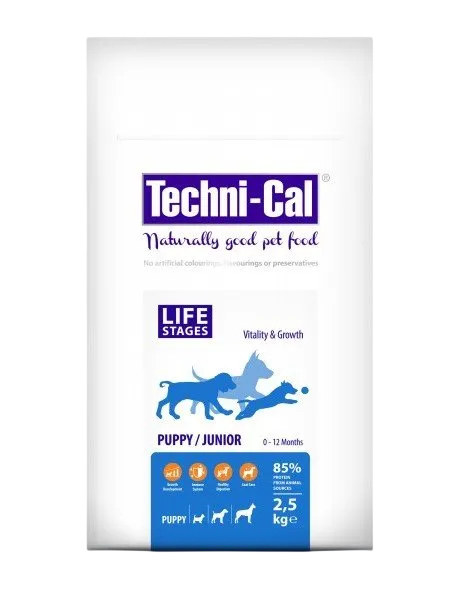
Techni-Cal Lifestages Puppy / Junior review
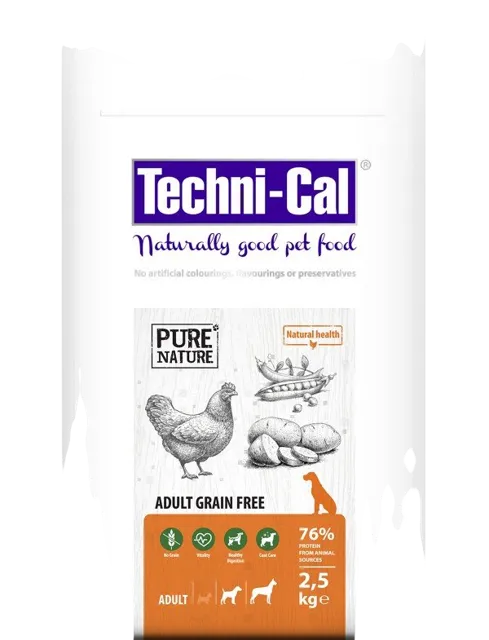
Techni-Cal Lifestages Puppy and Junior is a poultry led growth kibble with a short recipe and plenty of energy in it. Dehydrated chicken, turkey and duck open the list as one combined entry, with wheat and maize carrying the starch. A declared 393 kcal per 100g puts it above the 376 typical of a puppy dry food. Protein converts to 34.1% of dry matter. The food sits in our Excellent band, and what lifts it there is mostly what the label is willing to declare.
Our view
Likely to suit
Your pup runs hot from breakfast to bedtime, and this bag is built to keep the tank topped up.
- Busy, fast growing puppies, with 393 kcal in every 100g of kibble
- Pups that do well on poultry, since dehydrated chicken, turkey and duck supply the meat between them
- Households happy to feed cereals, with wheat and maize doing the binding
- Owners who like a prebiotic named in the recipe, with fructo-oligosaccharides closing the ingredient list
Worth watching
This label leaves some real gaps, and you will want them in hand before you buy.
- No calcium figure is printed anywhere, so a large breed puppy's mineral plan cannot be checked against this bag
- Chicken, turkey and duck share the one recipe alongside wheat, so it suits neither a single bird plan nor a wheat free one
Written by our editorial team. Independent guidance, not veterinary advice.
How this scores
How we scoreThe Details
Dog fit
Your pup runs hot from breakfast to bedtime, and this bag is built to keep the tank topped up. This label leaves some real gaps, and you will want them in hand before you buy.
Dry
Puppy
Toy, Small, Medium, Large, Giant
Chicken
The score, in context
This bag sits in our Excellent band, a step above the Good band the typical puppy dry food occupies. Nutritional balance and protein and processing both read Good, with transparency Outstanding. The headline analysis is respectable on protein and energy, and the label says a good deal for the job of growing a dog. There is a genuinely meaty opening to the ingredient list underneath all that, and the notes below give it its due.
What's in it
Ingredients, as declared: Dehydrated chicken, turkey and duck, wheat, maize, chicken fat, beet pulp, salmon oil (cold pressed), dried apple, brewers yeast, linseed, sodium chloride, fructo-oligosaccharides.
Named ingredients
Nutritional additives
- **Vitamins:** 3a672a Vitamin A - retinyl acetat 19,980 IU, 3a671 Vitamin D3 - cholecalciferol 1,998 IU, 3a700 Vitamin E - alpha-tocopherol 350 mg, 3a820 Vitamin B1 3.33 mg, 3aE101 Vitamin B2 13.32 mg, 3a831 Vitamin B6 2.66 mg, 3a314 Niacin 28.64 mg, 3a842 D-Pantothenic acid 39.96 mg, 3a Vitamin B12 0.13 mg, 3a880 Biotin 0.03 mg, 3a316 Folic acid 0.53 mg, 3a890 Choline chloride 2100 mg. - **Fatty acids:** Omega-3-fatty acids 5.66 g, Omega-6-fatty acids, 23.83 g _No trace elements / mineral additives are published; the site's additive panel stops at vitamins and fatty acids._
Ingredient notes
The recipe opens with dehydrated chicken, turkey and duck grouped as a single entry. Dehydrated meat has had its water taken out before it goes into the mixer, so the declared figure is not far off what the finished kibble actually holds. Three named birds at the head of a list is a better start than a category term. What the grouping takes away is the split. Nothing on the label says how much of that opening entry is chicken and how much is duck.
Wheat and maize come next and do the structural work every kibble needs from something. Maize is a perfectly digestible energy source once cooked. Wheat is the awkward one, since more dogs turn out intolerant of wheat than of any other cereal. Beet pulp follows further down as a moderate, well tolerated fibre, and dried apple adds a little natural sweetness and pectin.
Chicken fat carries much of the energy. Cold pressed salmon oil brings the long chain omega 3 fats a puppy's brain and eyes depend on. The label puts numbers on the fatty acids, printing omega 3 at 5.66g per kilo and omega 6 at 23.83g. Linseed adds a plant omega 3 on top of the fish. Brewers yeast brings B vitamins and a complete spread of amino acids in a small measure.
Sodium chloride is added salt, present as a palatability aid rather than a nutritional need, since the raw ingredients already carry sodium. Fructo-oligosaccharides close the list. They are a prebiotic for the bacteria in a young gut, and a food aimed at young digestions is exactly where you want that.
The analysis reads well enough on its own terms. Protein converts to 34.1% of dry matter, fat to 17.6% and carbohydrate to an estimated 39.5%, that last figure sitting right on the 39.0% typical for a puppy dry food. What is absent is the mineral picture. Ash converts to 6.6% of dry matter and there the detail stops, with no calcium and no phosphorus printed, and the maker's own additive panel published without a single trace element on it. For a growth food, and especially for a big pup, those are the numbers you would most like to have.
Price and value
Sold in 2.5kg and 12kg bags.
The maker's feeding guide is written per kilogram of the pup's own bodyweight, not as a flat daily amount. It asks 50g for every kilo a pup of 1 to 3kg weighs, 40g per kilo from 3 to 6kg, and 35g per kilo from 6 to 12kg. Redo that sum at each weigh in and the portion keeps pace with the growth curve instead of trailing it.
Nutritional analysis
Declared analysis
31%
16%
2%
6%
9%
Dry weight
34.1%
17.6%
2.2%
6.6%
39.5%
As-fed composition
Estimated breakdown of the finished product by ingredient category, from the declared ingredient list and ingoing weights. These are estimates, not measurements.
62.1%
30.6%
1.1%
4.8%
1.4%
Pricing & size
- Pack size
- 2.5 kg., 12 kg.
- Retailer pricing
- Coming soon
Live retailer pricing is not yet available for this food. Prices, cost per day and where to buy will appear here once retailer data is live.
Ingredients and nutrition are taken from manufacturer data. Retailer pricing is not yet live for this food.
Related dog food guides
Ranked shortlists that include foods like this one.