

Tails.com
Tails.com Pate review
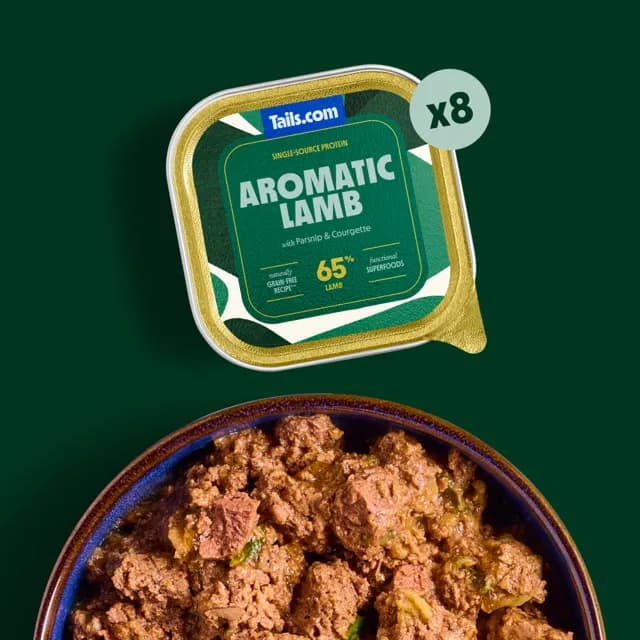
Tails.com Pate is the plainest tray in the brand's wet line up: one smooth recipe, four working entries and nothing decorative. Chicken is named at 4% inside a meat and animal derivatives base, green beans come in at 4%, and rice is declared at 2% uncooked, which the label puts at 5% once cooked. It sits in our Average band, held there by how little the list names rather than by anything in the analysis, which reads well.
Our view
Likely to suit
If your dog does better with something soft and uniform, this is that kind of dinner.
- Owners feeding a fussy eater who does well on chicken, the one animal named on this label
- Dogs that turn away from chunks, since the tray holds a single consistent texture
- Dogs that need water topped up through their food, with moisture declared at 82.0%
- Households happy with a little gentle rice, declared at 2% uncooked and 5% once cooked
- Adult dogs of every build, since one tray covers toy through to giant
Worth watching
This is a plain recipe that asks for a little trust, so it is worth seeing where you are placing it.
- Most of the tray is meat and animal derivatives, with only 4% chicken pinned to a species
- The grain reads as cereals with rice named inside it, so anything beyond that rice share is not tied to a crop
- Chicken and grain both appear here, so the tray cannot carry a dog through an elimination diet for either
- No calorie figure is printed on the label, so portions have to be worked out from an estimate
Written by our editorial team. Independent guidance, not veterinary advice.
How this scores
How we scoreThe Details
Dog fit
If your dog does better with something soft and uniform, this is that kind of dinner. This is a plain recipe that asks for a little trust, so it is worth seeing where you are placing it.
Wet
Adult
Toy, Small, Medium, Large, Giant
Chicken
The score, in context
There is a gap between how this tray reads and how it scores, and it sits in our Average band. Nutritional balance reads Outstanding here, while protein and processing comes out Average and transparency Good. Those two share a reason: a recipe whose meat, vegetables and grain are all given as categories leaves less on the label to check. Wet food as a class does well with us, and the shelf's middle lands in our Excellent band, so the distance here is real. What this is not is a poor dinner. The analysis is meat-heavy and light on starch, and a dog eating happily on it is not eating badly.
What's in it
Ingredients, as declared: Meat and animal derivatives (including 4% chicken*), Vegetables* (4% Green Beans) Cereals* (2% uncooked Rice equivalent to 5% cooked Rice), Minerals. *Natural Ingredients
Named ingredients
Nutritional additives
Vitamin D3 140.0iu/kg, Iodine (as Calcium Iodate Anhydrous) 0.3mg/kg, Zinc (as Zinc Sulphate Monohydrate) 12.0mg/kg, Manganese (as Manganous Oxide) 1.0mg/kg, Copper (as Copper Sulphate Pentahydrate) 0.5mg/kg
Ingredient notes
Four entries carry the recipe and three of them are written as categories. Meat and animal derivatives can be any warm-blooded land animal in any proportion, vegetables can be any vegetable or legume, and cereals can be any grain. The label pins down one animal, chicken at 4%, one vegetable, green beans at 4%, and one grain, rice at 2% uncooked. Everything else is left to the maker's discretion and can move from batch to batch without the tray changing.
Labelling like this is ordinary right across the wet aisle, and there is no hygiene worry in it. Category terms cover the best material as well as the worst, and some careful makers choose them to keep a recipe private. It does mean you are buying on reputation rather than on the list.
Rice is the one starch declared, at 2% before cooking and 5% after, which is a modest amount by any measure. It is gentle, digestible and about as uncontroversial as grain gets for a dog that tolerates it. Green beans at 4% are equally easy going.
On the analysis, this tray does better than its ingredient list suggests. Protein converts to 55.6% of dry matter and fat to 27.8%, and the estimated carbohydrate comes out at 2.7% of dry matter against the 15.8% that adult wet food usually shows. Whatever the category terms are covering, they are not covering a bowl of starch. Energy is not printed either, so the figure used here is our estimate from the analysis.
Minerals close the list and each addition is dosed in print: zinc at 12.0mg/kg, manganese at 1.0mg/kg, copper at 0.5mg/kg, iodine at 0.3mg/kg and vitamin D3 at 140.0iu/kg. Copper in particular is added to almost every complete food, since ingredients alone rarely land the target consistently.
Price and value
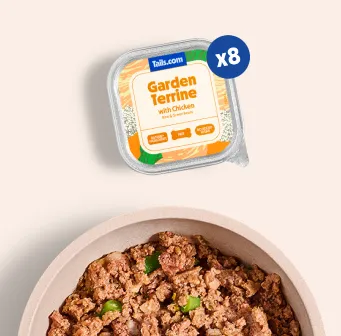
The tray comes in one size, 150 g, sold in packs of 8.
A 15kg adult dog in moderate condition would work through roughly 1061 grams a day here, on an energy estimate of about 840 kcal a day (110 × bodyweight^0.75, the standard maintenance estimate). That is a little over seven trays.
Nutritional analysis
Declared analysis
Estimated using Modified Atwater factors*
10%
5%
0.5%
2%
82%
Dry weight
55.6%
27.8%
2.8%
11.1%
2.7%
As-fed composition
Estimated breakdown of the finished product by ingredient category, from the declared ingredient list and ingoing weights. These are estimates, not measurements.
46.6%
17%
28%
8.4%
Pricing & size
- Pack size
- 150 g trays (sold in 8-tray packs)
- Retailer pricing
- Coming soon
Live retailer pricing is not yet available for this food. Prices, cost per day and where to buy will appear here once retailer data is live.
Ingredients and nutrition are taken from manufacturer data. Retailer pricing is not yet live for this food.
Related dog food guides
Ranked shortlists that include foods like this one.