


Skinner's
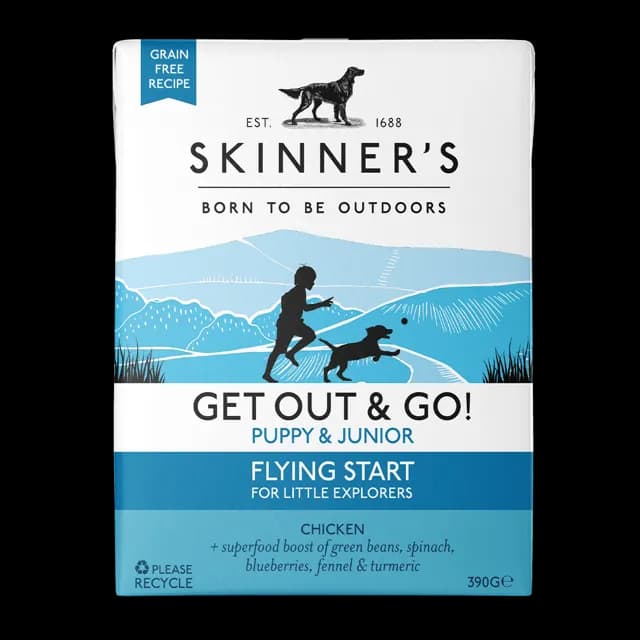
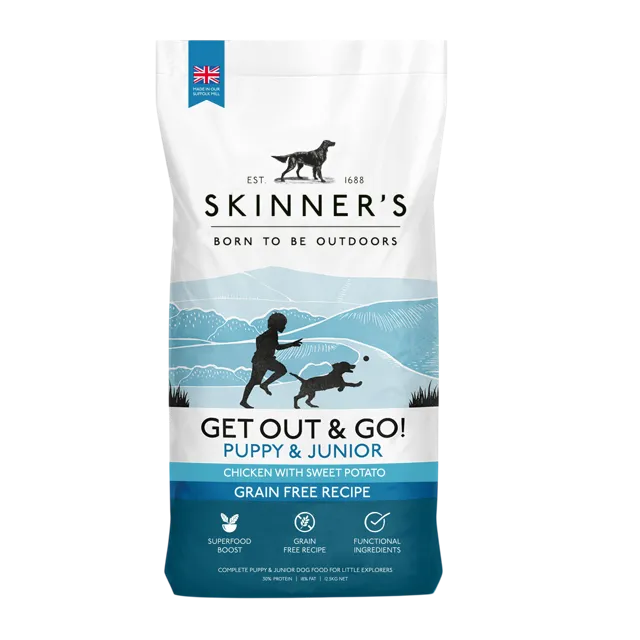
Skinner's Get Out & Go Puppy & Junior review
Skinner's Get Out & Go Puppy & Junior is the brand's grain free growth bag, and its plant side is unusually well itemised. Poultry meat meal at 28.5%, declared as at least 95% chicken, sits ahead of sweet potato chips at 17%. The list runs on through carrots, apple and parsnips at 1.2% each to kale, broccoli and spinach at 0.5%. Its transparency reads Excellent, protein is declared at 30.0%, and the food lands in our Good band.
Our view
Likely to suit
If you want a grain free growth bag whose greens are actually named and weighed, this is the label for you.
- Active pups and juniors, at 378 kcal per 100g against the 376 typical of a puppy dry food, with fat declared at 18.0%
- Grain free households, since potato flake and sweet potato chips at 17% carry the starch with no cereal at all
- Owners who like the small inclusions quantified, with kale, broccoli and spinach each at 0.5% and blueberries and cranberries at 200mg/kg
- Puppies whose owners like a named bird, since the poultry meat meal is declared at least 95% chicken
- Pups who benefit from a little gut support, with beet pulp, brewer's yeast and a yeast source of beta-glucan at 0.1% on the list
Worth watching
Before you commit to this bag, a few of the label details repay a read.
- No calcium figure is printed either, and that is the line a large breed puppy's growth plan leans on
- Pea protein sits fairly high in the order, a plant protein topping up the declared total rather than more meat
- The poultry fat names no species, worth knowing on a strict exclusion diet and less so on a preference
Written by our editorial team. Independent guidance, not veterinary advice.
How this scores
How we scoreThe Details
Dog fit
If you want a grain free growth bag whose greens are actually named and weighed, this is the label for you. Before you commit to this bag, a few of the label details repay a read.
Dry
Puppy
Toy, Small, Medium, Large, Giant
Poultry
The score, in context
This bag settles in our Good band, level with the middle of the puppy dry field.
Transparency reads Excellent, which is where the itemised plant list and the named meat meal earn their keep, and nutritional balance reads Good with protein and processing at Average behind it. The one place the label is thin is the analysis itself, which prints neither moisture nor calcium. The dry matter picture below is built on an assumed 8% moisture, and no growth plan for a big pup can be drawn from the pack.
What's in it
Ingredients, as declared: Poultry meat meal (min. 95% chicken) 28.5%, Sweet potato chips 17%, Poultry fat, Potato flake, Pea protein, Brewer's yeast, Whole linseed, Beet pulp, Peas, Dried egg, Vitamins & minerals, Carrots 1.2%, Apple 1.2%, Parsnips 1.2%, Marine algae meal, Cellulose, Kale 0.5%, Broccoli 0.5%, Spinach 0.5%, Yeast (source of beta-glucan) 0.1%, Blueberries 200mg/kg, Cranberries 200mg/kg, Yucca 200mg/kg, Fennel 150mg/kg
Named ingredients
Nutritional additives
_Nutritional additives per kg:_ | Additive | Amount | | --- | --- | | vitamin A | 15000iu/kg | | vitamin D3 | 2000iu/kg | | vitamin E (as all rac-alpha-tocopherol acetate) | 400mg/kg | _Minerals & Trace Elements:_ _(the page's own heading for this block reads "Trace Elements per kg:", but the block itself is introduced in-list as "Minerals & Trace Elements:" — the brand has mislabelled it; the in-list label is used here)_ | Additive | Amount | | --- | --- | | iron (as iron (II) sulphate monohydrate) | 26.7mg/kg | | iron (as iron (II) chelate of protein hydrolysates) | 13.3mg/kg | | iodine (as calcium iodate anhydrous) | 1.5mg/kg | | copper (as copper (II) sulphate pentahydrate) | 3.3mg/kg | | copper (as copper (II) chelate of protein hydrolysates) | 1.7mg/kg | | manganese (as manganese (II) oxide) | 16.7mg/kg | | manganese (as manganese chelate of protein hydrolysates) | 8.3mg/kg | | zin
Ingredient notes
Poultry meat meal at 28.5% is the meat content, declared as at least 95% chicken, which puts a name to most of what the generic term covers. Being a rendered dry powder, it has lost its water already. What the label prints is therefore close to what sits in the kibble. Protein is declared at 30.0%, and on the assumed moisture basis that converts to 32.6% of dry matter, a solid figure for a growth kibble.
Starch comes from potato flake and sweet potato chips at 17%, with peas behind and no cereal at all. The grain free claim holds up on the ingredients themselves. Carbohydrate estimates at 34.8% of dry matter, below the 39.0% average across puppy dry foods. That conversion rests on the assumed moisture, so read it with that in mind.
Pea protein sits high enough in the order to be worth naming. Peas leave it behind when they are processed, and it is on the list to lift the protein total. For quality and digestibility, refined plant proteins trail meat. Read this one as a supporting entry.
The produce list is the part that sets this bag apart. Carrots, apple and parsnips at 1.2% each, then kale, broccoli and spinach at 0.5% each, then blueberries and cranberries at 200mg/kg, yucca at 200mg/kg and fennel at 150mg/kg. Fibre and antioxidants come from the larger entries, a real if modest contribution. The milligram ones are garnish, and this label shows you exactly how much garnish that is.
The energy carrier added here is poultry fat, and no bird is named with it. In an otherwise specific list that is the one vague entry. Omega 3 arrives twice over, from whole linseed in its plant form and from marine algae meal in its marine one, with no fish on the label. Dried egg adds a complete protein and brewer's yeast a natural spread of B vitamins. A yeast source of beta-glucan at 0.1% and beet pulp handle the gut side, with cellulose alongside as a processed plant fibre.
The added panel is quantified: vitamin A at 15000iu, vitamin D3 at 2000iu and vitamin E at 400mg per kilogram. Each trace element appears twice, once as an inorganic salt or oxide and once as a protein hydrolysate chelate. Iron comes at 26.7mg and 13.3mg, manganese at 16.7mg and 8.3mg, copper at 3.3mg and 1.7mg, and iodine at 1.5mg.
Where the label runs short is the constituents block. Protein at 30.0%, fat at 18.0%, crude fibre at 3.5% and ash at 8.5% are printed, and then it stops. There is no moisture, so every dry matter figure here rests on the standard 8% assumption. There is no calcium either, and that is the first figure an owner of a big or giant breed pup reaches for. The energy figure of 378 kcal per 100g is declared rather than estimated, so at least that part needs no working out.
Price and value
£5.28 a kilo, sold in 2.5kg, 10kg and 12.5kg bags.
Feeding a growing dog means changing the amount as you go, so treat this as a marker. Our own energy estimate puts a 10kg puppy of 4 to 12 months at roughly 187 to 229 grams a day. From there the growth chart and your pup's outline should do the steering.
Nutritional analysis
Declared analysis
30%
18%
3.5%
8.5%
Dry weight
32.6%
19.6%
3.8%
9.2%
34.8%
As-fed composition
Estimated breakdown of the finished product by ingredient category, from the declared ingredient list and ingoing weights. These are estimates, not measurements.
29.7%
46.9%
5.4%
11.8%
6.2%
Pricing & size
- Pack size
- 2.5kg, 10kg, 12.5kg
- Retailer pricing
- Coming soon
Live retailer pricing is not yet available for this food. Prices, cost per day and where to buy will appear here once retailer data is live.
Ingredients and nutrition are taken from manufacturer data. Retailer pricing is not yet live for this food.
Related dog food guides
Ranked shortlists that include foods like this one.