



Pets at Home
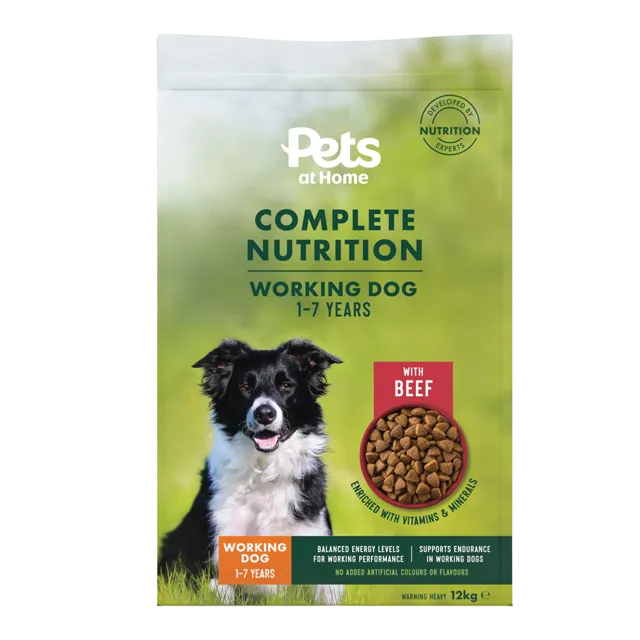
Pets at Home Complete Nutrition Working Dry review
Pets at Home Complete Nutrition Working is the plainest recipe in the shop's dry range, a five-line ingredients list built on cereals and meat and animal derivatives with 4% of the meat named as beef. There are no vegetables in it at all, and the meat entry carries no total. It lands in our Poor band. The fair reading is an everyday kibble in a big sack with no performance formula about it, since the protein and fat it declares are ordinary ones.
Our view
Likely to suit
Sometimes the simplest bag on the shelf is exactly the one you want.
- Kennels and multi-dog households buying one recipe to cover several adult dogs
- Adult dogs of every size, which is the full span this label covers
- Dogs that do well on plain food with nothing unusual in it to react to
- Dogs that get on with beef, the one meat this panel puts a name to
Worth watching
The word working on the front of the bag sets an expectation the panel does not quite meet, so go in with that in mind.
- Protein is declared at 21.0% and fat at 8.0%, ordinary figures for a dog genuinely putting in long days
- The meat entry carries no total, only the 4% beef inside it, so the meat share of the bag is not on the label
- At 9.5%, the ash figure is high, and that much mineral usually means plenty of bone in the meat used
- No moisture is declared, so the dry matter figures on this page work from the 8% a kibble usually holds
- Energy is an estimate at 314.8 kcal per 100 grams rather than a label figure, and it sits below the 357 typical of adult dry food
Written by our editorial team. Independent guidance, not veterinary advice.
How this scores
How we scoreThe Details
Dog fit
Sometimes the simplest bag on the shelf is exactly the one you want. The word working on the front of the bag sets an expectation the panel does not quite meet, so go in with that in mind.
Dry
Adult
Toy, Small, Medium, Large
Beef
The score, in context
This one finishes in our Poor band, and it is the least forthcoming label of the group. There is no meat total, no moisture figure, no vegetable content and no calcium declaration, so a fair part of this page is estimated rather than read off the bag. Put cereals in first place with three more category names beneath, and very little is left for a scoring system to reward. The typical adult dry food reaches our Good band largely by declaring more of itself.
Nothing in that suggests a healthy adult dog will come to grief on this food, and a large sack of plain complete kibble has an obvious place in a busy household. It simply means the bag will not tell you much about what your dog is eating.
What's in it
Ingredients, as declared: Cereals, Meat and Animal Derivatives (including 4% Beef), Derivatives of Vegetable Origin, Oils and Fats, Minerals.
Named ingredients
Nutritional additives
Vitamin A 17,000IU, Vitamin D3 1,500IU, Vitamin E 70mg. Trace Elements: Zinc (as Zinc Oxide) 100mg, Iron (as Iron (ll) Sulphate Monohydrate) 60mg, Manganese (as Manganese (ll) Oxide) 50mg, Copper (as Copper (II) Sulphate Pentahydrate) 8mg, Iodine (as Calcium Iodate, Anhydrous) 2.5mg, Selenium (as Sodium Selenite) 0.10mg. Technological additives: Antioxidants
Ingredient notes
The whole recipe runs to five entries, and four of those are categories: cereals, meat and animal derivatives, derivatives of vegetable origin, and oils and fats. Only the 4% beef inside the meat entry carries a species name. That is a short list even for a plain kibble, and it means the grain, the meat mix and the fat source can all change without a word on the bag changing with them.
The missing figure that matters most is the meat total. Labels of this kind normally print the percentage the meat entry accounts for, and this one gives only the 4% beef sitting inside it, which leaves the meat share of the bag to guesswork. Beef itself is a good, digestible and well-liked meat; the question is how much company it has.
The panel gives protein at 21.0%, fat at 8.0% and ash at 9.5% as fed. With the water out, protein reads 22.8%. Ash is the mineral residue left after burning, and a figure approaching double figures usually points to meat meals carrying a good deal of bone. There is no calcium declaration to check that against, which is a gap worth knowing about on any label.
Cereals and derivatives of vegetable origin do all the plant work in this recipe. No vegetables and no peas appear anywhere on the list. The carbohydrate estimate lands at 53.9% of dry matter against 46.2% typical for adult dry food, worked out on an assumed 8% moisture since the label declares none, and fibre is modest at 4.0%.
The added panel is fully dosed. Vitamin A is declared, with D3 at 1,500IU and E at 70mg, then zinc at 100mg, iron at 60mg, manganese at 50mg, copper at 8mg, iodine at 2.5mg and selenium at 0.10mg. There is no added amino acid on this label, only the vitamins and trace minerals, and the antioxidants at the end are declared by function without saying which are used.
Price and value
£1.17 a kilo, sold in a 12kg bag and no other size.
A 15kg adult in moderate condition needs about 840 kcal a day (110 × bodyweight^0.75). At an estimated 314.8 kcal per 100 grams, that is roughly 267 grams a day and about £0.31 a day. A working dog will need more than that. Feed to the condition you can feel and let the figure follow.
Nutritional analysis
Declared analysis
Estimated using Modified Atwater factors*
21%
8%
4%
9.5%
Dry weight
22.8%
8.7%
4.3%
10.3%
53.9%
As-fed composition
Estimated breakdown of the finished product by ingredient category, from the declared ingredient list and ingoing weights. These are estimates, not measurements.
28.3%
61.9%
6%
3.9%
Pricing & size
- Pack size
- 12kg - £13.99 (£1.17/kg)
- Retailer pricing
- Coming soon
Live retailer pricing is not yet available for this food. Prices, cost per day and where to buy will appear here once retailer data is live.
Ingredients and nutrition are taken from manufacturer data. Retailer pricing is not yet live for this food.
Related dog food guides
Ranked shortlists that include foods like this one.