

Pets at Home
Pets at Home Complete Nutrition Small Breed Dry review
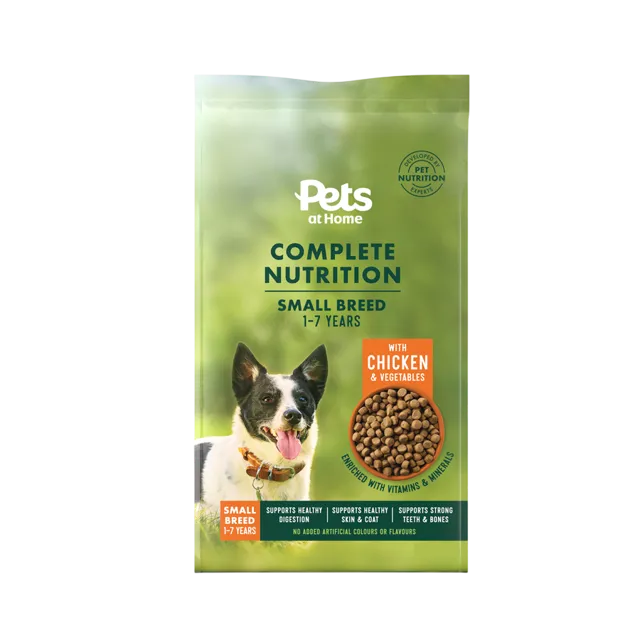
Pets at Home Complete Nutrition Small Breed takes the shop's house recipe and puts it in a bag written for little dogs. Chicken is the named meat within a 25% meat and animal derivatives entry, cereals open the panel, and dried peas are the only vegetable given a figure. Our scoring places it in the Poor band, almost entirely because the recipe describes its ingredients by category instead of naming them, and it stays a complete, uncomplicated everyday food for a small adult dog.
Our view
Likely to suit
Little dogs have small stomachs and firm opinions, and a plain kibble often suits both.
- Small breed adults, the dogs this particular bag was written around
- Owners who would rather buy a 2kg bag that gets eaten while it is fresh than a sack that stands open for months
- A dog with no quarrel with chicken, the one meat this label names
- Households picking food up alongside everything else on a trip to the shop
Worth watching
With a small dog, every mouthful counts for more, so give the panel a moment of your attention.
- A strict exclusion cannot be run from this bag, because cereals come first with no grain named
- The meat entry is 25% but only 4% of it is identified, the remainder being meat and animal derivatives
- Carbohydrate is estimated at 53.8% of dry matter against the 46.2% typical for adult dry food
- Calcium sits at 2.5% of dry matter, which is fine for a grown small dog but not a level to raise a puppy on
Written by our editorial team. Independent guidance, not veterinary advice.
How this scores
How we scoreThe Details
Dog fit
Little dogs have small stomachs and firm opinions, and a plain kibble often suits both. With a small dog, every mouthful counts for more, so give the panel a moment of your attention.
Dry
Adult
Small
Chicken
The score, in context
The Poor band on this page is a comment on the ingredients list, not on the dinner. Cereals, meat and animal derivatives, derivatives of vegetable origin and oils and fats do most of the carrying here. That leaves a label reader very little to verify, and our scoring credits only what is declared. Most adult dry foods reach our Good band, and naming their parts is a good share of how they get there.
Underneath the vagueness this is a normal complete kibble with a vitamin and mineral panel dosed in full, and a small dog fed sensible portions of it will be perfectly well nourished.
What's in it
Ingredients, as declared: Cereals, Meat and Animal Derivatives (25% including 4% Chicken), Derivatives of Vegetable Origin, Oils and Fats, Vegetables (1.3% Dried Peas, equivalent to 4% Peas), Minerals.
Named ingredients
Nutritional additives
Vitamins: Vitamin A 17,000IU, Vitamin D3 1,500IU, Vitamin E 70mg. Amino Acids: Methionine 1,500mg. Trace Elements: Zinc (as Zinc Oxide) 100mg, Iron (as Iron (ll) Sulphate Monohydrate) 60mg, Manganese (as Manganese (ll) Oxide) 50mg, Copper (as Copper (II) Sulphate Pentahydrate) 8mg, Iodine (as Calcium Iodate, Anhydrous) 2.5mg, Selenium (as Sodium Selenite) 0.10mg. Technological additives: Antioxidants
Ingredient notes
The order on the panel puts cereals first, which means grain is the single largest component of the bag. No grain is specified, which keeps the recipe flexible for whoever is milling it and leaves you guessing between wheat, maize and rice. Derivatives of vegetable origin, two lines later, is the same kind of umbrella held over the plant side.
One quarter of the recipe is declared as meat and animal derivatives, and 4% of that quarter is named as chicken. The unnamed portion is legally defined as parts of slaughtered warm-blooded land animals, which spans everything from decent muscle trim to the least glamorous offcuts. What reaches the bowl is 25.0% protein on a dry matter basis, a fair figure for an everyday kibble.
Vegetables amount to 1.3% dried peas, printed with their pre-drying equivalent of 4%, and nothing more. Whole peas are a genuinely useful ingredient, rich in fibre and a spread of vitamins. At this level, though, they are a nod in the right direction and little more.
Oils and fats is the recipe's third category name, so the fat source stays unknown even though fat is where a small dog gets much of its energy. Declared fat is 7.0% and energy comes to 328 kcal per 100 grams, a shade under the 357 typical for adult dry food. The daily portion is therefore a little larger than on a richer recipe.
Every addition carries a dose on the label. Vitamin A, D3 at 1,500IU and E at 70mg, methionine at 1,500mg, then zinc at 100mg, iron at 60mg, manganese at 50mg, copper at 8mg, iodine at 2.5mg and selenium at 0.10mg. The forms are the plain ones, zinc oxide and sodium selenite, which dogs absorb less readily than chelated minerals and organic selenium, though a complete panel dosed in print is still worth having.
Price and value
£1.17 a kilo in the 7.5kg bag and £1.25 a kilo in the 2kg.
Taking a 15kg adult in moderate condition as the standard comparison, that is about 256 grams a day from a target of roughly 840 kcal (110 × bodyweight^0.75, the usual maintenance estimate). That comes to about £0.30 a day. Scale that down to your own dog, since most dogs this bag is aimed at weigh a good deal less, and portion to the waistline.
Nutritional analysis
Declared analysis
23%
7%
4.5%
8%
8%
Dry weight
25%
7.6%
4.9%
8.7%
53.8%
As-fed composition
Estimated breakdown of the finished product by ingredient category, from the declared ingredient list and ingoing weights. These are estimates, not measurements.
27.4%
59.9%
4.5%
5.8%
2.4%
Pricing & size
- Pack size
- 2kg - £2.49 (£1.25/kg) · 7.5kg - £8.79 (£1.17/kg)
- Retailer pricing
- Coming soon
Live retailer pricing is not yet available for this food. Prices, cost per day and where to buy will appear here once retailer data is live.
Ingredients and nutrition are taken from manufacturer data. Retailer pricing is not yet live for this food.
Related dog food guides
Ranked shortlists that include foods like this one.