



Pedigree
Pedigree Tender Goodness Small Dog Dry review
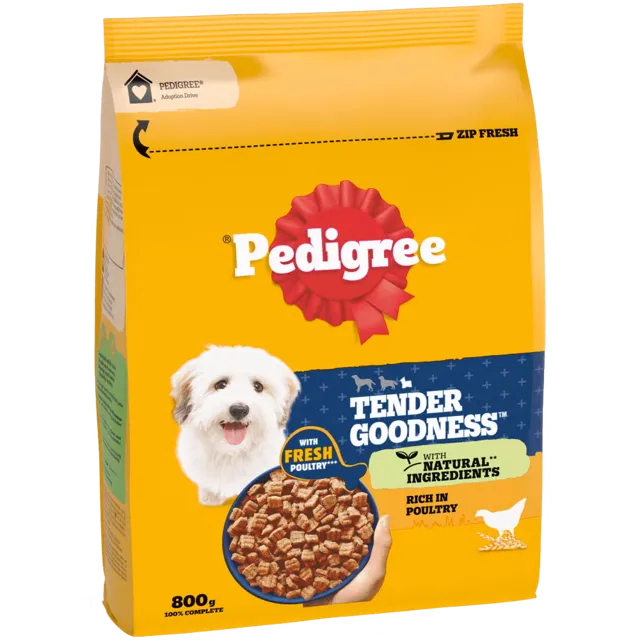
Pedigree Tender Goodness Small Dog is a soft, small-bite kibble for little mouths, and it is unusually moist for a dry food at 17% declared. A quarter of the recipe is animal content, with poultry pinned at 17% and fresh poultry at 4%, while the rest of the label is written in broad groups, from cereals to oils and fats. It sits in our Poor band, and what that measures is the label, which pins very little down. It is not a judgement on how a small dog gets on with the bowl.
Our view
Likely to suit
If your small dog does better with something softer than a hard, rattly biscuit, this is built exactly that way.
- Small adult dogs, the size both the kibble and the feeding table are written around
- Older small dogs and gentler mouths, since the extra moisture keeps each piece soft rather than sharp
- Dogs that get on with poultry, the only animal family the label names
- Owners who would sooner grab the bag with the weekly shop than wait on a delivery
Worth watching
Keep these label details in mind before you fill the bowl.
- Cereals, derivatives of vegetable origin and oils and fats are named only by category, so this cannot anchor an elimination diet
- The word poultry takes in goose, duck, turkey and chicken, so a dog with a known problem with one particular bird is neither ruled in nor out
- Fresh poultry is 4% of the recipe, with the remainder of the animal share arriving in dried and rendered forms
- The feeding table stops at 10kg, so a bigger dog is being fed outside what the label plans for
Written by our editorial team. Independent guidance, not veterinary advice.
How this scores
How we scoreThe Details
Dog fit
If your small dog does better with something softer than a hard, rattly biscuit, this is built exactly that way. Keep these label details in mind before you fill the bowl.
Dry
Adult
Toy, Small, Medium, Large, Giant
Poultry
The score, in context
Our scoring puts this in the Poor band, two bands under the Good band where the middle of the adult dry shelf settles. Most of that gap is about naming rather than about anything in the bowl. Cereals, derivatives of vegetable origin and oils and fats tell you the category and not the ingredient, and only part of the animal content is tied even to poultry. The analysis reads ordinary and holds nothing alarming. Protein converts to 25.3% of dry matter and estimated carbohydrate to 47.8%, against 46.2% for the typical adult dry food. Fed to the small adult dog it was designed around, it stays an easy, gentle bowl.
What's in it
Ingredients, as declared: Cereals*, Meat and Animal Derivatives (25%, including Poultry 17%, of Which Fresh Poultry 4%*), Derivatives of Vegetable Origin (including Dried Beet Pulp 3%*), Oils and Fats, Minerals, Vegetables* (including Dried Carrots 0.5%, Equivalent to Carrots 4%), *Natural ingredients
Named ingredients
Nutritional additives
Additives per kg:, Antioxidants:, Nutritional additives:, Vitamin D3: 1406 IU, Vitamin E: 100 mg, Copper (Copper(II) sulphate pentahydrate): 6.0 mg, lodine (Potassium iodide): 1.5 mg, Manganese (Manganous sulphate, monohydrate): 18.0 mg, Selenium (Sodium selenite): 0.15 mg, Zinc (Zinc sulphate, monohydrate): 51.0 mg
Ingredient notes
Moisture is declared at 17%, which is high for a kibble and is the whole point of the name. More water left in means a softer piece that a small mouth can break down without effort. It also means each gram carries a little less dry nutrition than a crunchier biscuit would, and the energy figure follows at 331 kcal per 100g where the typical adult dry food runs at 357.
The animal side is declared as meat and animal derivatives at 25%, with poultry pinned at 17% and fresh poultry at 4%. That leaves part of the animal content unnamed, and poultry itself covers any domestic fowl. Read plainly, a quarter of the recipe is animal and a good deal of it comes from the bird family without saying which bird.
Cereals leads the list without saying which grain, and derivatives of vegetable origin sits behind it in the same broad style. Wording like that can cover good grain or plain grain, and the label does not settle the question either way. Dried beet pulp at 3% is the one named entry among them, included for fibre and for keeping digestion regular.
Vegetables get one specific mention, dried carrots at 0.5%, which the label helpfully translates as the equivalent of 4% fresh carrots. Carrots bring vitamin A, soluble fibre and antioxidants, and they cook down into a form a dog digests easily. At 0.5% they are a garnish on the label.
Each added mineral has its dose printed: zinc at 51 mg, manganese at 18 mg, copper at 6 mg, iodine at 1.5 mg and selenium at 0.15 mg per kilo. Vitamin D3 is at 1406 IU and vitamin E at 100 mg. Sulphates do the job here in place of chelates, the everyday choice on this part of the shelf. Selenium arrives as sodium selenite, like most of the category. At 1.69% of dry matter, calcium sits easily for a grown dog.
Price and value
Sold in an 800g bag.
The label's own feeding guide is written around small dogs, asking 30 to 35 grams a day at 1kg, 95 to 105 grams at 5kg and 160 to 180 grams at 10kg. Let the waistline set the portion, and change it as your dog's shape asks you to.
Nutritional analysis
Declared analysis
21%
12%
2.4%
7.9%
17%
Dry weight
25.3%
14.5%
2.9%
9.5%
47.8%
As-fed composition
Estimated breakdown of the finished product by ingredient category, from the declared ingredient list and ingoing weights. These are estimates, not measurements.
25%
57.2%
3.7%
7.3%
6.8%
Pricing & size
- Pack size
- 800g
- Retailer pricing
- Coming soon
Live retailer pricing is not yet available for this food. Prices, cost per day and where to buy will appear here once retailer data is live.
Ingredients and nutrition are taken from manufacturer data. Retailer pricing is not yet live for this food.
Related dog food guides
Ranked shortlists that include foods like this one.