
Skip to content
Off the Leash
Pedigree Senior Dry – —

Pedigree

Pedigree Senior Dry review

25.1/100Poor
DryAdultSenior

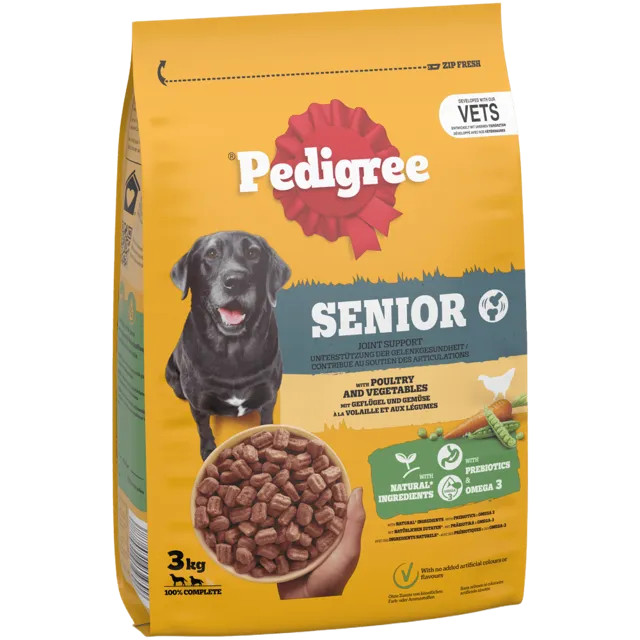
Pedigree Senior is the most specific label in the brand's dry range, and its differences fall in the right places for an older dog. Protein is up at 24%, fat is pulled back to 8%, rice is named at 4% inside the cereals and there is a small measured helping of fish oil at 0.25%. Cereals still lead the list and the meat is still declared as meat and animal derivatives with 4% named as poultry. It sits in our Poor band. The band measures how much of the recipe goes unnamed rather than how well the food suits the dog on the front of the pack.

Where to buy: coming soon
Live retailer pricing is coming soon. Once we have prices from UK retailers, the best price, cost per day and where to buy will appear here.

Our view

Likely to suit

An older dog usually wants a little more protein and a little less fat, and this recipe moves in both directions at the same time.

  • Older dogs easing off, since protein sits at 24% and fat is held to 8%
  • Owners feeding an adult and a senior together, since this bag is labelled for both
  • Dogs of any size in their later years, from a small terrier through to a giant breed
  • Owners who want omega 3 in the bowl, with fish oil declared and quantified at 0.25%
  • Older dogs whose digestion has turned delicate, with rice named at 4% and beet pulp at 3% behind it

Worth watching

Read these label details closely before you make this the regular bag.

  • There is fish oil in the oils and fats, worth knowing if your dog has reacted to fish before
  • The named animal protein is poultry at 4%, which leaves the particular bird unspecified
  • The cereals beyond the named rice go unnamed, so the rest of the grain can vary between batches
  • Estimated carbohydrate works out at 53.9% of dry matter against the 46.2% typical for adult dry food

Written by our editorial team. Independent guidance, not veterinary advice.

How this scores

How we score
25.1/100Poor
Protein and processingPoor
Nutritional balanceAverage
TransparencyGood
ValuePoor

The Details

Dog fit

An older dog usually wants a little more protein and a little less fat, and this recipe moves in both directions at the same time. Read these label details closely before you make this the regular bag.

Food type

Dry

Life stage

Adult, Senior

Breed size

Toy, Small, Medium, Large, Giant

Main protein

Poultry

The score, in context

The typical adult dry food occupies our Good band; this one reads Poor, and the reasons sit on the ingredients list rather than in the analysis. Protein at 26.1% of dry matter with fat at only 8.7% is a sensible pairing for an older dog, and nothing in the panel is out of place. What holds the reading down is naming, because cereals, meat and animal derivatives, oils and fats and derivatives of vegetable origin between them account for most of the bag. An owner who wants a soft landing for an older dog, and is not chasing a named-ingredient label, gets exactly that here.

What's in it

Ingredients, as declared: Cereals* (including Rice 4%), Meat and Animal Derivatives (including Poultry 4%), Derivatives of Vegetable origin (including Dried Beet Pulp 3%*), Oils and Fats (including Fish Oil 0.25%), Minerals, Vegetables* (including Dried Peas and Carrots Mix 0.7%, equivalent to Peas and Carrots Mix 4%), Yeast (including Brewer's Yeast 0.4%), *Natural Ingredients

Named ingredients

Cereals* (including Rice 4%), Meat and Animal Derivatives (including Poultry 4%), Derivatives of Vegetable origin (including Dried Beet Pulp 3%*), Oils and Fats (including Fish Oil 0.25%), Minerals, Vegetables* (including Dried Peas and Carrots Mix 0.7%, equivalent to Peas and Carrots Mix 4%), Yeast (including Brewer's Yeast 0.4%), *Natural Ingredients

Nutritional additives

Additives per kg:, Antioxidants, Preservatives:, Nutritional additives:, Vitamin B₁: 16 mg, Vitamin D₃: 1687 IU, Vitamin E: 100 mg, Biotin: 0.22 mg, Copper (Copper(II) sulphate pentahydrate): 8.1 mg, Iodine (Potassium iodide): 2 mg, Manganese (Manganous sulphate, monohydrate): 22.5 mg, Selenium (Sodium selenite): 0.1 mg, Zinc (Zinc sulphate, monohydrate): 63.7 mg

Ingredient notes

The senior thinking shows up in small, specific places. Rice is named at 4% within the cereal block. Of the common grains it is the kindest to an older digestion. Fish oil is declared at 0.25% inside the oils and fats, and that is the source of the long chain omega 3s here. Neither is a large inclusion. Both are printed with a figure though, and a number on the panel tells you more than a front-of-pack claim does.

The bulk of the recipe stays as it is elsewhere in the range. Cereals lead without further naming, meat and animal derivatives follow with poultry pinned at 4%, and derivatives of vegetable origin carries dried beet pulp at 3%. As a fermentable fibre, beet pulp keeps a stool holding its shape. That matters more with every passing year.

The declared analysis is the part of this label doing the real senior work. Protein converts to 26.1% of dry matter with fat at 8.7%, so an older dog takes in the amino acids it needs to hold muscle without the calories that settle on a slowing frame. Fibre reads 3.8% and energy is declared at 344 kcal per 100g, a deliberately unexciting picture that on a senior food counts as a compliment.

The vegetable share is a dried mix of peas and carrots at 0.7%. The pack puts that at the equivalent of 4% before drying. Brewer's yeast at 0.4% supplies B vitamins. Both are flourishes on the label. Nothing important in the recipe leans on them.

The added nutrition is dosed line by line: vitamin B1 at 16 mg, vitamin D3 at 1687 IU, vitamin E at 100 mg and biotin at 0.22 mg per kilo. The minerals follow, with zinc at 63.7 mg, manganese at 22.5 mg, copper at 8.1 mg and iodine at 2 mg. Calcium works out at 1.41% of dry matter, comfortable for a grown or elderly dog. Antioxidants and preservatives are the exception, declared by category and not by name.

Price and value

Sold as a 1.4kg bag. No price had been checked for this range at the time of writing. There is no per-kilo or per-day cost figure here as a result.

The standard maintenance estimate, around 840 kcal a day for a 15kg adult in moderate condition (110 × bodyweight^0.75), puts the daily amount near 244 grams. The label itself asks 125 to 135 grams at 10kg and 210 to 230 grams at 20kg, a shade leaner than our estimate. Your dog's waistline is the better guide to the difference.

Nutritional analysis

Declared analysis

Energy
344 kcal/100g
Protein

24%

Fat

8%

Fibre

3.5%

Ash

6.9%

Moisture

8%

Dry weight

Protein

26.1%

Fat

8.7%

Fibre

3.8%

Ash

7.5%

Carbs

53.9%

As-fed composition

Estimated breakdown of the finished product by ingredient category, from the declared ingredient list and ingoing weights. These are estimates, not measurements.

Meat

26.7%

Carbs

58.5%

Veg

2.9%

Oils

5.6%

Other

6.2%

Pricing & size
Pack size
1.4kg
Retailer pricing
Coming soon

Live retailer pricing is not yet available for this food. Prices, cost per day and where to buy will appear here once retailer data is live.

Ingredients and nutrition are taken from manufacturer data. Retailer pricing is not yet live for this food.

Related dog food guides

Ranked shortlists that include foods like this one.
All reviews

Featured feeding accessories

All feeding accessories

Brackenwood

Slow Feeder Maze Bowl

Slows fast eaters and eases gulping at mealtimes.

From £12.99· 4 retailers
View

Tarn & Co

Raised Double Diner

Height-set stand for easier, tidier eating.

From £28.99· 3 retailers
View

Reviewed by Off the Leash Editorial

Last updated 28 August 2026