


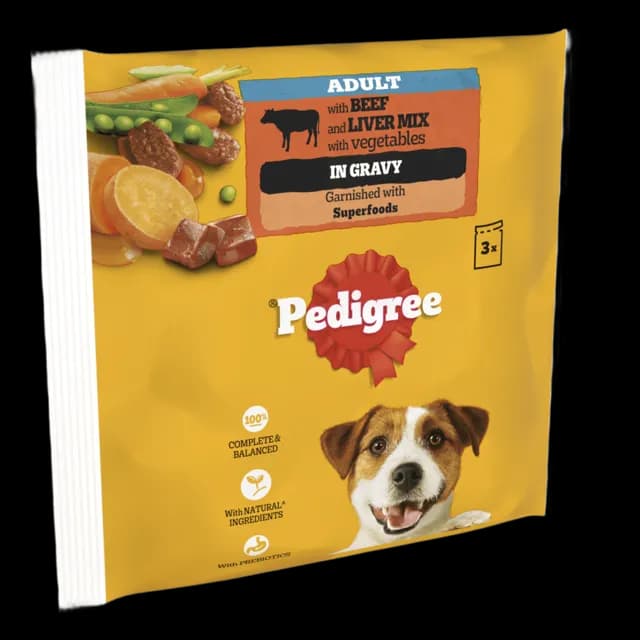

Pedigree
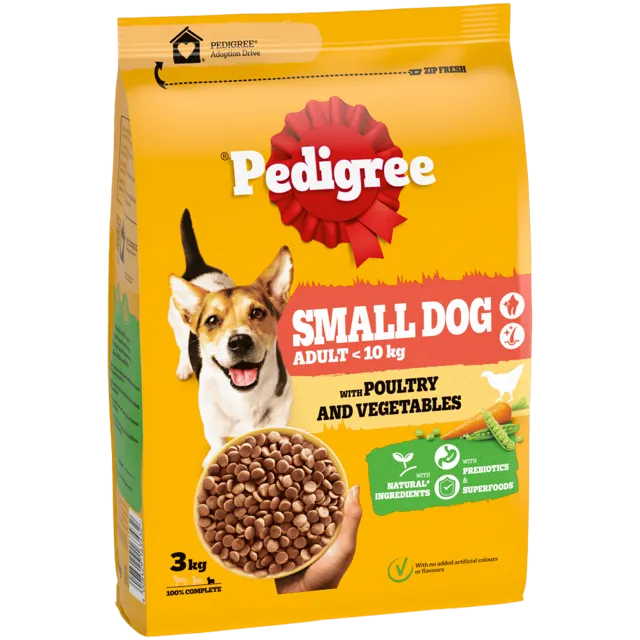
Pedigree Adult Small Dog Dry review
Pedigree Adult Small Dog is the familiar recipe scaled for a smaller mouth. It carries one entry the larger bags do not: sodium tripolyphosphate at 0.4%, put there to slow the tartar little breeds are so prone to. Cereals lead, meat and animal derivatives follow with 4% named as poultry, beet pulp and a peas and carrots mix sit behind them, and the feeding table starts at a dog of just 1kg. It sits in our Poor band, and as elsewhere in this range that is a verdict on a label which names very little rather than on anything in the bowl.
Our view
Likely to suit
Little dogs hold strong opinions about dinner, and a kibble they already recognise can be worth a great deal to a household.
- Owners of small and toy adults, with a kibble sized for a smaller jaw and a chart that begins at a 1kg dog
- Small dogs prone to tartar, since sodium tripolyphosphate is included specifically to slow it forming
- Households that measure carefully, because the label steps up in small increments through the lighter weights
- Owners who want a familiar complete food with its full vitamin and trace mineral panel printed per kilo
Worth watching
A careful reader will want these four label points.
- The only named animal is poultry at 4%, a term stretching over chicken and turkey and duck and goose without settling on one
- The cereals go unnamed, so the grain in the bag can change between production runs
- Estimated carbohydrate reaches 58.4% of dry matter, well above the 46.2% typical for an adult dry food
- With no moisture declared, the dry matter figures on this page take 8% as the dry food standard
Written by our editorial team. Independent guidance, not veterinary advice.
How this scores
How we scoreThe Details
Dog fit
Little dogs hold strong opinions about dinner, and a kibble they already recognise can be worth a great deal to a household. A careful reader will want these four label points.
Dry
Adult
Toy, Small, Medium, Large, Giant
Poultry
The score, in context
Our scoring lands this food in our Poor band, two bands below the Good the typical adult dry food reaches. The distance comes down to three plain readings: protein of 21.7% of dry matter, estimated carbohydrate of 58.4%, and an ingredients list on which nearly every line is a category rather than a nameable thing. Set against that, the food is complete, its added nutrition is dosed properly, the dental ingredient is a real one, and small dogs tend to eat it with enthusiasm. It does the basic job without telling you much about itself.
A low band here is not a warning, and that is worth saying plainly. What the band measures is how much of the recipe a reader can actually see. On a settled small dog with no dietary complaints, this remains an easy food to keep in the cupboard.
What's in it
Ingredients, as declared: Cereals*, Meat and Animal Derivatives (including Poultry 4%), Oils and Fats, Derivatives of Vegetable Origin (including Dried Beet Pulp 3%*), Minerals (including Sodium Tripolyphosphate 0.4%), Vegetables* (including Dried Peas and Carrots Mix 0.7%, equivalent to Peas and Carrots Mix 4%), Yeast (including Brewer's Yeast 0.4%), *Natural ingredients, Cereals*, Meat and Animal Derivatives (including Poultry 4%), Oils and Fats, Derivatives of Vegetable Origin (including Dried Beet Pulp* 3%), Minerals (including Sodium Tripolyphosphate 0.4%), Vegetables*(including Dried Peas and Carrots Mix 0.7%, Equivalent to Peas and Carrots Mix 4%), Yeast (including Brewer's Yeast 0.4%), *Natural Ingredients
Named ingredients
Nutritional additives
- _3kg:_ Additives per kg:, Antioxidants, Nutritional additives:, Vitamin B₁: 8.8 mg, Vitamin B₂: 15.1 mg, Vitamin D₃: 1406 IU, Vitamin E: 100 mg, Biotin: 0.21 mg, Copper (Copper(II) sulphate pentahydrate): 6.6 mg, Iodine (Potassium iodide): 1.7 mg, Manganese (Manganous sulphate, monohydrate): 20.3 mg, Selenium (Sodium selenite): 0.33 mg, Zinc (Zinc sulphate, monohydrate): 57.4 mg - _1.4kg:_ Additives per kg:, Antioxidants, Preservatives, Nutritional additives:, Vitamin B₂: 15.1 mg, Vitamin D₃: 1406 IU, Vitamin E: 100 mg, Biotin: 0.21 mg, Copper (Copper(II) sulphate pentahydrate): 6.6 mg, lodine (Potassium lodide): 1.7 mg, Manganese (Manganous sulphate, monohydrate): 20.3 mg, Selenium (Sodium selenite): 0.33 mg, Zinc (Zinc sulphate, monohydrate): 57.4 mg
Ingredient notes
Sodium tripolyphosphate at 0.4% is the entry that separates this bag from the rest of the range. It does its work in the mouth, binding the calcium in saliva so that plaque has a harder time hardening into tartar. Small breed and dental kibbles have carried it for a long time. A toothbrush still does more, and on a breed with crowded teeth this is a welcome thing to see on the list.
Above it, the construction follows the pattern of the range. Cereals come first without a name attached. Meat and animal derivatives are second, with poultry pinned at 4%, and oils and fats sit behind them unnamed as well. A dog that has struggled with one particular bird cannot be steered around it here, since poultry stands for four species at once.
Derivatives of vegetable origin brings dried beet pulp at 3%, a fermentable fibre that helps a small dog produce a firmer stool. The vegetable share comes to 0.7% of dried peas and carrots, noted on the pack as the equivalent of 4% before drying. Brewer's yeast at 0.4% is the final named entry and a genuine source of B vitamins.
The analysis reads gently: protein at 21.7% of dry matter, fat at 9.8% and fibre at 2.5%, with energy declared at 354 kcal per 100g. That is an unremarkable plate by design. A small dog with a settled routine and no dietary complaints will find nothing in it to cause trouble.
The added vitamins and minerals are printed in full, pitched a little higher per kilo than on the bigger bags. That is what a dog eating smaller amounts needs. Vitamin B2 comes at 15.1 mg, vitamin D3 at 1406 IU, vitamin E at 100 mg and biotin at 0.21 mg. Zinc is at 57.4 mg, manganese at 20.3 mg, copper at 6.6 mg, iodine at 1.7 mg and selenium at 0.33 mg. The antioxidants and preservatives, by contrast, are given as categories with no names.
Price and value
Sold in 1.4kg and 3kg bags. We had no checked price when this page was written, and no per-kilo or daily cost is quoted below.
On the standard estimate of around 840 kcal a day for a 15kg adult in moderate condition (110 × bodyweight^0.75), the daily amount would come to about 237 grams. A small dog is only a fraction of that reference weight, and the label reflects it: 25 to 30 grams at 1kg, 90 to 100 grams at 5kg and 150 to 165 grams at 10kg.
Nutritional analysis
Declared analysis
20%
9%
2.3%
7%
Dry weight
21.7%
9.8%
2.5%
7.6%
58.4%
As-fed composition
Estimated breakdown of the finished product by ingredient category, from the declared ingredient list and ingoing weights. These are estimates, not measurements.
27.6%
54.1%
3%
9%
6.4%
Pricing & size
- Pack size
- 1.4kg, 3kg
- Retailer pricing
- Coming soon
Live retailer pricing is not yet available for this food. Prices, cost per day and where to buy will appear here once retailer data is live.
Ingredients and nutrition are taken from manufacturer data. Retailer pricing is not yet live for this food.
Related dog food guides
Ranked shortlists that include foods like this one.