



Pala
Pala Turkey, Duck & Herring review
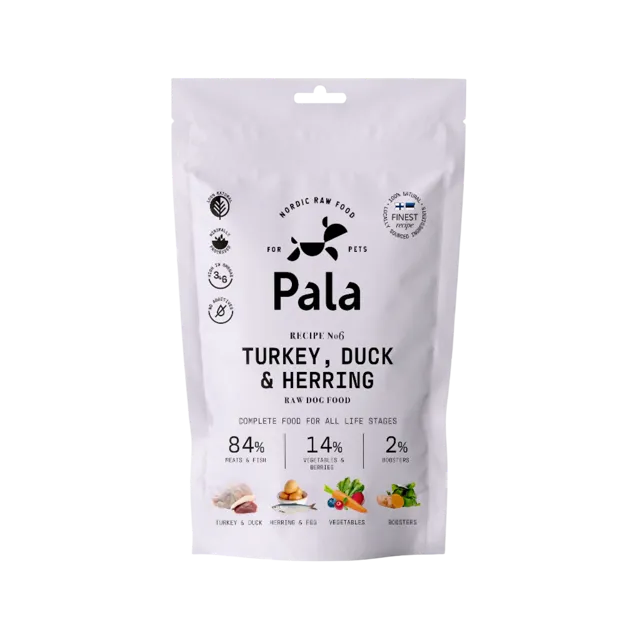
Pala Turkey, Duck & Herring is built from four named animals and a garden. Turkey takes 39%, duck and herring take 19% apiece and egg adds 3%, then spinach, carrot, banana, cabbage, beet and squash follow with berries and kelp behind them. The label promises no synthetic preservatives and keeps that promise with natural tocopherols and rosemary extract, and the analysis comes out unusually rich, fat reaching 33.6% straight from the bag. It sits in our Good band.
Our view
Likely to suit
A dog that eats better when dinner actually smells of dinner will take to this bag quickly.
- Dogs with an appetite for poultry, since turkey and duck carry the greater part of the recipe between them
- Owners who prefer natural preservation, with tocopherols and rosemary extract keeping the fat fresh
- Working and sporting dogs, because the energy here arrives densely packed
- Small breeds whose bowls need very little, given how much sits in each spoonful
- Families feeding one bag to a puppy, to an adult and to an older dog, with all three stages on the pack
Worth watching
Before you settle on this recipe, give these details a moment.
- Turkey, duck, herring and egg all share the label, so neither a fish free bowl nor a single protein plan works here
- Fat is declared at 33.6%, lively enough that a settled, gentle dog wants a measured portion rather than a generous one
- No calcium figure appears anywhere on the label, worth a question to Pala before a large breed puppy eats it
Written by our editorial team. Independent guidance, not veterinary advice.
How this scores
How we scoreThe Details
Dog fit
A dog that eats better when dinner actually smells of dinner will take to this bag quickly. Before you settle on this recipe, give these details a moment.
Dry
Puppy, Adult, Senior
Toy, Small, Medium, Large, Giant
Turkey
The score, in context
A label like this gives our scoring very little to guess at. Four animal entries each carry a figure, the plant side runs all the way down to the herbs, and nothing arrives as a category. The recipe lands in our Good band, with nutritional balance and transparency both Outstanding, while protein and processing and value read Good. There is no settled air-dried cohort for us to hold it against, so nothing in that band comes from a comparison; it is what the label itself declares.
What's in it
Ingredients, as declared: Turkey (39%), Duck (19%), Herring (19%), Egg (3%), spinach, carrot, banana, cabbage, beet, squash, wheat grass, kelp, sea buckthorn, cranberry, blueberry, sea salt, turmeric, black pepper, natural tocopherols with rosemary extract, citrus bioflavonoids. 100% natural. No additives, supplements, flavours or synthetic preservatives.
Named ingredients
Ingredient notes
Dehydration changes what a percentage is worth. The meat here gave up its water before the recipe was weighed. That is why turkey at 39%, duck at 19% and herring at 19% stand for much more real animal than those same figures would on a fresh meat kibble. Much of that weight leaves in the oven. Protein comes out at 37.5% as fed, which converts to 41.7% of dry matter.
The two birds do different jobs. Turkey is the leaner of the pair and the one most often chosen for gentle diets, while duck brings richer meat and a flavour that wins over dogs who pick at their food. Egg at 3% is a small entry doing outsized work, because no protein digests much better than egg does. Herring adds the marine fatty acids the birds cannot supply.
Richness is the headline of the analysis. Fat is declared at 33.6% as fed and 37.3% of dry matter, energy reaches 491 kcal in each 100g, and the estimated carbohydrate stays modest at 10.6% of dry matter. Feed this the way you would feed a concentrate: weigh the first week, then let your hands on the ribs settle the portion.
The plant list is unusually long for a food this meat heavy, running from spinach, carrot and cabbage through beet and squash to sea buckthorn, cranberry and blueberry, with kelp supplying iodine and trace minerals. Turmeric, sea salt and black pepper finish the list, and citrus bioflavonoids sit alongside the tocopherols as antioxidants.
The label states that nothing synthetic goes in, and the preservation is done by natural tocopherols with rosemary extract, the vitamin E family compounds that slow fats turning rancid. The other side of that approach is that no dosed vitamin and mineral panel is printed, so the micronutrition rests on the ingredients rather than on figures you can check line by line.
Price and value
£42.95 a kilo, with 100g, 400g and 1kg bags available.
Feeding a 15kg adult dog in moderate condition comes to roughly 171 grams a day and £7.35 a day, taking about 840 kcal a day as the target (110 × bodyweight^0.75, the standard maintenance estimate). Pala's own chart is a shade lighter again, listing 141 grams for that dog.
Nutritional analysis
Declared analysis
37.5%
33.6%
2.3%
7%
10%
Dry weight
41.7%
37.3%
2.6%
7.8%
10.6%
As-fed composition
Estimated breakdown of the finished product by ingredient category, from the declared ingredient list and ingoing weights. These are estimates, not measurements.
44.4%
55.6%
Pricing & size
- Pack size
- 100 g (PALA-06-0100) · 400 g (PALA-06-0400) · 1 kg (PALA-06-1000)
- Retailer pricing
- Coming soon
Live retailer pricing is not yet available for this food. Prices, cost per day and where to buy will appear here once retailer data is live.
Ingredients and nutrition are taken from manufacturer data. Retailer pricing is not yet live for this food.
Related dog food guides
Ranked shortlists that include foods like this one.