



More
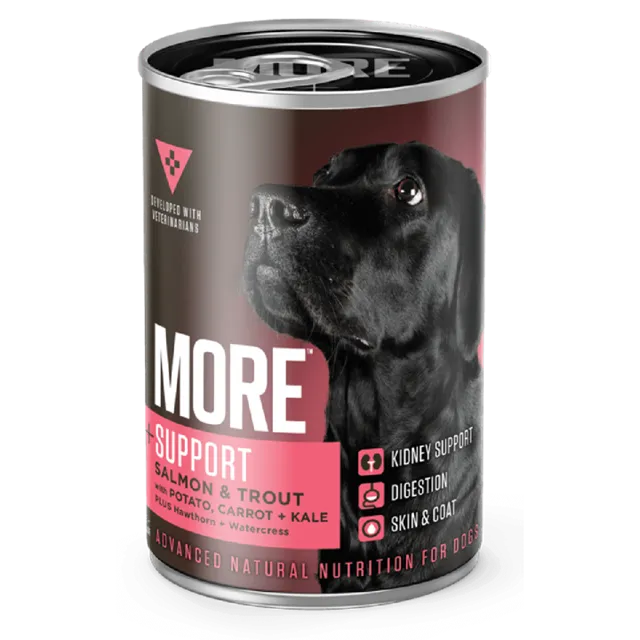
More Kidney Support Wet Food review
More Kidney Support Wet Food is the fish recipe in the More line-up, and it names its species outright. Salmon and trout take 31% each, fish broth adds 25%, and potato, carrots and kale fill in behind them. Our Excellent band holds it, and at 121 kcal per 100g it carries more energy than most wet food, so portions run a little smaller.
Our view
Likely to suit
If your dog eats better when the bowl smells of the sea, this recipe plays straight to that.
- A dog who prefers fish, and here salmon and trout each take 31%
- Owners who want species rather than a vague fish description, since both are printed by name
- Lighter eaters and smaller dogs, since a richer recipe at 121 kcal per 100g means less of it goes in the bowl
- Households avoiding grain, as potato at 7% carries the starch on its own
- Older dogs kept on the same food as the adults around them, since one recipe serves both
Worth watching
Before you lean on the name, it is worth seeing what the analysis panel actually declares.
- Phosphorus is the figure that matters most for a dog with diagnosed kidney disease, and this label does not print one, so use it alongside a vet's plan and not in place of one
- Crude ash runs a little high for a wet recipe, converting to 13.6% of dry matter
- Salmon and trout share the recipe, so it cannot anchor an elimination diet for a dog reacting to either
Written by our editorial team. Independent guidance, not veterinary advice.
How this scores
How we scoreThe Details
Dog fit
If your dog eats better when the bowl smells of the sea, this recipe plays straight to that. Before you lean on the name, it is worth seeing what the analysis panel actually declares.
Wet
Adult, Senior
Toy, Small, Medium, Large, Giant
Fish
The score, in context
This one settles in our Excellent band. The category scores well with us and the typical adult recipe reaches the same band, so the interesting part is where this label gains ground and where it gives some back. Nutritional balance reads Outstanding on the strength of the analysis. Protein and processing and transparency both read Excellent, held back from more by a broth described only as fish and by an added panel that leaves one vitamin without a number. Two named fish species on a wet label is still more than the shelf usually offers.
What's in it
Ingredients, as declared: 62% Fish (composed of 31% Salmon, 31% Trout), Fish Broth (25%), Potato (7%), Carrots (3%), Kale (1%), Minerals (1%), Linseed Oil (0.5%), Coriander (0.1%), Hawthorn (0.1%), Watercress (0.1%)
Named ingredients
Nutritional additives
Antioxidants: Vitamin A, Zinc as zinc sulfate monohydrate (3b605) 25mg, Manganese as manganous sulphate monohydrate (3b503) 1.4mg, Iodine as Calcium Iodate Anhydrous (3b202) 0.75mg, Copper as Copper (II) sulphate pentahydrate (3b405) 2mg
Ingredient notes
The fish comes to 62%, split evenly at 31% salmon and 31% trout. Naming two species and giving each its own percentage is unusual on a wet label, where a general fish or white fish description is the norm. It is exactly the detail a household with an avoidance list needs. Protein converts to 44.5% of dry matter and fat to 26.8%, a rich, oily reading that suits the fish.
Fish broth at 25% gets a percentage but not a species. The likely answer is salmon, trout or both, and the label leaves it open, which is the one place this ingredient list stops short of the standard it sets elsewhere.
Behind the fish, the plants are few and named: potato at 7%, carrots at 3% and kale at 1%. Carbohydrate converts to an estimated 13.3% of dry matter, a little under the 15.8% typical for adult wet food, so the starch here is a supporting player.
Coriander, hawthorn and watercress sit at 0.1% each, with linseed oil at 0.5% adding plant omega-3 on top of what the oily fish already brings. These are the herbs the name gestures at, and at trace level that is what they are: a nod to the theme, not a treatment.
That theme deserves a straight answer. A therapeutic renal diet is built around restricted phosphorus and carefully controlled protein, and this label declares neither, so read the name as kidney-friendly intent rather than a clinical claim. For a healthy dog, none of that takes anything away: what you are buying is a well-built fish dinner with both species on the label.
The added panel is mostly dosed, with zinc at 25 mg, manganese at 1.4 mg, iodine at 0.75 mg and copper at 2 mg, each per kilogram of food. Vitamin A is listed alongside them with no figure attached, which is the small gap in an otherwise well-declared list.
Price and value
£9.04 a kilo, in a 375g size.
As a guide, feeding a 15kg adult dog in moderate condition comes to about £6.29 a day, which is roughly 695 grams, assuming about 840 kcal a day (110 × bodyweight^0.75, the standard maintenance estimate). The guide printed on the label for that weight runs from 375 to 750 grams a day.
Nutritional analysis
Declared analysis
9.8%
5.9%
0.4%
3%
78%
Dry weight
44.5%
26.8%
1.8%
13.6%
13.3%
As-fed composition
Estimated breakdown of the finished product by ingredient category, from the declared ingredient list and ingoing weights. These are estimates, not measurements.
62.2%
25%
7%
4%
0.5%
1.3%
Pricing & size
- Pack size
- 375g (£3.39)
- Retailer pricing
- Coming soon
Live retailer pricing is not yet available for this food. Prices, cost per day and where to buy will appear here once retailer data is live.
Ingredients and nutrition are taken from manufacturer data. Retailer pricing is not yet live for this food.
Related dog food guides
Ranked shortlists that include foods like this one.