

Lily's Kitchen
Lily's Kitchen Dry Small Breed: Chicken & Duck review
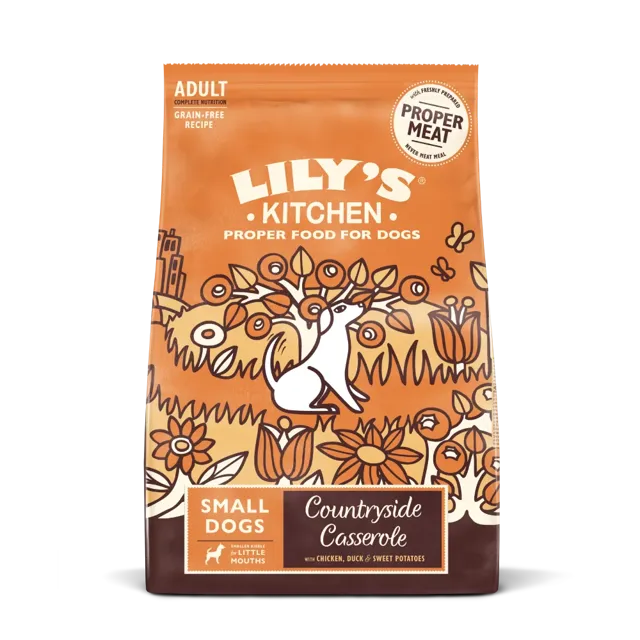
Lily's Kitchen Dry Small Breed takes the brand's chicken and duck recipe and bakes it into a kibble a little mouth can manage. The two birds are declared at 42% together. Sweet potato at 29% takes on the starch, peas and lentils sit behind it, and the joint mix and prebiotics both arrive with figures printed against them. Our reading places it in the Good band, level with the typical adult dry food.
Our view
Likely to suit
A small dog eats less of everything, so what goes into each mouthful has to work harder.
- Small breed dogs, since the kibble is baked at a size a little jaw can get around
- Owners of a stiffening small dog, since the label prints glucosamine and methylsulfonylmethane at 175 mg/kg each and chondroitin sulphate at 125 mg/kg
- Little dogs kept away from grain, with sweet potato, whole peas and whole lentils carrying the starch in place of cereal
- Households with a small dog prone to an unsettled tummy, with mannan oligosaccharides at 1.3g/kg and fructooligosaccharides at 0.8g/kg dosed in print
Worth watching
A few label points deserve a look first.
- Salmon oil and egg on the list, so this is neither fish-free nor egg-free
- Pea protein and potato protein both sit above the middle of the list, so plants are supplying some of what the protein figure counts
Written by our editorial team. Independent guidance, not veterinary advice.
How this scores
How we scoreThe Details
Dog fit
A small dog eats less of everything, so what goes into each mouthful has to work harder. A few label points deserve a look first.
Dry
Adult
Small
Chicken
The score, in context
This one reaches the Good band, where the average adult dry food also ends up. The case for it is straightforward: a large declared share of freshly prepared bird, a base of sweet potato and pulses in place of cereal, and supplements that carry figures and not just names. Transparency is the pillar that reads Outstanding here, with protein and processing and nutritional balance each sitting at Average. What holds it back from a higher band is the water in the fresh meat before baking, which leaves protein at 25.5% of dry matter once the arithmetic is done.
What's in it
Ingredients, as declared: 42% Chicken & Duck: Fresh Chicken (31%), Freshly Prepared Duck (8%), Chicken Liver (3%). Sweet Potatoes (29%), Whole Peas (6.5%), Whole Lentils, Pea Protein, Flaxseed, Egg, Potato Protein, Chicken Gravy, Minerals, Botanicals & Herbs* (1%), Salmon Oil, Prebiotics (Mannan Oligosaccharides 1.3g/kg, Fructooligosaccharides 0.8g/kg), Carrots, Apples, Joint Care Mix (Glucosamine 175mg/kg, Methylsulfonylmethane 175mg/kg, Chondroitin Sulphate 125mg/kg), Cranberries, Spinach. *Botanicals & Herbs: Alfalfa, Chickweed, Cleavers, Goldenrod, Nettles, Seaweed, Dandelion Root, Celery Seeds, Milk Thistle, Burdock Root, Marigold Flowers, Rosehips.
Named ingredients
Ingredient notes
The bird is declared at 42% in total: fresh chicken at 31%, freshly prepared duck at 8% and chicken liver at 3%. The second bird is duck, easily digested and reliably popular in taste tests. Chicken liver is the sort of small entry that does real nutritional work, dense in vitamin B12, vitamin A and copper. That 42% is a wet weight, so less animal material than that survives into the baked kibble. Protein converts to 25.5% of dry matter, a respectable figure for a small dog's bowl.
Sweet potato at 29% is the single biggest plant entry and a sound choice for the job. Sweet potato is not really a potato, and it carries more fibre and a great deal more vitamin A than the common sort. Behind them come whole peas at 6.5% and whole lentils, both useful sources of fibre and micronutrients when they are used in moderation as they are here. There is no grain anywhere on the list.
Both pea protein and potato protein appear fairly high up the list. They are concentrated plant proteins, and neither matches meat protein for quality or digestibility, so they are worth spotting even though the recipe is not leaning on them heavily. Egg sits near them and is the opposite case: a small amount of genuinely high quality protein.
The label measures its supplements instead of merely mentioning them. Glucosamine and methylsulfonylmethane come in at 175 mg/kg each, with chondroitin sulphate at 125 mg/kg, a set aimed squarely at joints. The prebiotic pair of mannan oligosaccharides at 1.3g/kg and fructooligosaccharides at 0.8g/kg is there to feed the bacteria of the large intestine. The salmon oil brings omega 3s of the marine kind, and it is the entry to watch where fish is off the menu.
The twelve-herb botanical blend at 1%, and the carrots, apples, cranberries and spinach behind it, are the finishing touches rather than the foundation. All of that tail sits at trace level, and the real work happens much further up the list.
Price and value
£10.00 a kilo, sold in a 2.5kg bag.
For a 15kg adult dog in moderate condition the guide portion is about 234 grams a day, assuming roughly 840 kcal a day (110 × bodyweight^0.75, the standard maintenance estimate). That lands at £2.34 a day. A small dog eats a good deal less than that, so scale both the portion and the day rate down to your own dog.
Nutritional analysis
Declared analysis
23.5%
12%
3%
7%
Dry weight
25.5%
13%
3.3%
7.6%
50.6%
As-fed composition
Estimated breakdown of the finished product by ingredient category, from the declared ingredient list and ingoing weights. These are estimates, not measurements.
59.1%
34.9%
1.4%
0.4%
4.3%
Pricing & size
- Pack size
- - 2.5kg - £25.00
- Retailer pricing
- Coming soon
Live retailer pricing is not yet available for this food. Prices, cost per day and where to buy will appear here once retailer data is live.
Ingredients and nutrition are taken from manufacturer data. Retailer pricing is not yet live for this food.
Related dog food guides
Ranked shortlists that include foods like this one.