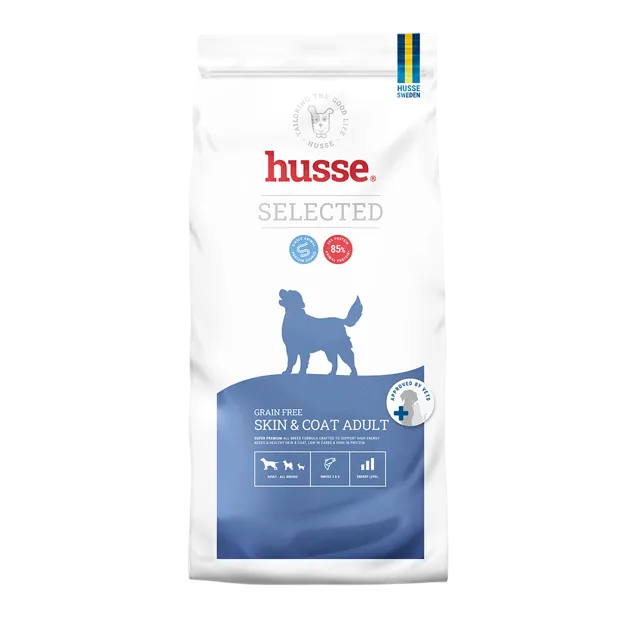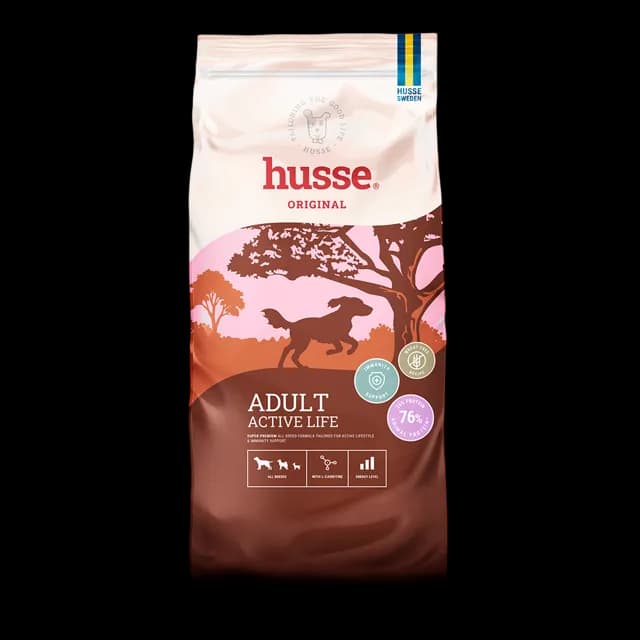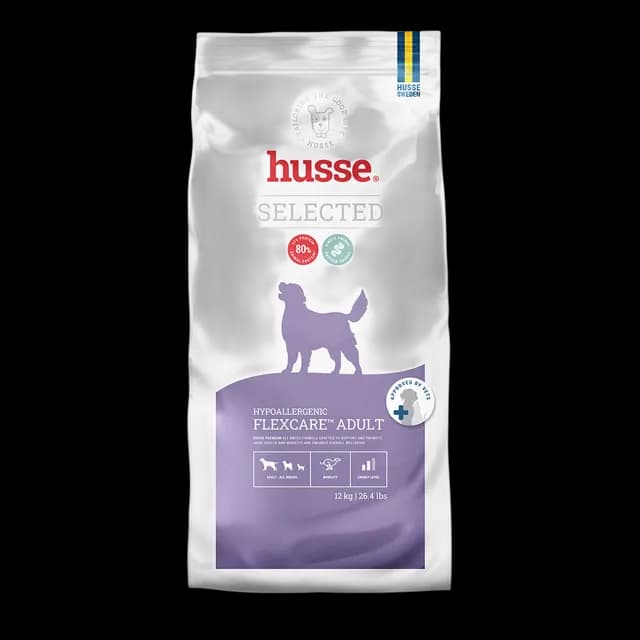



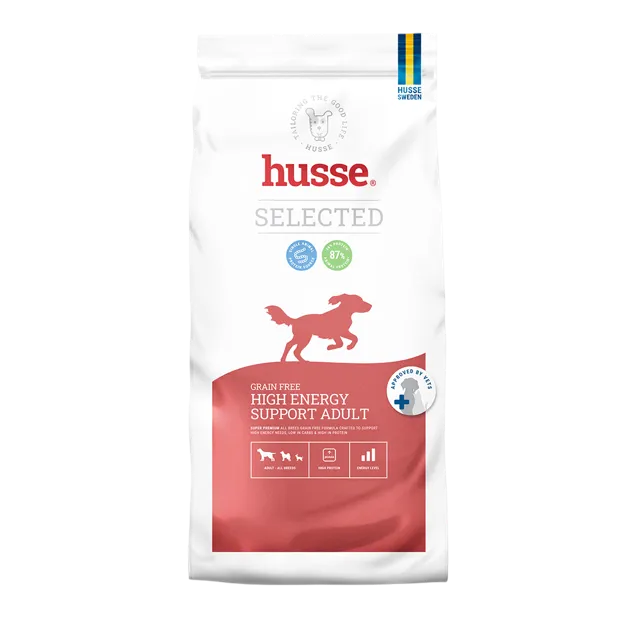

Husse
Husse Sterilised review
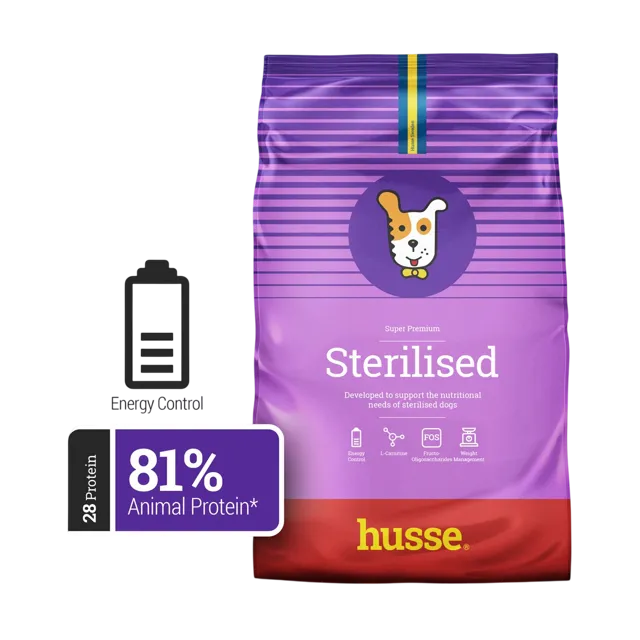
Husse Sterilised is built for the medium or large dog whose appetite did not get the memo after neutering. The analysis is its strong suit, with protein at 30.4% of dry matter, crude fibre at 5.4% to help a dog feel full and carbohydrate at 45.1%, just under the 46.2% typical. Chicken leads, though wheat and maize sit close behind, and L-carnitine is dosed at 200 mg per kilo. Our scale leaves it in the Average band, and the reasons for that sit in the ingredients list rather than in the figures.
Our view
Likely to suit
Neutering tends to cut what a dog needs without cutting what a dog wants, and this recipe is aimed straight at that gap.
- Neutered medium and large dogs whose appetite has outrun their requirements
- Owners who want a filling bowl, with crude fibre declared at 5.0% to slow a fast eater down
- Dogs that need protein kept up while calories come down, with protein declared at 28.0%
- Households wanting one bag that covers a medium and a large dog together
Worth watching
Read these off the label before you switch.
- A wheat-sensitive dog will want another recipe, with wheat second on the list
- Salmon, salmon oil and dried whole eggs all appear, so it is neither fish free nor egg free
- Energy is declared at 373 kcal per 100g, above the 357 typical, so portion control does the work, not a watered-down kibble
- A strict elimination trial is out here, since the hydrolysed protein and the animal fat both go without a species
Written by our editorial team. Independent guidance, not veterinary advice.
How this scores
How we scoreThe Details
Dog fit
Neutering tends to cut what a dog needs without cutting what a dog wants, and this recipe is aimed straight at that gap. Read these off the label before you switch.
Dry
Adult
Medium, Large
Chicken
The score, in context
Our scale leaves this in the Average band, a step under the typical adult dry food, so read it as a solid everyday option rather than a disappointment. On paper it does rather well. Protein converts to 30.4% of dry matter, carbohydrate to 45.1% where 46.2% is typical, and crude fibre reaches 5.4%, high for a dry food and genuinely useful in a dog that finishes dinner too quickly. What keeps it where it is comes from the middle of the ingredients list, where wheat and maize arrive early and the fat and palatant entries name no species. Protein and processing reads Average, while nutritional balance and transparency both read Good.
What's in it
Ingredients, as declared: chicken, wheat, rice, maize, vegetable fibres, animal fat, linseed, minerals, salmon, hydrolysed animal protein, brewer's yeast, salmon oil, fructo-oligosaccharides (0.3%), dried whole eggs, lecithin, sea algae, rosemary.
Named ingredients
Nutritional additives
Nutritional additives: vitamin A 17870 IU/kg, vitamin D3 1620 IU/kg, vitamin E 500 mg/kg, vitamin C 200 mg/kg, 3b103 (Iron) 201 mg/kg, 3b202 (Iodine) 3.1 mg/kg, 3b405 (Copper) 7.5 mg/kg, 3b502 (Manganese) 62.5 mg/kg, 3b605 (Zinc) 108 mg/kg, 3b607 (Zinc) 12 mg/kg, 3b801 (Selenium) 0.20 mg/kg, L-carnitine 200 mg/kg, beta-carotene 1 mg/kg; Antioxidants: tocopherols; Technological additives: Clinoptilolite of sedimentary origin: 10 g/kg.
Ingredient notes
Chicken opens the list in the plain form, so part of that weight is water bound for the oven. The finished figures are still the best thing about this label: protein at 30.4% of dry matter with fat at 12.0%. Salmon further down adds a second named animal to the recipe.
Wheat and maize sit high on the list with rice between them, and that is the recipe's main compromise. Of all the grains, wheat is the one behind most food intolerances. Check it first if your dog has a history. Set against that, carbohydrate finishes at 45.1% of dry matter, under the 46.2% typical for an adult dry food. The cereals, then, are not being asked to carry as much as their position suggests.
Fibre is the quiet hero of a neutering diet. Vegetable fibres come fifth on the list, and crude fibre reaches 5.4% of dry matter, well above what most adult kibbles declare. That gives a dog something to fill up on while the calories are being trimmed. Fructo-oligosaccharides at 0.3% add a prebiotic layer on top of that.
The other weight lever is L-carnitine, dosed at 200 mg per kilo. It is an amino acid, and it pushes the body towards burning fat and away from storing it. Brewer's yeast brings B vitamins and dried whole eggs a small serving of high-quality protein. Lecithin helps the fats disperse. Rosemary is there as a natural antioxidant, not as a herb for flavour.
Energy is declared at 373 kcal per 100g against the 357 typical for an adult dry food, and that is worth reading properly. This is not a watered-down kibble, so the weight control comes from measuring the bowl, not from the food doing it for you. The trace panel is well filled, with zinc at 108 mg and 12 mg per kilo, iron at 201 mg and vitamin E at 500 mg. Calcium is the one figure this label leaves out.
Price and value
£3.46 a kilo, sold in a 12 kg bag and a 2 x 12 kg double.
A 15kg adult dog in moderate condition, needing roughly 840 kcal a day (110 × bodyweight^0.75, the standard maintenance estimate), would eat about 225 grams, which comes to £0.78 a day. The label's own table asks 132 to 420 grams for a dog between 11kg and 30kg, and a neutered dog usually belongs at the lower end of a range like that.
Nutritional analysis
Declared analysis
28%
11%
5%
6.5%
Dry weight
30.4%
12%
5.4%
7.1%
45.1%
As-fed composition
Estimated breakdown of the finished product by ingredient category, from the declared ingredient list and ingoing weights. These are estimates, not measurements.
39.8%
50.7%
4.1%
2.3%
3%
Pricing & size
- Pack size
- 12 kg, 2 x 12 kg
- Retailer pricing
- Coming soon
Live retailer pricing is not yet available for this food. Prices, cost per day and where to buy will appear here once retailer data is live.
Ingredients and nutrition are taken from manufacturer data. Retailer pricing is not yet live for this food.
Related dog food guides
Ranked shortlists that include foods like this one.