

Husse
Husse Senior Mini review
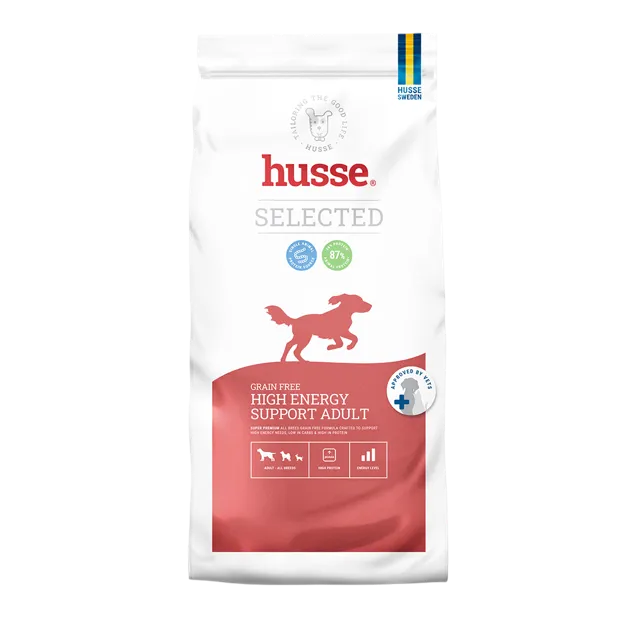
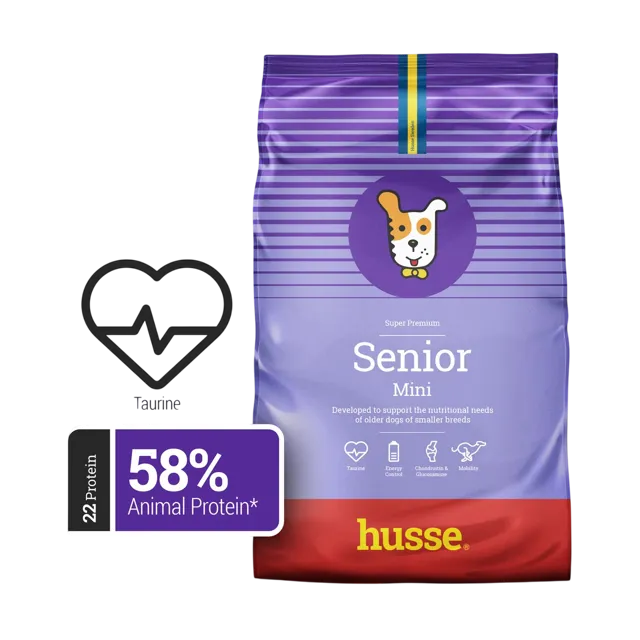
Husse Senior Mini puts the brand's senior thinking into a small-breed bag. Chicken opens the ingredients, wheat and maize sit behind it, and salmon, egg and glucosamine at 500 mg per kilo fill out the lower half of the list. It falls into our Average band, a step below the Good band where the adult dry middle ground sits. For a small older dog already settled on cereal-based food it stays an easy bowl to fill.
Our view
Likely to suit
Small dogs grow old too, and this bag is sized and shaped with them in mind.
- Small older dogs, since both the kibble and the 7 kg bag are scaled to them
- Ageing small breeds who need joint support, with glucosamine printed at 500 mg per kilo
- Owners of a picky older dog, as hydrolysed animal protein and yeast are both there to keep the bowl interesting
- Households where a cereal-based recipe has always suited the small dog
Worth watching
Read these closely before the first bag goes home.
- Wheat appears twice near the top, so a dog with a wheat problem will need another option
- Fish is in this recipe twice over, as salmon and as salmon oil, and a fish-free household will want to know
- Added salt is declared, worth noting if your dog's sodium intake is being kept down
- The energy figure here is an estimate rather than a declared one, at 336 kcal per 100g
Written by our editorial team. Independent guidance, not veterinary advice.
How this scores
How we scoreThe Details
Dog fit
Small dogs grow old too, and this bag is sized and shaped with them in mind. Read these closely before the first bag goes home.
Dry
Adult, Senior
Small
Chicken
The score, in context
This one lands in our Average band, one step under the Good band that most adult dry foods share, and the gap is narrow rather than dramatic. What holds it back is construction. The cereals take up a lot of room, carbohydrate is estimated at 56.5% of dry matter against the 46.2% typical, protein comes out at 23.9% and several entries name no species. Value reads Good and the other three pillars read Average. For the dog on the front of the bag, a small senior who eats happily and needs a hand with stiff joints, none of that stops the food doing its job.
What's in it
Ingredients, as declared: chicken, wheat, wheat meal, maize, rice flour, rice, vegetable fibres, linseed, animal fat, hydrolysed animal protein, salmon, salmon oil, yeast, dried whole eggs, salt, fructo-oligosaccharides (0.3%), potassium chloride, lecithin, sea algae, glucosamine (500 mg/kg), rosemary.
Named ingredients
Nutritional additives
Nutritional additives: vitamin A 17874 IU/kg, vitamin D3 1625 IU/kg, vitamin E 500 mg/kg, vitamin C 200 mg/kg, 3b103 (Iron) 201 mg/kg, 3b202 (Iodine) 3 mg/kg, 3b405 (Copper) 8 mg/kg, 3b502 (Manganese) 63 mg/kg, 3b605 (Zinc) 108 mg/kg, 3b607 (Zinc) 12 mg/kg, 3b801 (Selenium) 0.20 mg/kg, beta-carotene 1 mg/kg; Antioxidants: tocopherols; Technological additives: Clinoptilolite of sedimentary origin: 10 g/kg.
Ingredient notes
Chicken heads the list in its plain form, which means a good part of that weight is water headed for the oven. What reaches the bowl is 23.9% protein and 9.8% fat on a dry matter basis, a lean set of figures suited to an older dog with a slower daily round.
Wheat, wheat meal, maize, rice flour and rice make up the starch side, and there is plenty of it: carbohydrate is estimated at 56.5% of dry matter where 46.2% is the adult dry norm. Wheat carries gluten, and although the vast majority of dogs eat it happily their whole lives, it is the entry to note if yours has ever had an itch nobody could explain.
The interesting half of this label is the lower half. Marine omega 3 arrives with the salmon and the salmon oil, and linseed adds the plant version. Dried whole eggs contribute quality protein and sea algae supplies trace minerals. Glucosamine arrives at 500 mg per kilo, a dose specific enough to hold the maker to, and fructo-oligosaccharides at 0.3% are there to feed the gut bacteria.
The vitamin and mineral panel is thorough. Zinc is declared in two forms at 108 mg and 12 mg per kilo, iron at 201 mg, vitamin E at 500 mg and vitamin C at 200 mg, with beta-carotene at 1 mg. Calcium works out at 1.09% of dry matter, comfortably where an adult dog wants it.
Two of the small entries are worth a straight comment. Salt is added for palatability, and a kibble's own ingredients usually carry the sodium a dog needs, so it matters most in a dog with a heart history. Clinoptilolite at 10 g per kilo is a mineral clay used during manufacturing and does nothing nutritionally. Neither should change your mind, but both are worth reading.
Price and value
£6.14 a kilo, sold in a 7 kg bag.
As a guide, a 15kg adult dog in moderate condition would eat about 250 grams a day, assuming around 840 kcal a day (110 × bodyweight^0.75, the standard maintenance estimate). That puts the figure at £1.54 a day. This is a small-breed food, so a more realistic 8kg dog would sit nearer the label's own guide of 72 to 150 grams.
Nutritional analysis
Declared analysis
Estimated using Modified Atwater factors*
22%
9%
3%
6%
Dry weight
23.9%
9.8%
3.3%
6.5%
56.5%
As-fed composition
Estimated breakdown of the finished product by ingredient category, from the declared ingredient list and ingoing weights. These are estimates, not measurements.
37.3%
59%
1.6%
0.7%
1.4%
Pricing & size
- Pack size
- 7 kg
- Retailer pricing
- Coming soon
Live retailer pricing is not yet available for this food. Prices, cost per day and where to buy will appear here once retailer data is live.
Ingredients and nutrition are taken from manufacturer data. Retailer pricing is not yet live for this food.
Related dog food guides
Ranked shortlists that include foods like this one.