



Husse
Husse Senior review
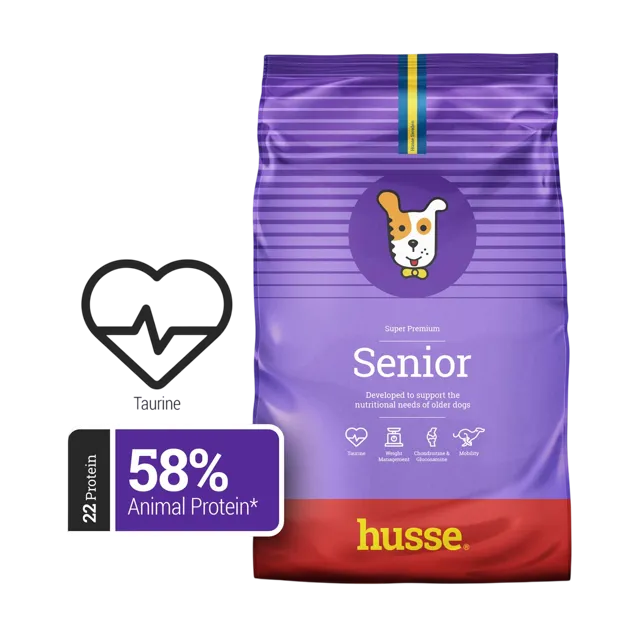
Cereals sit at the heart of Husse Senior, a chicken kibble written for medium and large dogs in old age. Chicken heads the list, then wheat, wheat meal, maize and two forms of rice do the carrying, with salmon, egg and glucosamine at 500 mg per kilo tucked further down. It finishes in our Average band, a step under where the typical adult dry food lands, so read it as a competent everyday food for a big old dog rather than a showstopper.
Our view
Likely to suit
For a large dog easing into old age on the sort of food they have always known, this is a gentle and unfussy bowl.
- Medium and large dogs in their senior years, the size bracket the label is written for
- Older dogs who could use a little joint help, with glucosamine dosed at 500 mg per kilo
- Dogs that have always eaten a cereal-based kibble and do perfectly well on one
- Owners who want omegas from both directions, with salmon and salmon oil alongside linseed
Worth watching
Some of what is on the list needs a word before you buy.
- Wheat sits second and wheat meal third, worth knowing if wheat does not suit your dog
- Salt is declared on the ingredients list, worth knowing for a dog whose sodium is being watched
- The hydrolysed animal protein names no species, and neither does the animal fat
- Carbohydrate lands at 56.5% of dry matter where 46.2% is typical for adult dry food
Written by our editorial team. Independent guidance, not veterinary advice.
How this scores
How we scoreThe Details
Dog fit
For a large dog easing into old age on the sort of food they have always known, this is a gentle and unfussy bowl. Some of what is on the list needs a word before you buy.
Dry
Adult, Senior
Medium, Large
Chicken
The score, in context
Our scoring leaves this one in the Average band, just under the Good band most adult dry foods share, so the honest read is a solid everyday option rather than a standout. Chicken at the front is the strong point. Behind it, wheat in two forms plus maize and two rices push carbohydrate to 56.5% of dry matter, protein settles at 23.9% and fat at 9.8%, and several working entries name no species. Protein and processing and nutritional balance each read Average, with transparency a notch up at Good, which is a fair summary: nothing here is badly done.
What's in it
Ingredients, as declared: chicken, wheat, wheat meal, maize, rice flour, rice, vegetable fibres, linseed, animal fat, hydrolysed animal protein, salmon, salmon oil, yeast, dried whole eggs, salt, fructo-oligosaccharides (0.3%), potassium chloride, lecithin, sea algae, glucosamine (500 mg/kg), rosemary.
Named ingredients
Nutritional additives
Nutritional additives: vitamin A 17874 IU/kg, vitamin D3 1625 IU/kg, vitamin E 500 mg/kg, vitamin C 200 mg/kg, 3b103 (Iron) 201 mg/kg, 3b202 (Iodine) 3 mg/kg, 3b405 (Copper) 8 mg/kg, 3b502 (Manganese) 63 mg/kg, 3b605 (Zinc) 108 mg/kg, 3b607 (Zinc) 12 mg/kg, 3b801 (Selenium) 0.20 mg/kg, beta-carotene 1 mg/kg; Antioxidants: tocopherols; Technological additives: Clinoptilolite of sedimentary origin: 10 g/kg.
Ingredient notes
Chicken sits at the head of the list in the plain, undried form. A good share of that declared weight is water, and it goes in the oven. Protein still arrives at 23.9% of dry matter with fat at 9.8%, a lean profile that suits a dog doing rather less than it used to. Energy is declared at 373 kcal per 100g against the 357 typical.
The cereal block is the defining feature. Wheat and wheat meal come straight after the chicken, with maize, rice flour and rice behind them. Wheat carries gluten, and among grains it is the usual suspect when dinner disagrees with a dog. Most dogs handle it without a murmur for a lifetime, but if yours has form, wheat is where to start looking. Carbohydrate lands at 56.5% of dry matter against the 46.2% typical. The moisture figure of 8.0% is declared on this label, not assumed, and that counts in its favour.
Marine omega 3 comes from the salmon and the salmon oil, with linseed adding the plant form. Dried whole eggs bring a little very digestible protein. Yeast supplies B vitamins and sea algae is there for iodine and other trace minerals.
Glucosamine at 500 mg per kilo is the joint entry, printed at a dose you can hold the maker to, though there is no chondroitin standing beside it. Fructo-oligosaccharides at 0.3% are prebiotic fibre for the gut bacteria, and lecithin helps the fats disperse evenly through the kibble.
A couple of entries deserve a plain word. Salt is added as a flavour enhancer, and most kibbles already carry the sodium a dog needs without it. Clinoptilolite at 10 g per kilo is a natural mineral used in manufacturing, not a nutrient. The panel itself is well filled by contrast, with zinc declared twice at 108 mg and 12 mg per kilo, iron at 201 mg and vitamin E at 500 mg. Calcium itself works out at 1.09% of dry matter.
Price and value
£3.59 a kilo, sold in a 12 kg bag and a 2 x 12 kg double.
As a guide, a 15kg adult dog in moderate condition eats around 225 grams a day, assuming about 840 kcal a day (110 × bodyweight^0.75, the standard maintenance estimate), which comes to £0.81 a day. The label's own table asks 99 to 360 grams for a dog between 11kg and 30kg. Where those two differ, let the waistline decide.
Nutritional analysis
Declared analysis
22%
9%
3%
6%
8%
Dry weight
23.9%
9.8%
3.3%
6.5%
56.5%
As-fed composition
Estimated breakdown of the finished product by ingredient category, from the declared ingredient list and ingoing weights. These are estimates, not measurements.
37.3%
59%
1.6%
0.7%
1.4%
Pricing & size
- Pack size
- 12 kg, 2 x 12 kg
- Retailer pricing
- Coming soon
Live retailer pricing is not yet available for this food. Prices, cost per day and where to buy will appear here once retailer data is live.
Ingredients and nutrition are taken from manufacturer data. Retailer pricing is not yet live for this food.
Related dog food guides
Ranked shortlists that include foods like this one.