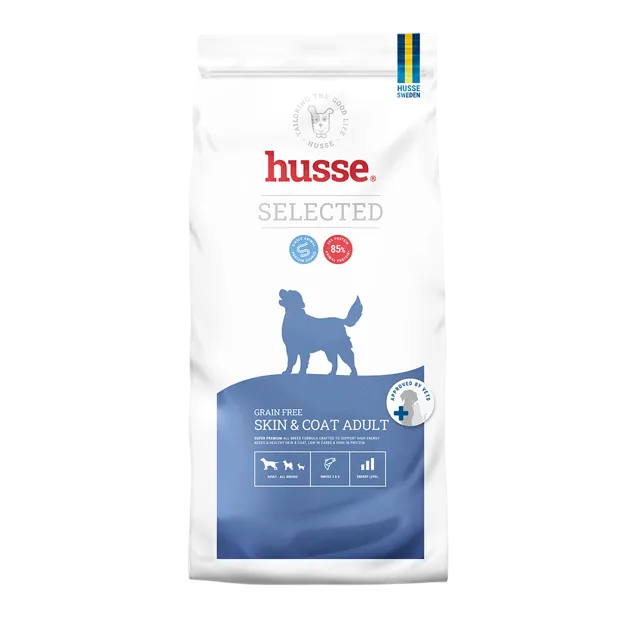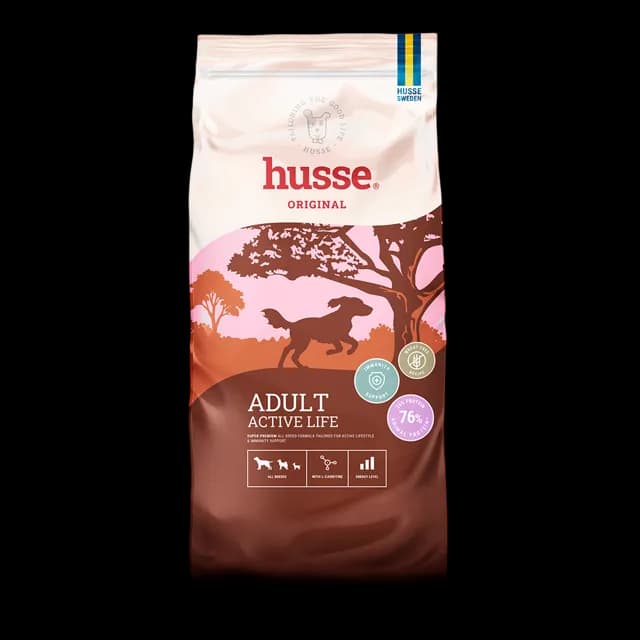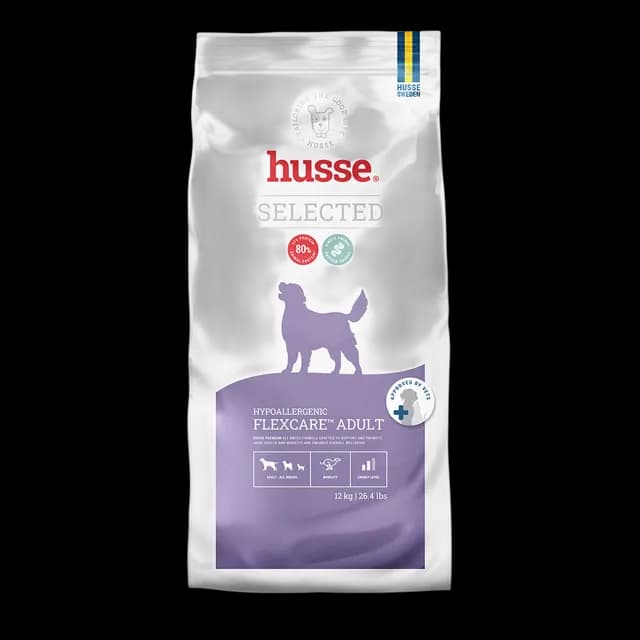




Husse
Husse Pro Selekt review
Husse Pro Selekt is a straightforward chicken kibble built to feed a whole household from one bag. Dried chicken heads the list, maize at 23% and rice at 14% carry the starch, and a fully dosed vitamin and mineral panel sits underneath. No fish appears anywhere on the label and no wheat either, which makes it an unusually simple food to place. Our reading puts it in the Good band, level with the middle of the adult dry shelf.
Our view
Likely to suit
If one bag has to feed several dogs, this is a simple place to begin.
- Multi-dog households, since one recipe covers everything from toy up to giant on the label
- Dogs kept away from fish, with neither fish meal nor fish oil on the ingredients list
- Wheat-sensitive dogs, as maize and rice carry the starch and no wheat is declared at all
- Owners who like the mineral panel printed in full, with zinc at 65 mg and iron at 50 mg per kilo
Worth watching
Get a few label details straight before you order.
- Chicken is the only named meat and the animal fat and hydrolysed protein name no species, so a strict elimination trial cannot lean on it
- Maize appears twice and rice once, with the plant side reaching 52.8% of dry matter against the 46.2% typical of adult dry food
Written by our editorial team. Independent guidance, not veterinary advice.
How this scores
How we scoreThe Details
Dog fit
If one bag has to feed several dogs, this is a simple place to begin. Get a few label details straight before you order.
Dry
Adult
Toy, Small, Medium, Large, Giant
Chicken
The score, in context
Pro Selekt settles in our Good band, the same one the everyday adult dry food occupies. It gets there by doing ordinary things properly, with no headline to chase. The meat entry is dried rather than fresh, so the weight declared is weight that survives the oven. On a dry matter basis the analysis holds up: protein 25.0% and fat 14.1%. Every trace mineral is dosed on the label instead of being left to the imagination. Protein and processing, transparency and value all read Good, and nutritional balance sits at Average behind them.
What's in it
Ingredients, as declared: dried chicken, maize (23%), maize meal, rice (14%), animal fat, vegetable fibres (5%), linseed (1.5%), hydrolysed animal protein.
Named ingredients
Nutritional additives
Nutritional additives/kg: vitamin A 15000 IU, vitamin D3 1350 IU, vitamin E 145 mg, vitamin C 90 mg, 3b103 (Iron) 50 mg, 3b202 (Iodine) 1.5 mg, 3b405 (Copper) 5 mg, 3b502 (Manganese) 35 mg, 3b605 (Zinc) 65 mg, 3b801 (Selenium) 0.1 mg; Antioxidants: tocopherol extracts from vegetable oils (1b306(i)) and rosemary extract; Technological additives/kg: Sepiolite 10 g.
Ingredient notes
Dried chicken opens the list, and dried is the useful word. Fresh meat entries lose most of their weight in the oven, so a dried entry at the front means the protein you are reading about is protein that reached the finished kibble. It converts to 25.0% of dry matter with fat at 14.1%, a comfortable everyday balance for an adult dog. Energy is declared at 385 kcal per 100g against the 357 typical, so bowls run a little smaller than the bag size might suggest.
Maize at 23%, maize meal behind it and rice at 14% do the carrying. Maize is a workhorse cereal with no pretensions to luxury. It holds a kibble together and supplies energy at a sensible level of digestibility. Where 46.2% is typical for an adult dry food, carbohydrate here works out at 52.8% of dry matter, so the plants are carrying a fair share. Wheat, the cereal that gets named most often when a dog reacts to something, is absent altogether.
Vegetable fibres at 5% is the consumer-friendly name a label usually gives to beet pulp. Its job is gut regularity, not nutrition, and crude fibre lands at 2.7% of dry matter.
The omega source is linseed at 1.5%, the only oil-bearing seed on the list. It supplies omega 3 in its plant form. A dog must convert that into the versions that show in skin and coat, and conversion is slower than taking them ready made from a marine oil. Allow a coat a few weeks to answer. The upside is that no fish appears in the bag at all, which is genuinely handy if you are keeping your dog off it.
Hydrolysed animal protein sits at the end as a palatant, the entry that makes a plain kibble worth finishing. It names no species, as does the animal fat above it, so neither can be pinned to a particular bird or beast. The additive panel is thorough by contrast, with vitamin E at 145 mg and vitamin C at 90 mg per kilo and iron, iodine, copper, manganese, zinc and selenium each dosed in print. Sepiolite at 10 g per kilo is a clay used as a processing aid and does nothing nutritional.
Price and value
£2.50 a kilo, sold as a single 15 kg bag or as a 2 x 15 kg double.
As a guide, a 15kg adult dog in moderate condition eats about 218 grams a day, assuming around 840 kcal a day (110 × bodyweight^0.75, the standard maintenance estimate). That works out at £0.55 a day. For a dog of 10kg to 20kg the label's own table asks 110 to 260 grams, and the waistline can settle any difference between the two.
Nutritional analysis
Declared analysis
23%
13%
2.5%
5%
Dry weight
25%
14.1%
2.7%
5.4%
52.8%
As-fed composition
Estimated breakdown of the finished product by ingredient category, from the declared ingredient list and ingoing weights. These are estimates, not measurements.
33.7%
54.2%
5%
5.6%
1.5%
Pricing & size
- Pack size
- 15 kg, 2 x 15 kg
- Retailer pricing
- Coming soon
Live retailer pricing is not yet available for this food. Prices, cost per day and where to buy will appear here once retailer data is live.
Ingredients and nutrition are taken from manufacturer data. Retailer pricing is not yet live for this food.
Related dog food guides
Ranked shortlists that include foods like this one.