



Husse
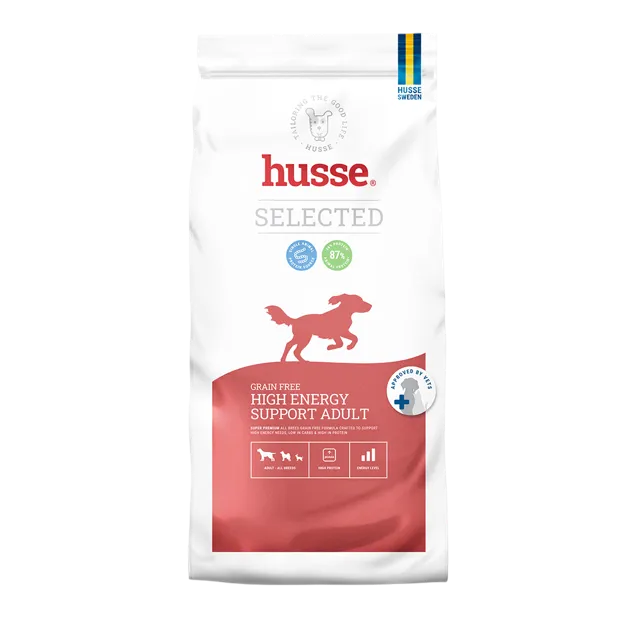
Husse Optimal Mini review
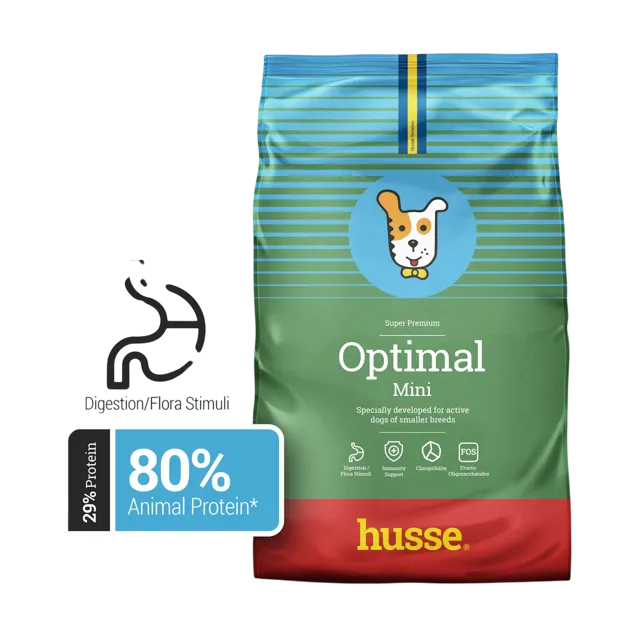
Husse Optimal Mini is the liveliest of the brand's everyday chicken kibbles, sized small and set up for a little dog with a fast engine. Protein and fat both run higher here than in the standard recipe, maize protein backs up the chicken, and two different prebiotics work together at the end of the list. It lands in our Good band, and for a small dog who burns through their day it is an easy fit.
Our view
Likely to suit
Small dogs are rarely small in energy, and this recipe is set up for the ones that never quite sit still.
- Small breed adults, the kibble sized for little mouths and the feeding table written up to 10kg
- Busy, high energy little dogs, since protein reaches 29.0% and fat 18.0%
- Owners who want the grain kept simple, since the starch is rice and maize and wheat never appears
- Dogs with a delicate digestion, given fructo-oligosaccharides at 0.5% and mannan-oligosaccharides listed separately
Worth watching
It is a rich little kibble, and that shapes what to keep an eye on.
- The energy density is high, and a quiet little dog can gain weight if the scoop is generous
- Fish appears twice, as salmon and salmon oil, so check this one if your dog is kept away from fish
Written by our editorial team. Independent guidance, not veterinary advice.
How this scores
How we scoreThe Details
Dog fit
Small dogs are rarely small in energy, and this recipe is set up for the ones that never quite sit still. It is a rich little kibble, and that shapes what to keep an eye on.
Dry
Adult
Small
Chicken
The score, in context
Mini finishes in our Good band alongside the middle of the adult dry category, though the two arrive there by different routes. This recipe's numbers are the strongest part of its case: protein converts to 31.5% of dry matter and carbohydrate to only 38.0%, comfortably under the 46.2% typical for a dry food. What holds it where it is are the label's silences, an undeclared meat percentage and two animal entries without a species between them, rather than anything in the analysis.
What's in it
Ingredients, as declared: chicken, rice, maize, animal fat, linseed, vegetable fibres, maize protein, hydrolysed animal protein, salmon, salmon oil, yeast, salt, fructo-oligosaccharides (0.5%), dried whole eggs, potassium chloride, mannan-oligosaccharides, lecithin, sea algae, rosemary.
Named ingredients
Nutritional additives
Nutritional additives: vitamin A 20853 IU/kg, vitamin D3 1895 IU/kg, vitamin E 583 mg/kg, 3b103 (Iron) 201 mg/kg, 3b202 (Iodine) 3 mg/kg, 3b405 (Copper) 8 mg/kg, 3b502 (Manganese) 62.5 mg/kg, 3b605 (Zinc) 108 mg/kg, 3b607 (Zinc) 12 mg/kg, 3b801 (Selenium) 0.2 mg/kg, beta-carotene 1 mg/kg; Antioxidants: tocopherols; Technological additives: Clinoptilolite of sedimentary origin: 10 g/kg.
Ingredient notes
Chicken leads, and the analysis behind it is a lively one: 29.0% protein and 18.0% fat as fed, which convert to 31.5% and 19.6% of dry matter once the declared 8.0% moisture is removed. Energy lands at 395 kcal per 100g. A small dog eats small amounts, so a denser kibble is a reasonable way of fitting everything a day needs into a modest bowl.
Rice and maize do the binding, with no wheat on the list at all, which is worth knowing if wheat is the cereal your dog has struggled with in the past. Maize is a thoroughly digestible grain for most dogs once it has been cooked properly, and it brings a little more protein along with it than rice does.
Maize protein appearing sixth is the entry to read carefully. This is a concentrated plant protein. It is not a poor ingredient, but it raises the protein figure with no meat behind it, so the 29.0% headline is not all coming from the chicken. On a food otherwise this well supplied with animal ingredients, that is a small point rather than a serious one.
The gut gets proper attention. Fructo-oligosaccharides are dosed at 0.5% and mannan-oligosaccharides are listed separately just behind the potassium chloride. The two feed different populations of friendly bacteria in the large intestine, so having both on one label is genuine belt and braces.
Salmon and salmon oil sit mid list as the marine omega source, linseed supplies the plant form alongside them, and dried whole eggs add a small amount of protein about as complete as protein gets. Rosemary closes the list, almost certainly as the extract, where its job is to keep the fats from turning rancid.
The additive panel gives figures, not vague assurances. Vitamin A is at 20853 IU/kg, vitamin E at 583 mg/kg, iron at 201 mg/kg, zinc at 108 mg/kg plus 12 mg/kg from a second source and manganese at 62.5 mg/kg. Calcium converts to 1.3% of dry matter, a settled adult level, and clinoptilolite at 10 g/kg keeps the kibble loose in the bag.
Price and value
£4.70 a kilo, sold in 2kg and 7kg bags.
As a guide, a 15kg adult dog in moderate condition would eat about 213 grams a day at roughly 840 kcal (110 × bodyweight^0.75, the standard maintenance estimate), or £1.00 a day. Most dogs fed this recipe are a fair bit smaller than that. The label asks 65 to 150 grams for a dog between 5kg and 10kg, so the real daily figure comes down accordingly.
Nutritional analysis
Declared analysis
29%
18%
2.5%
7.5%
8%
Dry weight
31.5%
19.6%
2.7%
8.2%
38%
As-fed composition
Estimated breakdown of the finished product by ingredient category, from the declared ingredient list and ingoing weights. These are estimates, not measurements.
42.3%
44.7%
2.7%
5.7%
4.6%
Pricing & size
- Pack size
- 2 kg, 7 kg
- Retailer pricing
- Coming soon
Live retailer pricing is not yet available for this food. Prices, cost per day and where to buy will appear here once retailer data is live.
Ingredients and nutrition are taken from manufacturer data. Retailer pricing is not yet live for this food.
Related dog food guides
Ranked shortlists that include foods like this one.