



Husse
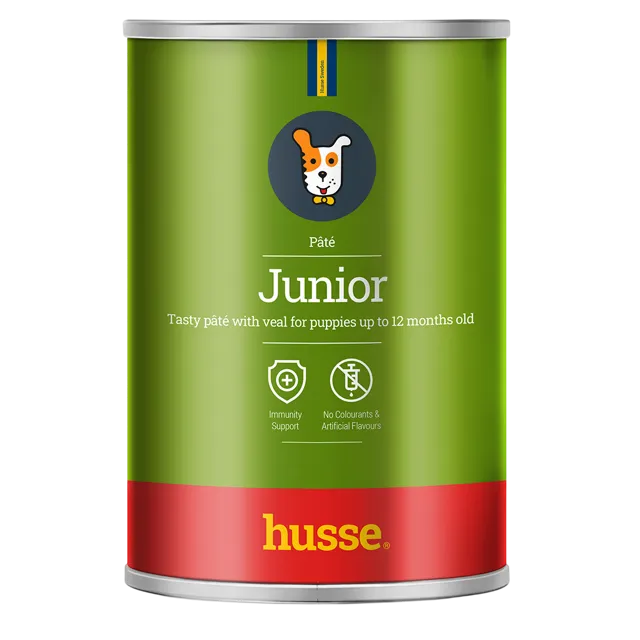
Husse Junior Paté review
Husse Junior Paté is a three ingredient loaf built almost entirely from meat, with the animal content declared at 80% and veal named inside it at 14%. Hardly anything else goes in: a small plant fraction carrying dried ginseng, and minerals. That construction shows up in the analysis, where protein converts to 47.4% of dry matter and carbohydrate to only 5.2%. It sits in our Good band, held back by how the label names things and not by how the food feeds.
Our view
Likely to suit
Junior dogs past the first rush of growth still need food built on meat, and yours will find plenty of it here.
- Junior dogs who do best on a low starch diet, with carbohydrate converting to only 5.2% of dry matter
- Growing dogs who need protein density, at 47.4% of dry matter once the water is taken out
- Fussy juniors, since a soft paté is usually the easiest thing to get down a reluctant dog
- Households that want a wet food with almost nothing added, given the whole declaration runs to three entries
Worth watching
A short list means a short answer to most questions, and here is what it leaves open for you.
- No calcium figure is declared and the ash converts to a light mineral load, so a large or giant breed junior's bone minerals cannot be planned from this label
- Veal is the only meat named, at 14% of a meat entry running to 80%, which leaves the bulk of the animal content unidentified
Written by our editorial team. Independent guidance, not veterinary advice.
How this scores
How we scoreThe Details
Dog fit
Junior dogs past the first rush of growth still need food built on meat, and yours will find plenty of it here. A short list means a short answer to most questions, and here is what it leaves open for you.
Wet
Puppy
Toy, Small, Medium, Large, Giant
The score, in context
Our band for this loaf is Good, a step under the Excellent band a typical junior tin occupies, and the split across the pillars is where the real story sits. Nutritional balance reads Outstanding, the top of the four, and it reflects an analysis genuinely built on meat rather than on cereal. Protein and processing reads Average, and that is entirely a matter of wording: four fifths of the tin is described by a legal category and the plant fraction by another. There is very likely good material behind those words. The label simply does not let a buyer confirm it.
What's in it
Ingredients, as declared: meat and animal derivatives 80% (veal 14%), derivatives of vegetable origin (dried ginseng 0.5%), minerals.
Named ingredients
Nutritional additives
Nutritional additives/kg: vitamin A (3a672a) 2500 IU, vitamin D3 250 IU, vitamin E (3a700i) 5 mg.
Ingredient notes
Three lines make up this entire recipe, and the first of them is 80% of the tin. Meat and animal derivatives is what European labelling law provides for animal material. The phrase stretches from prime muscle right down to a carcass's least appealing parts, with no distinction drawn between them. Veal is named inside it at 14%, which accounts for a fraction of that 80% and leaves the remainder open to interpretation.
The analysis argues strongly that whatever is in there really is meat. Protein converts to 47.4% of dry matter and fat to 39.5%, while carbohydrate comes out at an estimated 5.2% against the 13.6% a typical junior tin runs at. Very few wet foods have that shape, and it is not a shape you can fake with cereal.
Derivatives of vegetable origin is the second entry, and the label pins exactly one thing inside it: dried ginseng at 0.5%. Ginseng is a root, put in as a botanical signature and not as a nutrient source. At that level it is a flourish more than a working ingredient. The rest of the plant fraction goes undescribed.
Minerals closes the list, and the added panel prints vitamin A at 2500 IU per kg, vitamin D3 at 250 IU per kg and vitamin E at 5 mg per kg. Nowhere on the label is there a calcium figure. That is the biggest gap a growth food can have, because a junior dog heading for size is fed to a calcium target ahead of almost any other number.
Moisture is declared at 81%, a wetter loaf than most, and yet energy still lands at 108 kcal per 100g, a shade above the 106 typical. Crude fibre converts to 2.6% of dry matter and ash to 5.3%, the latter being modest for a dog with bone still to lay down.
Price and value
£4.00 a kilo, sold in 400g tins, singly and in cases of twenty-four.
Our standard energy estimate puts a 10kg junior between four and twelve months old at somewhere around 656.1 to 801.9 grams a day. A wet food of this density will always ask for that kind of volume.
That amount falls away as growth slows, so read the chart again against your dog's age and expected adult size every few weeks instead of fixing on one daily portion.
Nutritional analysis
Declared analysis
9%
7.5%
0.5%
1%
81%
Dry weight
47.4%
39.5%
2.6%
5.3%
5.2%
As-fed composition
Estimated breakdown of the finished product by ingredient category, from the declared ingredient list and ingoing weights. These are estimates, not measurements.
80%
12%
6.2%
1.8%
Pricing & size
- Pack size
- 400 g, 24 x 400 g
- Retailer pricing
- Coming soon
Live retailer pricing is not yet available for this food. Prices, cost per day and where to buy will appear here once retailer data is live.
Ingredients and nutrition are taken from manufacturer data. Retailer pricing is not yet live for this food.
Related dog food guides
Ranked shortlists that include foods like this one.