

Husse
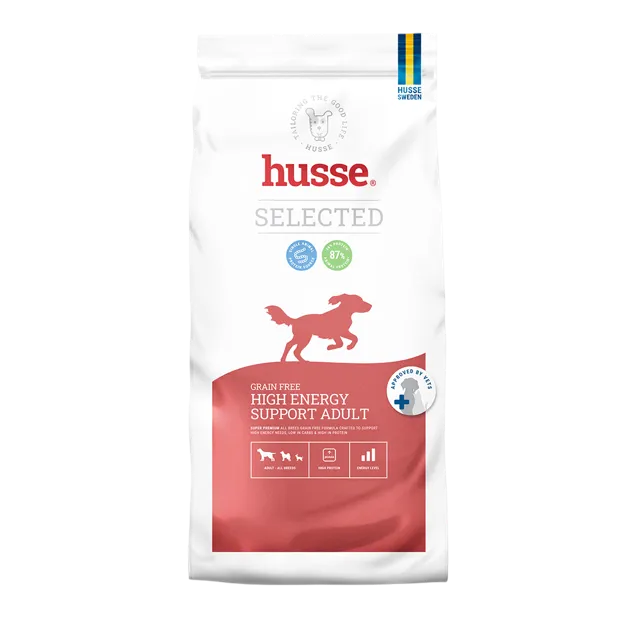
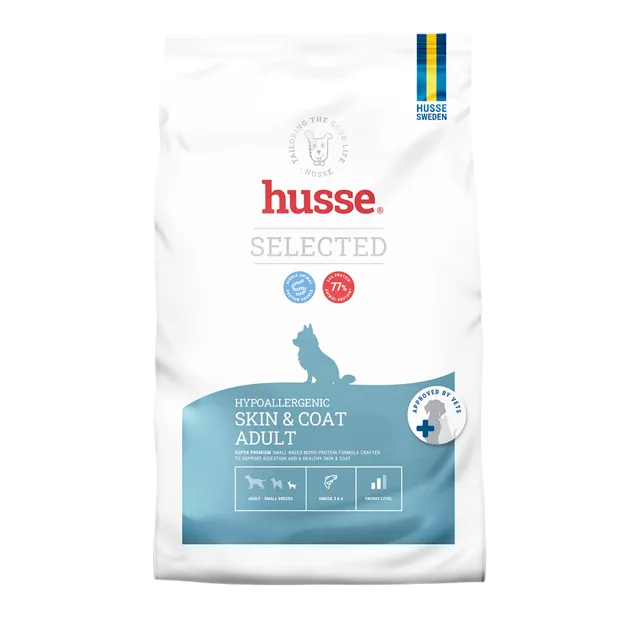
Husse Hypoallergenic Skin & Coat Adult Small Breeds review
Husse Hypoallergenic Skin & Coat Adult Small Breeds is the brand's salmon and rice recipe sized and bagged for a little dog. Dried salmon is the one animal the list names, rice turns up in three forms, and linseed with salmon oil carry the skin brief. Crude ash is light at 5.7% of dry matter and calcium modest at 1.2%, while estimated carbohydrate runs full at 49.7%. Our banding gives it a Good reading, no higher and no lower than the typical adult dry food.
Our view
Likely to suit
Everything a small dog eats is a big share of their day, so the short list here is doing real work.
- Toy and small breed adults, the size of dog this kibble and its feeding table are built around
- Little dogs with flaky skin or a dull coat, since linseed at 2% stands behind the claim along with salmon oil at 1%
- Owners avoiding poultry and red meat, as no animal but salmon appears on the list
- Dogs kept to a modest mineral intake, with crude ash at 5.7% of dry matter and calcium at 1.2%
Worth watching
You will find a few honest limits here, and not one of them is dramatic.
- Fish arrives twice, in the dried salmon and the salmon oil, and the fat and the palatant are named only as animal rather than by species
- Estimated carbohydrate runs to 49.7% of dry matter, a full load in a bowl that is already small
Written by our editorial team. Independent guidance, not veterinary advice.
How this scores
How we scoreThe Details
Dog fit
Everything a small dog eats is a big share of their day, so the short list here is doing real work. You will find a few honest limits here, and not one of them is dramatic.
Dry
Adult
Small
Salmon
The score, in context
Our banding gives this bag a Good reading, and the typical adult dry food earns the same, so the interest is in the design rather than the position. Protein converts to 26.1% of dry matter and estimated carbohydrate to 49.7%, above the 46.2% typical, which is what happens when rice fills three places on a list and the fish carries no percentage. The panel of vitamins and trace minerals is fully dosed and the ash load is light. Read it as a small-breed food for a dog with fussy skin, and it delivers what the front of the bag describes.
What's in it
Ingredients, as declared: dried salmon, brown rice, rice, animal fat, rice flour, linseed (2%), vegetable fibres, hydrolysed animal protein, salmon oil (1%), brewer's yeast, inulin (0.3%, source of fructo-oligosaccharides), minerals, marine algae.
Named ingredients
Nutritional additives
Nutritional additives/kg: vitamin A 18000 IU, vitamin D3 1700 IU, vitamin E 500 mg, vitamin C 425 mg, 3b103 (Iron) 50 mg, 3b202 (Iodine) 1.5 mg, 3b405 (Copper) 5 mg, 3b502 (Manganese) 35 mg, 3b605 (Zinc) 65 mg, 3b801 (Selenium) 0.1 mg, beta-carotene 1 mg, biotin 1 mg, L-carnitine 300 mg; Antioxidants: tocopherol extracts from vegetable oils (1b306(i)) and rosemary extract; Technological additives/kg: Sepiolite 10 g.
Ingredient notes
Salmon arrives dried, which is the form that comes through the oven with its weight intact, so seeing it first on the list means something. It is also the sensible fish for a skin recipe, because the omega 3s in the flesh itself are already in the shape a dog's body wants them. No percentage is given, so the meat share has to be read off the analysis, and there protein reaches 26.1% of dry matter.
Behind the fish sit brown rice, rice and rice flour. Using one grain in three guises keeps the recipe simple for a dog that reacts to things, and it leaves wheat, maize and soya off the label altogether. Rice is gentle and easily digested, and it is also why the estimated carbohydrate figure of 49.7% of dry matter sits on the full side of the 46.2% typical.
The coat plan is fat led. Salmon oil at 1% supplies the marine omega 3s that skin uses without conversion. Linseed at 2% supplies the plant form for the body to work on more slowly, and marine algae adds iodine and trace minerals. Brewer's yeast is the B vitamin source, and B vitamins matter as much to skin as anything you can put in a bowl. Coats answer in weeks, not days, so give a first bag time to speak.
Digestion has not been forgotten. Inulin at 0.3% is a prebiotic, and the good bacteria further down the gut are what it feeds. Vegetable fibres, beet pulp by another name, keep stools tidy. Crude fibre finishes at 3.3% of dry matter, enough to do that job without hurrying anything through.
The label goes quiet in one place. The animal fat says nothing about its species and neither does the hydrolysed animal protein. The fat carries most of the energy and the hydrolysate makes the kibble taste of something. For the vast majority of dogs neither is an issue, but they are the reason the fish-only reading of this list does not quite hold up. Everywhere else the figures are printed, zinc at 65 mg, vitamin E at 500 mg and biotin at 1 mg per kilo among them.
Price and value
£6.99 a kilo, in 2kg and 7kg bags.
The day rate quoted here uses a 15kg adult dog in moderate condition, heavier than most dogs this bag is written for. About 840 kcal a day (110 × bodyweight^0.75, the standard maintenance estimate) comes to roughly 231 grams and £1.62. A 5kg dog eats a fraction of that, and the label's own table asks 65 to 160 grams once a dog is between 5kg and 10kg.
Nutritional analysis
Declared analysis
Estimated using Modified Atwater factors*
24%
14%
3%
5.2%
Dry weight
26.1%
15.2%
3.3%
5.7%
49.7%
As-fed composition
Estimated breakdown of the finished product by ingredient category, from the declared ingredient list and ingoing weights. These are estimates, not measurements.
40.2%
46.8%
3.1%
6.1%
3.8%
Pricing & size
- Pack size
- 2 kg, 7 kg
- Retailer pricing
- Coming soon
Live retailer pricing is not yet available for this food. Prices, cost per day and where to buy will appear here once retailer data is live.
Ingredients and nutrition are taken from manufacturer data. Retailer pricing is not yet live for this food.
Related dog food guides
Ranked shortlists that include foods like this one.