

Husse
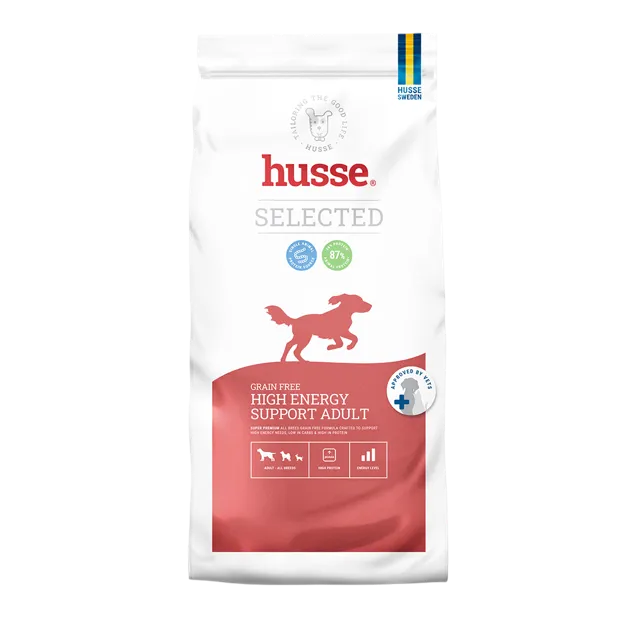
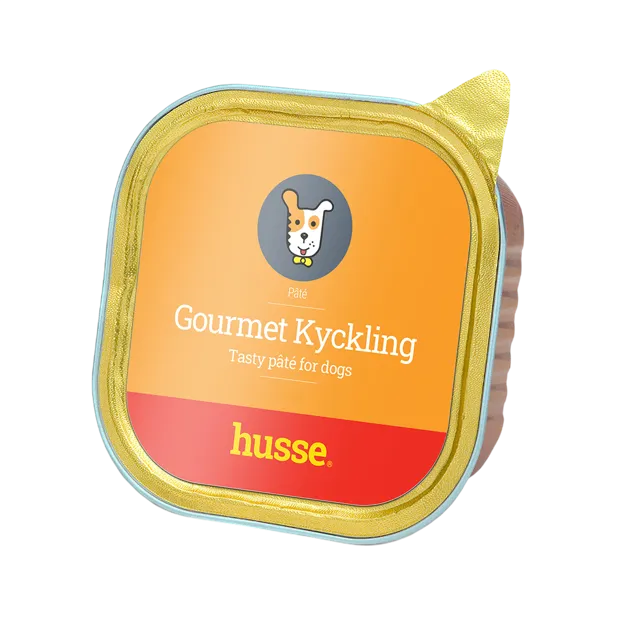
Husse Gourmet Kyckling review
Husse Gourmet Kyckling keeps its label about as short as a wet food label goes: animal content declared at 80%, chicken named inside it, and minerals. No cereal, no vegetable term and nothing added to thicken the gravy, so the bowl is grain free by the list itself. The analysis behind it is rich in protein and richer still in fat. It lands in our Average band, and that whole story lives in how little of the 80% is given a name.
Our view
Likely to suit
When grain has to stay out of your dog's bowl, a label this short is a straightforward place to start.
- Dogs kept off grain, since the list runs to animal content and minerals with no cereal anywhere on it
- Dogs that need very little starch in a meal, the estimated carbohydrate converting to 5.5% of dry matter against 15.8% for the typical adult wet food
- Working dogs and hard keepers, as fat converts to 41.7% of dry matter and makes this a properly rich bowl
- Owners of a smaller dog, since the 300 g size opens closer to a single day's food than a larger one would
Worth watching
A short label is not the same as an open one, so it is worth knowing what you are trusting here.
- Chicken is named at 6% inside an 80% animal share, so the great majority of the meat is not pinned to a species
- That leaves the recipe unable to anchor an elimination diet, even with only one animal named on the front
- Fat converts to 41.7% of dry matter, so a dog who gains weight easily will want a measured bowl
- The additives are vitamin A at 2000 IU, vitamin D3 at 150 IU and vitamin E at 5 mg in every kilogram, with no trace elements printed
Written by our editorial team. Independent guidance, not veterinary advice.
How this scores
How we scoreThe Details
Dog fit
When grain has to stay out of your dog's bowl, a label this short is a straightforward place to start. A short label is not the same as an open one, so it is worth knowing what you are trusting here.
Wet
Adult
Chicken
The score, in context
Of all the reasons a wet food can come out low on our scoring, this one leans almost entirely on labelling. It sits in our Average band while the typical adult wet food reaches our Excellent band. The distance comes down to one line: chicken is the only animal named, at 6% of a recipe whose animal content is declared at 80%. Protein and processing reads Average as a result, while transparency comes back Outstanding. Nutritional balance reads Outstanding and deserves to, because protein converts to 44.4% of dry matter, fat to 41.7%, and there is almost no carbohydrate in the analysis at all. None of that is a safety judgement. The gap is between a label that shows its working and a label you simply have to trust.
What's in it
Ingredients, as declared: meat and animal derivatives 80% (chicken 6%), minerals.
Named ingredients
Nutritional additives
Nutritional additives/kg: vitamin A (3a672a) 2000 IU, vitamin D3 150 IU, vitamin E (3a700i) 5 mg.
Ingredient notes
The entire recipe is meat and animal derivatives at 80% and minerals, with chicken picked out at 6% inside the first of them. Meat and animal derivatives is labelling law's own phrase for the fleshy parts and processing products of warm-blooded land animals. Prime meat and the least appealing offcuts sit under it without being told apart. Plenty of European makers reach for it out of habit rather than concealment, but the effect on a reader is the same either way.
The analysis is the strong part of this label. Protein converts to 44.4% of dry matter and fat to 41.7%, so nearly all the dry weight of the food is animal-shaped. The estimated carbohydrate lands at 5.5% where the typical adult wet food sits at 15.8%. Moisture is declared at 82.0%, high even for a wet recipe, and energy works out at 104 kcal per 100g.
There is no cereal, no starch and no vegetable term anywhere on the list, which is unusual enough to be worth crediting. A dog kept away from grain can eat this without any of the guesswork a word like cereals would introduce, and no thickener or gelling agent is declared either.
The added panel stops at three vitamins, A, D3 and E, with a figure against each. Nothing else is printed, so the minerals entry on the ingredient list is presumably carrying the trace elements without naming any of them. A label like this will never let you check a calcium or a zinc level.
Price and value
£6.13 a kilo. The 300 g size comes on its own and in a case of 18.
As a guide, a 15kg adult dog in moderate condition works out at about £4.98 a day, or roughly 812 grams. That works from an assumed 840 kcal a day, the standard maintenance estimate of 110 × bodyweight^0.75.
Nutritional analysis
Declared analysis
8%
7.5%
0.5%
1%
82%
Dry weight
44.4%
41.7%
2.8%
5.6%
5.5%
As-fed composition
Estimated breakdown of the finished product by ingredient category, from the declared ingredient list and ingoing weights. These are estimates, not measurements.
80%
12%
8%
Pricing & size
- Pack size
- 300 g, 18 x 300 g
- Retailer pricing
- Coming soon
Live retailer pricing is not yet available for this food. Prices, cost per day and where to buy will appear here once retailer data is live.
Ingredients and nutrition are taken from manufacturer data. Retailer pricing is not yet live for this food.
Related dog food guides
Ranked shortlists that include foods like this one.