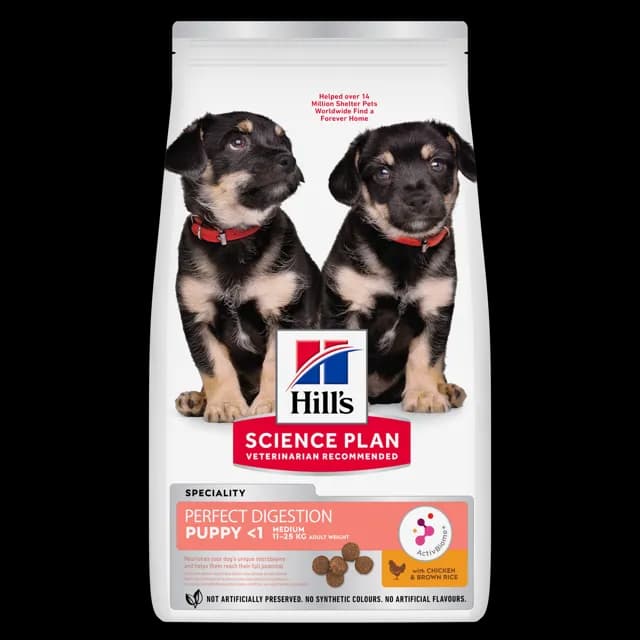




Hill's Science Plan
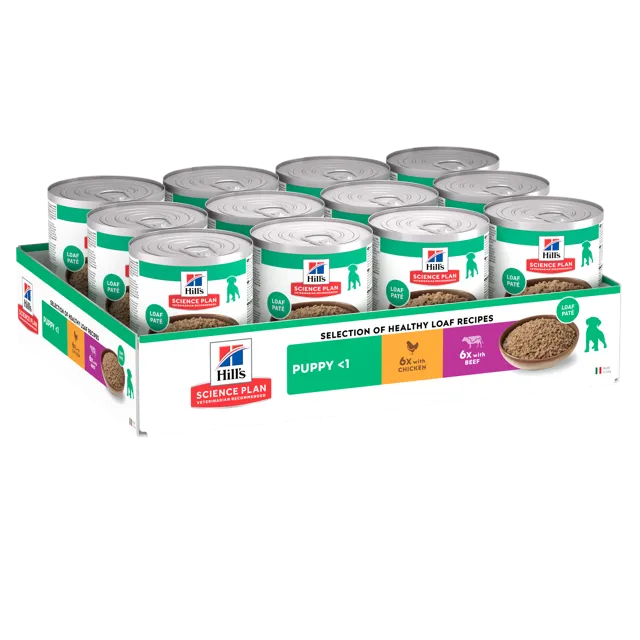
Hill's Science Plan Puppy Food with Chicken, with Beef review
Hill's Science Plan Puppy Food with Chicken, with Beef is a growth tin sold on two meats, only one of which reaches the ingredients list. Chicken is declared at 21% inside a broad meat entry, while beef appears in the product name and nowhere in the declaration itself. The analysis is printed in full, calcium converts to 1.33% of dry matter, and the recipe sits in our Average band on the strength of what the wording leaves unsaid.
Our view
Likely to suit
Wet food earns its place in a puppy's routine through appetite, and this is a tin built for the pup in your house who prefers eating that way.
- Puppies who clear a soft, spoonable meal faster than they clear kibble
- Owners who read mineral figures before they buy, since calcium is declared here and converts to 1.33% of dry matter
- Small breed puppies, the size band this tin is listed for
- Pups who need the water going in with the food, with moisture declared at 76% of the tin
Worth watching
Read the front of the tin and the ingredients list side by side before you decide, because they do not quite say the same thing.
- A puppy who does well specifically on beef is not guaranteed it here, because the front of the tin names beef and the declaration never does
- The meat entry names chicken and stops, which leaves the remaining animal material unidentified
- Three of the entries are umbrella terms, cereals, derivatives of vegetable origin and oils and fats, so the mix inside them can move from batch to batch with the wording untouched
- Starch lands at an estimated 37.9% of dry matter, a good deal more cereal than the 13.6% typical of the wet puppy shelf
Written by our editorial team. Independent guidance, not veterinary advice.
How this scores
How we scoreThe Details
Dog fit
Wet food earns its place in a puppy's routine through appetite, and this is a tin built for the pup in your house who prefers eating that way. Read the front of the tin and the ingredients list side by side before you decide, because they do not quite say the same thing.
Wet
Puppy
Small
Chicken
The score, in context
Our Average band is where this tin lands, and the gap to the Excellent band a typical wet puppy food occupies comes down to naming rather than to nutrition. Protein and processing, nutritional balance and transparency each come back Good. There is nothing evasive about the printed figures, which run to a full analysis and a usable calcium number. The difficulty is an ingredients list that names one meat by percentage and covers everything else with legal categories.
What's in it
Ingredients, as declared: Meat and animal derivatives (chicken 21%), cereals, derivatives of vegetable origin, minerals, oils and fats.
Named ingredients
Nutritional additives
ADDITIVES PER KG: Nutritional additives: 3b103 (Iron) 9.6mg, 3b202 (Iodine) 0.3mg, 3b405 (Copper) 1.6mg, 3b502 (Manganese) 2.1mg, 3b603 (Zinc) 24.6mg.
Ingredient notes
The name of this tin does more work than the ingredients list does. Chicken is declared at 21%, sitting inside meat and animal derivatives, and beef is on the front of the pack yet never appears in the declaration. Where a product name and an ingredients list disagree, the list is the document that counts, so read this as a chicken recipe with unidentified animal material alongside the chicken.
That opening entry is a legal umbrella stretching across the flesh and by-products of any warm-blooded land animal. Good makers use it and weaker ones use it, so its presence is not evidence of a poor tin on its own. What it does mean is that nobody outside the factory can say what share of the meat is muscle, what share is organ and what share is something else again.
Cereals and derivatives of vegetable origin do the same job on the plant side of the recipe. Between them they explain why carbohydrate converts to an estimated 37.9% of dry matter, several times the 13.6% a typical puppy tin runs at. Protein still converts to 28.8% of dry matter and fat to 20.8%, so the tin is far from thin; it is simply built more on cereal than the shelf around it.
Calcium is the bright spot in the printed figures. It converts to 1.33% of dry matter, comfortably inside the window a growing skeleton needs, and it is declared rather than implied. Ash converts to 7.5% of dry matter alongside it, a sensible mineral load for a pup being reared on wet food.
The additive panel comes with its doses attached: zinc at 24.6 mg/kg, iron at 9.6 mg/kg, manganese at 2.1 mg/kg, copper at 1.6 mg/kg and iodine at 0.3 mg/kg. Energy sits at 99 kcal per 100g against the 106 typical of the category, so a hungry pup will work through a fair amount of tin in a day. Crude fibre converts to 5.0% of dry matter.
Price and value
£6.22 a kilo, sold in 370g tins.
A puppy's portion keeps moving while they grow. Let the pack's chart and your dog's shape set the daily amount, and revisit it as the months pass.
Nutritional analysis
Declared analysis
6.9%
5%
1.2%
1.8%
76%
Dry weight
28.8%
20.8%
5%
7.5%
37.9%
As-fed composition
Estimated breakdown of the finished product by ingredient category, from the declared ingredient list and ingoing weights. These are estimates, not measurements.
41.7%
11%
40.1%
2.7%
4.5%
Pricing & size
- Pack size
- 370 g
- Retailer pricing
- Coming soon
Live retailer pricing is not yet available for this food. Prices, cost per day and where to buy will appear here once retailer data is live.
Ingredients and nutrition are taken from manufacturer data. Retailer pricing is not yet live for this food.
Related dog food guides
Ranked shortlists that include foods like this one.