



Hill's Science Plan
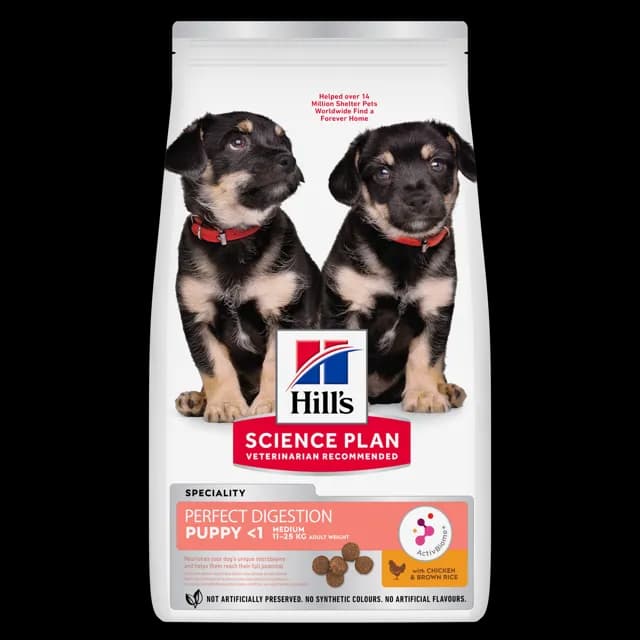
Hill's Science Plan Puppy <1 review
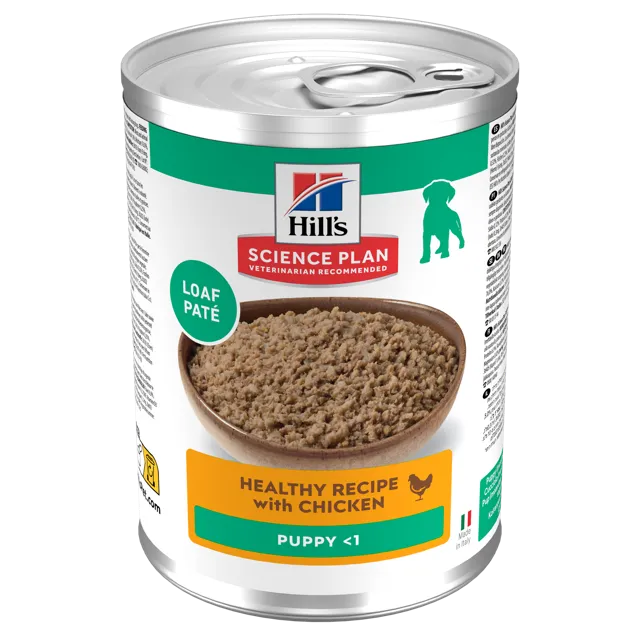
Hill's Science Plan Puppy <1 in the tin is the wet counterpart to the brand's growth kibble, and it is a much shorter read. Five entries make up the whole recipe, chicken is named at 21% inside a broader meat line, and the analysis is printed in full with calcium converting to 1.33% of dry matter. The rest of the tin goes undescribed, and that silence is why it sits in our Average band.
Our view
Likely to suit
If your puppy eats better from a tin than from a bowl of biscuit, this is the wet food the brand pairs with its own kibble.
- Puppies who take to wet food more readily than dry, with moisture declared at 76% so every meal brings water with it
- Owners who want the calcium checked on a wet growth food, here converting to 1.33% of dry matter and inside the growth range
- Households already feeding the brand's kibble and wanting a tin from the same maker to serve alongside it
- Pups whose digestion likes a little more bulk, with crude fibre converting to 5.0% of dry matter
Worth watching
A short ingredients list has its trade-offs, and you will want these ones clear before you buy.
- Past the 21% chicken, the meat line does not say which animals it draws on, so a puppy avoiding a particular species is not catered for
- The cereals entry names no grain, which is the same difficulty in a different aisle
- This is a starchier wet food than most, with carbohydrate converting to an estimated 37.9% of dry matter where the typical puppy tin runs at 13.6%
- Oils and fats is given without a source, and a pup kept off fish or off one particular plant oil is not covered by the declaration
Written by our editorial team. Independent guidance, not veterinary advice.
How this scores
How we scoreThe Details
Dog fit
If your puppy eats better from a tin than from a bowl of biscuit, this is the wet food the brand pairs with its own kibble. A short ingredients list has its trade-offs, and you will want these ones clear before you buy.
Wet
Puppy
Medium
Chicken
The score, in context
Our Average band is where this tin lands, and the distance from the Excellent band a typical puppy wet food occupies is mostly a distance in disclosure. Protein and processing, nutritional balance and transparency all read Good. The analysis is complete and the calcium is printed, the chicken percentage is real and the mineral doses are given per kilo, so nothing here is being hidden from the buyer. It is the four umbrella terms doing the rest of the naming that keep the reading low.
What's in it
Ingredients, as declared: Meat and animal derivatives (chicken 21%), cereals, derivatives of vegetable origin, minerals, oils and fats.
Named ingredients
Nutritional additives
ADDITIVES PER KG: Nutritional additives: 3b103 (Iron) 9.6mg, 3b202 (Iodine) 0.3mg, 3b405 (Copper) 1.6mg, 3b502 (Manganese) 2.1mg, 3b603 (Zinc) 24.6mg.
Ingredient notes
Only five entries appear on this list, and the first of them carries most of the tin. Meat and animal derivatives, with chicken declared at 21%, is the opening line, and the law behind that phrase covers the flesh of any warm-blooded land animal, from prime cuts to the least appealing offcuts. Hill's formulates to a fixed specification and does not rework recipes casually, so what goes in is likely to be consistent from batch to batch. The point is simply that the wording gives a buyer no way to verify it.
Second on the list is cereals, every bit as broad a term, standing in for whichever grain the recipe happens to use. Derivatives of vegetable origin follows, covering processed plant material of almost any kind. Neither term tells you whether anything changed between one tin and the next.
The starch that comes with those entries shows up plainly in the analysis. Carbohydrate converts to an estimated 37.9% of dry matter, well clear of the 13.6% a typical puppy tin runs at, so more of the work here is being done by cereal than by meat. Protein still converts to 28.8% of dry matter and fat to 20.8%, a respectable shape with the water discounted.
Calcium converts to 1.33% of dry matter, declared and sitting inside the range a growing skeleton is reared on. On a growth food this is the number that earns the most trust, and it is printed here without any fuss made about it.
The added mineral panel is dosed per kilo: iron at 9.6 mg/kg, zinc at 24.6 mg/kg, manganese at 2.1 mg/kg, copper at 1.6 mg/kg and iodine at 0.3 mg/kg. Energy is 99 kcal per 100g against a 106 typical. Crude fibre converts to 5.0% of dry matter, higher than most tins manage and welcome in a pup whose stools want a little more form to them.
Price and value
Sold in 370g tins.
The label's own guide runs from 92.5g a day for a 1kg puppy up to 740g a day at the top of its chart.
That climb is steep in the early months and then levels off. Read the chart against your puppy's age and the size they are heading for, and keep updating the figure as they grow.
Nutritional analysis
Declared analysis
6.9%
5%
1.2%
1.8%
76%
Dry weight
28.8%
20.8%
5%
7.5%
37.9%
As-fed composition
Estimated breakdown of the finished product by ingredient category, from the declared ingredient list and ingoing weights. These are estimates, not measurements.
41.7%
11%
40.1%
2.7%
4.5%
Pricing & size
- Pack size
- 370 g
- Retailer pricing
- Coming soon
Live retailer pricing is not yet available for this food. Prices, cost per day and where to buy will appear here once retailer data is live.
Ingredients and nutrition are taken from manufacturer data. Retailer pricing is not yet live for this food.
Related dog food guides
Ranked shortlists that include foods like this one.