



Hill's Science Plan
Hill's Science Plan Mature Adult Dog Food with Chicken, with Beef review
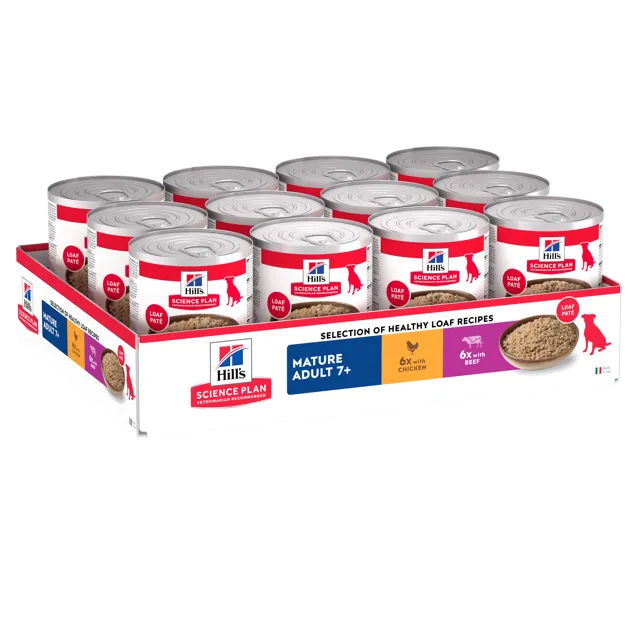
Hill's Science Plan Mature Adult arrives here as a choice of two 370 g tins, one naming chicken at 12% and one naming beef at 5%. Underneath the two front labels sits the same set of category terms and the same declared analysis, so the flavour changes and very little else does. Both read Average on our scoring, a verdict about how much of the tin is described rather than about how a dog fares on it.
Our view
Likely to suit
When your older dog starts leaving food in the bowl, a change of meat is the simplest thing to try.
- Small dogs in their later years, the group these tins are written for
- Owners of a bored senior, since the chicken and the beef swap the flavour without disturbing the rest of the meal
- Older dogs that need dinner to be easy work, with soft chunks and 77.0% moisture in every serve
- Dogs on a gentle fat intake, declared at 3.1% and converting to 13.5% of dry matter
- Households that would rather keep one brand across a dog's whole life than start again at seven
Worth watching
The two tins differ less than their front labels suggest, and both keep the same things back.
- Chicken is named at 12% but beef only at 5%, so the beef tin identifies less of its animal content than the chicken one does
- Both labels rest on meat and animal derivatives, cereals and derivatives of vegetable origin, none of them tied to a species or a grain
- One declared analysis covers both tins, so the nutrition figures will not tell the two apart
- Estimated carbohydrate sits at 55.6% of dry matter, well ahead of the 15.8% typical for adult wet food
- An elimination diet is out with either tin, because the animal content beyond the named meat goes undescribed
Written by our editorial team. Independent guidance, not veterinary advice.
How this scores
How we scoreThe Details
Dog fit
When your older dog starts leaving food in the bowl, a change of meat is the simplest thing to try. The two tins differ less than their front labels suggest, and both keep the same things back.
Wet
Adult, Senior
Small
Chicken
The score, in context
Both tins carry the same reading because they declare the same analysis and the same run of categories, and that reading is Average. Nutritional balance reads Poor, while protein and processing and transparency each come back Good, on a label of five entries of which a single one is an identified ingredient.
Measured against the typical adult wet food, which is an Excellent band food, the shortfall is largely one of nutritional balance. Wet food as a category scores well with us, and part of how it does that is by naming its meat and printing the share.
Nothing in any of this suggests a tin that will not keep an older dog in good order. Hill's formulates to a fixed nutrient specification, backs it with its own feeding research, and this is food many senior dogs have eaten happily for years. Our scoring can only weigh a recipe it is allowed to see.
What's in it
Ingredients, as declared: with Chicken: COMPOSITION: Meat and animal derivatives (chicken 12%), cereals, minerals, derivatives of vegetable origin, oils and fats.; with Beef: COMPOSITION: Meat and animal derivatives (beef 5%), cereals, minerals, derivatives of vegetable origin, oils and fats.
Named ingredients
Nutritional additives
with Chicken: ADDITIVES PER KG: Nutritional additives: 3b103 (Iron) 10.0mg, 3b202 (Iodine) 0.3mg, 3b405 (Copper) 1.7mg, 3b502 (Manganese) 2.2mg, 3b603 (Zinc) 25.8mg.; with Beef: ADDITIVES PER KG: Nutritional additives: 3b103 (Iron) 10.2mg, 3b202 (Iodine) 0.3mg, 3b405 (Copper) 1.7mg, 3b502 (Manganese) 2.3mg, 3b603 (Zinc) 26.3mg.
Ingredient notes
Each label runs to the same five entries: meat and animal derivatives with the headline meat in brackets, then cereals, minerals, derivatives of vegetable origin and oils and fats. The named share is where the two genuinely part company, chicken at 12% against beef at 5%, so the chicken tin puts more than twice as much of its animal content on the record. Both are honest as far as they go; the chicken label simply goes further.
The category terms behind those figures are the standard vocabulary of large scale wet food. Meat and animal derivatives covers any part of any warm blooded land animal. Cereals means any grain at all. Oils and fats means fat from any source, and derivatives of vegetable origin covers nearly any plant material. They allow the maker to keep a formula private and to adjust it batch by batch, which is legal and common. These tins therefore have to be taken on the strength of the name rather than the list.
One declared analysis serves both flavours. Protein converts to 22.6% of dry matter and fat to 13.5%, a moderate pairing that sits well with an older dog and an easier daily routine, and moisture is declared at 77.0%. Energy is 90 kcal per 100g, slightly under the 97 kcal typical for adult wet food, so a senior dog gets a decently full bowl for its calories.
Estimated carbohydrate reaches 55.6% of dry matter where the typical adult wet food runs at 15.8%. The unnamed cereals are doing a substantial share of the work in these tins, and that is the main structural reason our reading lands where it does. It is worth knowing if you moved to wet food specifically to bring the starch down.
Calcium comes to 1.13% of dry matter. A healthy adult handles that level comfortably. Tell your vet about it if a mineral restricted plan is already in place.
The added minerals are the one place the two labels differ in print. The chicken tin lists iron at 10.0 mg, copper at 1.7 mg, manganese at 2.2 mg and zinc at 25.8 mg per kilo. The beef tin reads 10.2 mg, 1.7 mg, 2.3 mg and 26.3 mg, with iodine at 0.3 mg on both. Those are a whisker apart, which tells you plainly that one formulation sits under both tins.
Price and value
£5.38 a kilo, in 370 g tins, the same figure on the chicken and the beef.
As a guide, a 15kg adult dog in moderate condition would get through about 939 grams a day, which comes to roughly £5.05. That is on an allowance of about 840 kcal a day (110 × bodyweight^0.75, the standard maintenance estimate). Older dogs doing less than they used to tend to settle under that, so weigh your dog every few weeks and adjust from there.
Nutritional analysis
Declared analysis
5.2%
3.1%
0.6%
1.3%
77%
Dry weight
22.6%
13.5%
2.6%
5.7%
55.6%
As-fed composition
Estimated breakdown of the finished product by ingredient category, from the declared ingredient list and ingoing weights. These are estimates, not measurements.
40%
12%
36.9%
2.9%
8.1%
Pricing & size
- Pack size
- 370 g
- Retailer pricing
- Coming soon
Live retailer pricing is not yet available for this food. Prices, cost per day and where to buy will appear here once retailer data is live.
Ingredients and nutrition are taken from manufacturer data. Retailer pricing is not yet live for this food.
Related dog food guides
Ranked shortlists that include foods like this one.