


Growling Tums
Growling Tums Delicate review
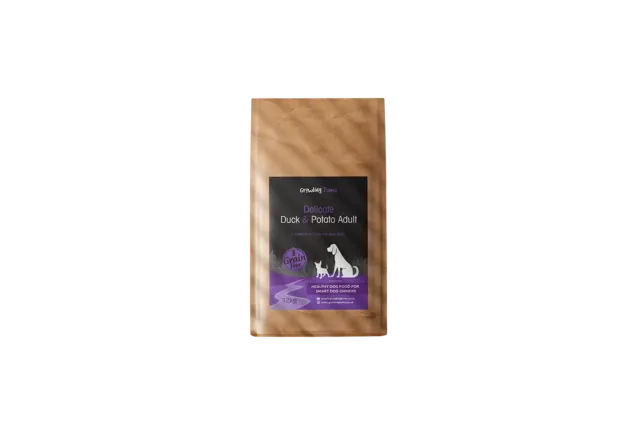
Growling Tums Delicate is a duck kibble with an unusually tidy list behind it. Duck accounts for 36% of the recipe: dried duck at 27%, duck fat at 7% and duck gravy at 2%. Potato at 31% leads the plant side, and peas, beet pulp, brewer's yeast and linseed finish the job. No second animal appears anywhere, no ingredient is left unnamed, and there is no cereal at all. It sits in our Good band, which undersells how useful a list this short can be to an owner working out what their dog reacts to.
Our view
Likely to suit
A list you can read in one breath is worth a lot while you work out what upsets your dog.
- Dogs on an exclusion diet, since every animal entry here is duck, the fat and the gravy included
- Owners who want the bowl kept off cereal, with potato at 31% and peas carrying the starch instead
- Itchy dogs whose owners are working through proteins one at a time, duck being uncommon enough that many dogs have never met it
- Households feeding dogs of wildly different sizes, as one bag covers everything from toy to giant
- Owners who want a species named against every animal entry rather than a general fat or gravy line
Worth watching
There is little here to trip you up, though a few points are worth carrying to the checkout.
- There is no second protein behind the duck, and a dog with a duck reaction already has no other option inside this recipe
- Carbohydrate is estimated at 46.7% of dry matter, a substantial plant side, so a meatier bowl than 36% duck may suit some dogs better
- Linseed is the only omega source here, and a coat answers plant omega 3 more slowly than it answers the marine kind
- No calcium figure is declared, so this recipe belongs to the adults of the house rather than to a puppy still growing
Written by our editorial team. Independent guidance, not veterinary advice.
How this scores
How we scoreThe Details
Dog fit
A list you can read in one breath is worth a lot while you work out what upsets your dog. There is little here to trip you up, though a few points are worth carrying to the checkout.
Dry
Adult
Toy, Small, Medium, Large, Giant
Duck
The score, in context
This lands squarely in our Good band, the same band the typical adult dry food occupies, so the score is not the argument for it. Transparency reads Outstanding and value Good, in step with the overall placing, while protein and processing and nutritional balance both read Average. The arithmetic explains that pair: duck makes up 36% of the recipe against potato at 31% with peas behind, so the plant side carries roughly as much as the animal side. What a score cannot show is how clean the list is. For an owner narrowing down a reaction, one named animal, one named fat and no anonymous entries is worth more than a couple of points either way.
What's in it
Ingredients, as declared: Duck 36% (including Dried Duck 27%, Duck Fat 7% & Duck Gravy 2%), Potato (31%), Peas, Beet Pulp (7%), Brewer's Yeast, linseed, Minerals, Vitamins.
Named ingredients
Nutritional additives
Vitamins: Vitamin A 15,000 IU, Vitamin D3 2,250 IU, Biotin 150 mcg; Trace Elements: Ferrous Sulphate Monohydrate 167 mg (Iron 50 mg), Zinc Sulphate Monohydrate 139 mg (Zinc 50 mg), Manganous Sulphate Monohydrate 109 mg Manganese 35 mg), Cupric Sulphate Pentahydrate 60 mg (Copper 15 mg), Calcium Iodate Anhydrous 1.64 mg (Iodine 1 mg), Sodium Selenite 0.67 mg (Selenium 0.3 mg)
Ingredient notes
Duck at 36% arrives as dried duck at 27%, duck fat at 7% and duck gravy at 2%. With the water already gone, dried is the concentrated form. That 27% is close to what genuinely sits in the finished kibble. A fresh weight would have shrunk in the oven. Duck itself is easy on a dog's digestion and goes down well in taste tests, which is presumably why the recipe is named the way it is.
Naming the fat matters more than it looks. Most kibbles list an animal fat or a poultry fat and leave the species open, which quietly undoes an elimination diet. Here the fat is duck fat. Every animal entry stays on one bird, and an owner ruling ingredients in and out can trust the label.
Potato at 31% is the main energy source, with peas behind it. Wheat, rice, maize and barley are nowhere in the bag. Whole peas carry starch, and they bring fibre and antioxidants with a little plant protein. In a recipe where the animal share is 36% they are doing a fair amount of the filling as well.
Beet pulp at 7% is a generous fibre entry, and fibre is often the quiet reason a sensitive dog settles. Brewer's yeast follows, and few natural sources of B vitamins beat it. Linseed closes the working part of the list with plant omega 3, useful for skin and coat if slower to show than fish oil.
Every added mineral is printed with a dose, per kilo: iron at 50 mg, zinc at 50 mg and manganese at 35 mg. Copper follows at 15 mg, iodine at 1 mg and selenium at 0.3 mg, with biotin at 150 mcg on top. Biotin is worth a mention on a recipe aimed at delicate dogs, since it is one of the vitamins skin and coat lean on most.
Price and value
£4.33 a kilo, sold in 3kg, 7.5kg, 10kg, 15kg and 20kg bags, the 20kg supplied as two 10kg bags.
As a guide, a 15kg adult dog in moderate condition eats about 233 grams a day, assuming around 840 kcal a day (110 × bodyweight^0.75, the standard maintenance estimate), which comes to £1.01 a day. Let the waistline set the portion, not the table on the bag.
Nutritional analysis
Declared analysis
26%
11%
4%
8%
8%
Dry weight
28.3%
12%
4.3%
8.7%
46.7%
As-fed composition
Estimated breakdown of the finished product by ingredient category, from the declared ingredient list and ingoing weights. These are estimates, not measurements.
29%
7%
52.7%
11.3%
Pricing & size
- Pack size
- 3kg, 7.5kg, 10kg, 15kg, 20kg (2x10kg)
- Retailer pricing
- Coming soon
Live retailer pricing is not yet available for this food. Prices, cost per day and where to buy will appear here once retailer data is live.
Ingredients and nutrition are taken from manufacturer data. Retailer pricing is not yet live for this food.
Related dog food guides
Ranked shortlists that include foods like this one.