



Gelert
Gelert Sporting Dog Variety Tins review
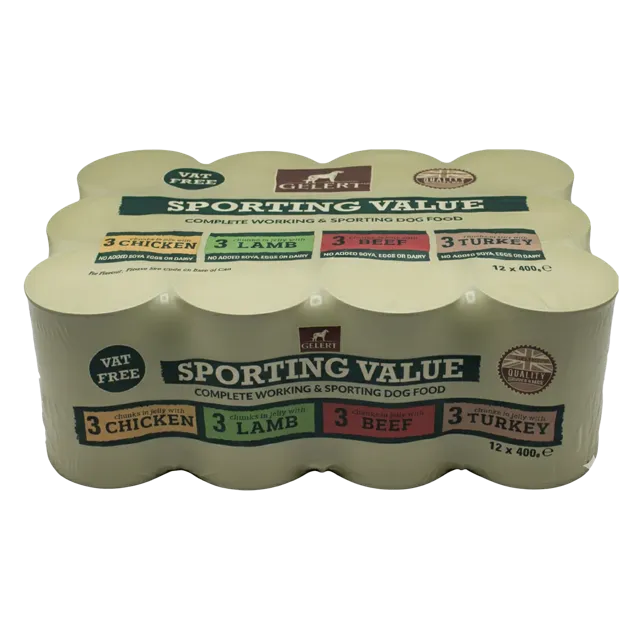
Gelert Sporting Dog Variety Tins are a mixed case aimed at active dogs and busy kennels. Chicken, beef, lamb and turkey are each named at 4% inside a base of meat and animal derivatives, with cereals, minerals and derivatives of vegetable origin filling in behind them. The tin comes out in our Good band, and that placement is about how much the label names rather than anything troubling in the analysis. The analysis reads sensibly: protein converts to 40.0% of dry matter and fat to 25.0%.
Our view
Likely to suit
For a household feeding several dogs the same thing every day, this keeps mealtimes simple.
- Working and sporting dogs in a busy kennel, the group Gelert points these tins at
- Owners who want the bowl to change day to day without the recipe underneath changing with it
- Dogs that find richer tins heavy going, with fat converting to a moderate 25.0% of dry matter
- Dogs that are casual about their water bowl, since moisture is declared at 80.0%
- Big eaters, because a tin this size goes a long way in a bowl
Worth watching
Knowing what the category terms on this label do and do not pin down is worth a minute.
- Only chicken, beef, lamb and turkey carry a figure, at 4% apiece, and the unnamed remainder is meat and animal derivatives, so no elimination diet can be built on this tin
- No cereal is named either, and that matters when you are steering a dog around one grain in particular
- At 92 kcal per 100g these are light tins for a hard-working dog, so daily volumes run large
- There is no separate additives panel, so the minerals are declared inline in the composition
Written by our editorial team. Independent guidance, not veterinary advice.
How this scores
How we scoreThe Details
Dog fit
For a household feeding several dogs the same thing every day, this keeps mealtimes simple. Knowing what the category terms on this label do and do not pin down is worth a minute.
Wet
Adult
Toy, Small, Medium, Large, Giant
Chicken
The score, in context
Good is where this tin comes out, one step below the Excellent mark the typical adult wet food reaches. The analysis is not what holds it there. Protein at 40.0% of dry matter and carbohydrate at an estimated 20.0% are perfectly respectable figures for something fed from a tin, and protein and processing reads Good with nutritional balance Outstanding. Transparency stops at Good, and the reason is on the label. Four meats are named at 4% each, and everything else is written in the legal category terms that let a maker move the mix around between batches without reprinting anything.
What's in it
Ingredients, as declared: Meat and Animal Derivatives (Chicken 4%), (Beef 4%), (Lamb 4%), (Turkey 4%), Cereals, Minerals, Derivatives of Vegetable Origin.
Named ingredients
Nutritional additives
No separate additives panel published — "Minerals" is declared inline in the composition.
Ingredient notes
Meat and animal derivatives is a legal umbrella that covers the fleshy parts and by-products of warm-blooded land animals. It can describe anything from very good material to very ordinary material, and the label gives no way of telling which. Gelert does at least pin four species to a number, with chicken, beef, lamb and turkey each at 4%, so a defined slice of the tin is accounted for by name. The rest is taken on trust, and plenty of long-established British tinned food is sold exactly that way.
The plant side is described as cereals and derivatives of vegetable origin, both of them broad terms that can be met by different materials from one batch to the next. The cereal is doing a fair amount of the work here, with carbohydrate converting to an estimated 20.0% of dry matter against the 15.8% typical for adult wet food. That carbohydrate figure is calculated by difference and not measured. On a label as sparse as this one it inherits every rounding in the printed analysis.
What the analysis does say is reassuring enough. Protein at 40.0% of dry matter is a strong number for a tin, fat at 25.0% is moderate rather than rich, and ash at 12.5% is unremarkable. Moisture is declared at 80.0%, which is simply what a tin of this kind is, and it is part of why a working dog will need a good volume of it.
No separate additives table is published. Minerals appear as a line in the composition, which tells you a supplement has gone in but not which vitamins or trace elements it covers or at what dose.
Price and value
£1.87 a kilo, in 400g tins sold twelve to a case.
As a guide, feeding a 15kg adult dog in moderate condition works out at around £1.71 a day, or roughly 913 grams. Behind that sits an energy assumption of about 840 kcal a day, the standard maintenance figure of 110 × bodyweight^0.75.
For its weight, wet food carries few calories, so daily amounts on a tin like this look large next to a dry food. Plenty of owners spoon it over a smaller dry portion.
Nutritional analysis
Declared analysis
8%
5%
0.5%
2.5%
80%
Dry weight
40%
25%
2.5%
12.5%
20%
As-fed composition
Estimated breakdown of the finished product by ingredient category, from the declared ingredient list and ingoing weights. These are estimates, not measurements.
77.4%
15%
6.3%
1.4%
Pricing & size
- Pack size
- 12x400g
- Retailer pricing
- Coming soon
Live retailer pricing is not yet available for this food. Prices, cost per day and where to buy will appear here once retailer data is live.
Ingredients and nutrition are taken from manufacturer data. Retailer pricing is not yet live for this food.
Related dog food guides
Ranked shortlists that include foods like this one.